
Why the Business You Built the Hard Way Is the One Acquirers Pay Most For
Accreditation, contracted revenue, retained engineers and a clean compliance record are the hardest assets to build and the first things a serious acquirer prices. Here is what moves the multiple in building services, facilities management and healthcare.

What is your business worth today?
Enter your website and our M&A team will prepare a written valuation and exit optimisation report. No cost, no credit card, no obligation.
Strictly confidential
Strictly confidential. Your personalized report is prepared by our internal team alone — the founder, head of M&A and associates. It is never shown to buyers or anyone outside the deal team without your permission.
Already know your number?
Serving business owners across the United Kingdom and United States
You built your company the hard way. You hired the engineers, took the late night callouts, carried payroll through two recessions, and passed every audit that landed on your desk. Nobody applauded. The buildings stayed compliant, the plant kept running, the patients kept being seen, and the invoices went out on time.
That work is exactly what acquirers are buying in 2026 and 2027. Not the story, not the brand, not the potential. The proven, permitted, certificated, contracted operating machine underneath it. This article explains why the hardest work you have done carries the highest value in a sale, what buyers pay for line by line, and how to get an honest read on your own number before you speak to anyone.
If you want a figure first, run the free valuation tool. If you want to see who is actively buying in your sector, use the free buyer list.
What "hardest" actually means in a valuation
"The hardest thing you have done" is not a sentiment. In a valuation it has a precise meaning: the parts of your business that a well funded competitor cannot buy off the shelf, cannot recruit into existence in ninety days, and cannot shortcut with software.
There are usually four of them.
- Accreditation and permission to trade. Third party certification takes time and audit history to earn. Fire businesses carry BAFE schemes and FIA trained engineers. Security firms carry NSI or SSAIB approval and SIA licensed staff. Electrical contractors carry NICEIC registration, heat pump installers carry MCS certification, care providers carry a CQC rating, and dental practices answer to the GDC. None of that is transferable by cheque alone, which is why buyers price it.
- Contracted, repeating revenue. A planned preventative maintenance portfolio with annual uplift and low churn is the single most valuable asset most owner led businesses hold. It converts a trading business into an income stream.
- A skilled workforce that stays. Engineers, technicians, nurses and clinicians are scarce. An acquirer who buys your business buys your training pipeline, your retention rate and your callout coverage.
- A clean compliance record. Every regulated sector has a public trail. Buyers read it. A business with no enforcement history and complete documentation removes a category of risk from the deal.
Everything on that list was difficult, slow and unglamorous to build. That is precisely why it prices well.
Why acquirers are paying premiums for unglamorous businesses
The market narrative concentrates on technology. The transaction volume does not. Trade buyers and private equity backed platforms in building services, facilities management and healthcare are consolidating fragmented markets where the average business is owner led, profitable and under-marketed.
Three forces are behind it.
Consolidation economics. A platform that acquires at five times EBITDA and is itself valued at nine or ten times creates value on the arithmetic alone, before a single synergy lands. That gap is the engine behind almost every roll up you will read about, and it explains the buyer appetite described in our analysis of private equity acquisitions in building services and the wider UK roll up strategy.
Regulation as a moat. Regulation raises the cost of entry. The Fire Safety (England) Regulations 2022 expanded duties on responsible persons, HSE guidance L8 governs legionella control, and LOLER sets inspection duties on lifting equipment. Each obligation converts discretionary spend into a legal requirement, and legal requirements produce recurring, non-cyclical revenue.
Demographics. A large cohort of founders in these sectors is approaching retirement at the same time. Supply of good businesses is rising, which makes preparation the differentiator. A prepared business gets a competitive process. An unprepared one gets a single bidder and a discount.
What buyers actually value, line by line
When a corporate development team or a private equity deal team models your business, they price these variables. Each one moves the multiple.
| Value driver | What buyers look for | Effect on multiple |
|---|---|---|
| Recurring revenue share | Contracted PPM and monitoring above 50 percent of turnover | Strong uplift |
| Contract quality | Multi-year terms, indexation clauses, low churn | Strong uplift |
| Customer concentration | No single client above 15 to 20 percent of revenue | Protects the multiple |
| Second tier management | Operations, sales and technical leadership below the owner | Strong uplift |
| Gross margin | Stable or improving margin across at least three years | Moderate uplift |
| Accreditation | Current schemes, clean audit history, certificated engineers | Protects and lifts |
| Financial hygiene | Reconciled management accounts, defensible add-backs, WIP discipline | Protects the multiple |
| Owner dependence | Business trades normally when the owner takes a month off | Large downside if absent |
The last line is the one that costs owners the most money. It is also the one most within your control. Our exit planning guide sets out how to remove owner dependence over a twelve to twenty four month runway, and the sector guides in the valuation guides hub show what each of these drivers is worth in your specific niche.
The psychology that gets in the way
Most owners who built something difficult carry two beliefs that cost them money at exit.
The first is that the business is an extension of themselves. It feels disloyal to hand it over, and there is genuine concern for staff who have been there fifteen years. That concern is legitimate and it is negotiable. Employment protections, retention pots, role guarantees and cultural fit criteria are all things we build into a process rather than hope for afterwards. How and when you tell your team matters as much as the terms, which is why we wrote a separate piece on pre-sale communication with directors and employees.
The second is that involvement equals value. It is the opposite. A business where the founder signs off every quote, holds every client relationship and carries the technical knowledge in their head is a business the buyer must rebuild after completion. They price that rebuild, and they price it against you. The shift from central operator to architect of a system is the hardest one to make, and it is the one with the clearest financial return.
Sector by sector: where the premiums sit
The value drivers are consistent, but the weightings differ by niche. These guides carry the current multiple ranges, the active acquirer set and the diligence issues specific to each sector.
- Fire safety valuation guide, and the sector page for fire safety M&A
- HVAC valuation guide, and the sector page for HVAC M&A
- Electrical contractor valuation guide, and the sector page for electrical contracting M&A
- Security systems valuation guide
- Compliance, testing and inspection valuation guide, and the testing, inspection and certification hub
- Water hygiene and legionella control guide, and the water hygiene sector page
- Maintenance contracts valuation guide, and the facilities management sector page
- Lift and elevator maintenance guide, with sector detail on lift maintenance M&A
- Commercial plumbing and drainage guide, and the commercial plumbing sector page
- Care home valuation guide, and the care home M&A page
- Dental practice valuation guide, and the dental M&A page
- Healthcare M&A overview for clinics, veterinary, pharmacy and domiciliary care
Timing, tax and the cost of waiting
Two clocks run at the same time. The first is market appetite, which is currently strong but is a function of debt cost and platform funding cycles. The Bank of England base rate directly affects what a leveraged buyer can pay, because cheaper debt supports a higher offer.
The second is tax. Business Asset Disposal Relief and the wider capital gains tax rules determine what you keep rather than what you are offered, and the rate changes from April 2026 materially alter net proceeds for owners in these sectors. We covered the numbers in detail in the BADR changes analysis. Take specific advice from your own accountant before acting on any of it.
Waiting has a cost that owners rarely quantify. A year of drift with 60 percent reactive revenue and no second tier management is not a neutral year. It is a year in which the multiple you would achieve stays where it is while a prepared competitor in the same postcode moves ahead of you in the buyer queue.
A practical sequence for the next twelve months
- Establish the baseline. Get an indicative range and a list of the specific factors holding it down. The free valuation tool does this in a few minutes and does not require a call.
- See the demand. Confirm there is a real market for your specific business with the free buyer list. It draws on a network of more than 13,000 active acquirers and shows what they are searching for.
- Fix the two biggest discounts. In most owner led businesses they are owner dependence and reactive revenue mix. Both take months, not weeks.
- Tidy the evidence. Three years of reconciled management accounts, a contract register with renewal dates, a certification and audit file, and a clean employment record. Diligence rewards preparation and punishes reconstruction.
- Run a process, not a conversation. A single approach from one trade buyer is not a market test. Competitive tension is what converts a fair offer into a full one.
- Then talk to an adviser. When you are ready, book a confidential call. No obligation, and no cost to find out where you stand.
The point
The hardest thing you have done is the compliance file nobody thanked you for, the engineer you trained for four years, the contract you renewed eleven times, and the reputation that means the client calls you at 2am and not somebody else. It is invisible from outside the industry and it is the first thing a serious acquirer checks.
You do not need to sell to benefit from understanding it. You need to know your number, know who is buying, and know which two or three changes would move the number most. Everything after that is timing.
Start with your valuation, then look at the active buyer list, and read the guide for your sector.
Sources and further reading
- Business Asset Disposal Relief, GOV.UK
- Capital Gains Tax, GOV.UK
- Fire Safety (England) Regulations 2022, legislation.gov.uk
- Legionnaires disease: HSE Approved Code of Practice L8
- LOLER: lifting equipment inspection duties, HSE
- Care Quality Commission
- General Dental Council
- Bank of England Bank Rate
- ONS Business Demography, UK
Related reading
- All sector valuation guides: EBITDA multiples by niche
- Fire safety valuation guide
- HVAC valuation guide
- Maintenance contracts valuation guide
- Building services M&A
- Facilities management M&A
- Healthcare M&A
- Exit planning guide for owners
- Free valuation estimate
- See who is buying: free buyer list
- Book a confidential call
Sources
- Business Asset Disposal Relief, GOV.UK
- Capital Gains Tax, GOV.UK
- Bank of England Bank Rate
- ONS Business Demography, UK
Experienced Dealmakers Lead Your Exit
A senior M&A bench, plus a sector specialist recruited for your industry on every deal.

Head of M&A
Joining 22 August 2026, name announcing soon
Joining full-time on 22 August 2026 from the largest M&A advisory firm in the UK, owned by K3 Capital. As an ex-Director he managed teams of M&A advisors, analysts and associates, working daily with business owners, buyers and stakeholders on live acquisition deals. Selected from 260 applicants alongside colleagues from investment banking backgrounds, he brings that experience and network to lead the advisory bench across Building Services, Facilities Management, and Healthcare.
Joining full-time on 22 August 2026 from the largest M&A advisory firm in the UK, owned by K3 Capital. As an ex-Director he managed teams of M&A advisors, analysts and associates, working daily with business owners, buyers and stakeholders on live acquisition deals. Selected from 260 applicants alongside colleagues from investment banking backgrounds, he brings that experience and network to lead the advisory bench across Building Services, Facilities Management, and Healthcare.

Martin is one of the most well-connected figures in UK fire, security, building services and FM. He is Chairman of both the Fire Industry Association and the British Security Industry Association, the only person in the UK to hold both roles simultaneously. Martin spent over a decade in senior leadership at Mitie, latterly as Industry Liaison Director for its fire and security division, helping scale the business past £500m in revenue and playing a role in the £366m acquisition of Marlowe plc, which created one of the UK's largest compliance, fire and security services groups. He joined DealFlowAgent because owners in these sectors deserve a genuine sector-specialist advisor across valuation, business optimisation and buyer access. In recognition of his industry roles, he acts in a personal, non-partisan capacity.
Martin is one of the most well-connected figures in UK fire, security, building services and FM. He is Chairman of both the Fire Industry Association and the British Security Industry Association, the only person in the UK to hold both roles simultaneously. Martin spent over a decade in senior leadership at Mitie, latterly as Industry Liaison Director for its fire and security division, helping scale the business past £500m in revenue and playing a role in the £366m acquisition of Marlowe plc, which created one of the UK's largest compliance, fire and security services groups. He joined DealFlowAgent because owners in these sectors deserve a genuine sector-specialist advisor across valuation, business optimisation and buyer access. In recognition of his industry roles, he acts in a personal, non-partisan capacity.

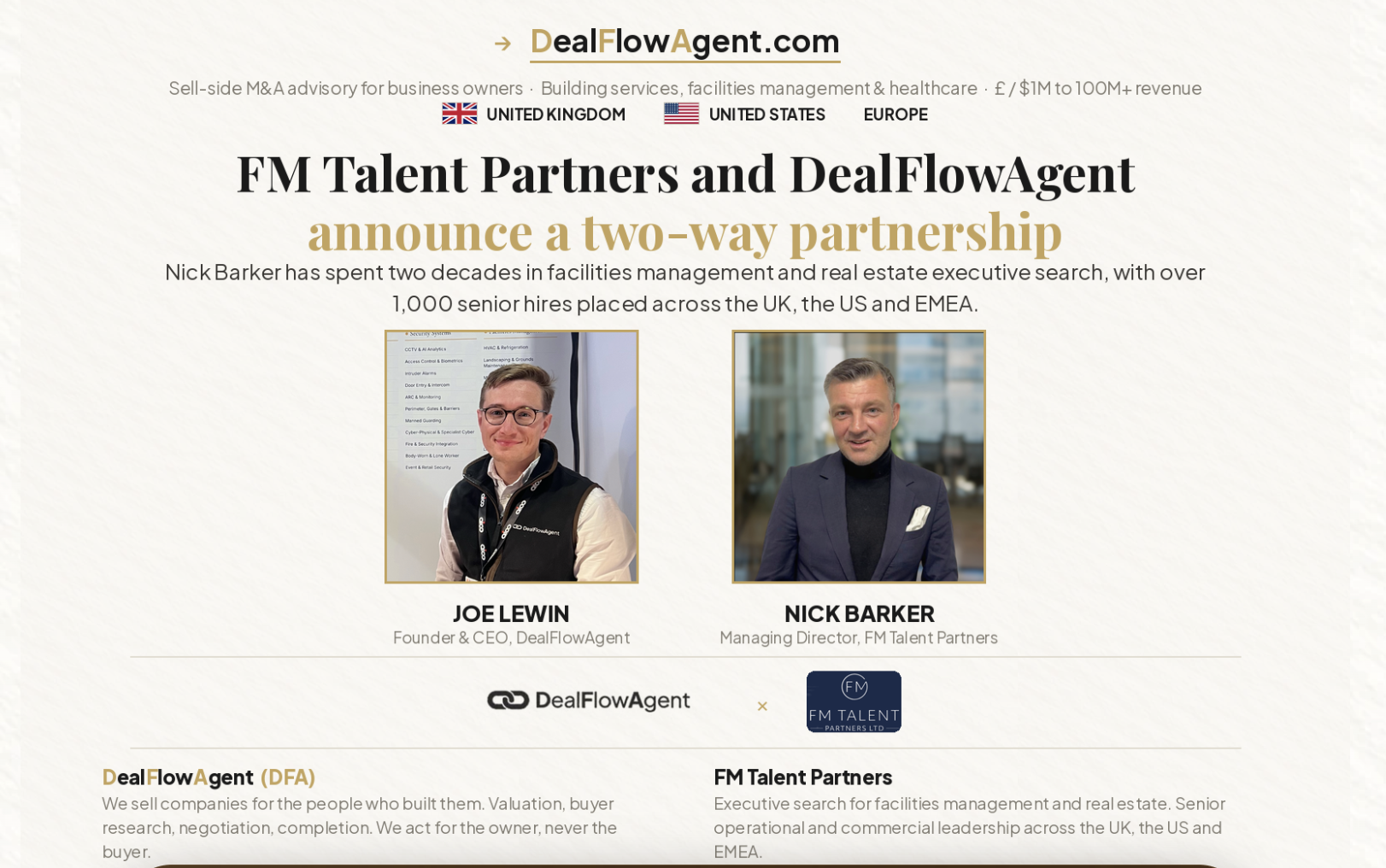
Nick leads FM Talent Partners, the facilities management and real estate leadership search firm, and is a leading specialist in building services and FM management talent. He partners with DealFlowAgent on two-way referrals: helping business owners and acquirers fill the key roles that decide whether a business is sellable, and introducing owners who are thinking about their next chapter to a team that knows their industry and their market. Key-person dependency is one of the two most common reasons a sale collapses, and Nick fixes it at source.
Nick leads FM Talent Partners, the facilities management and real estate leadership search firm, and is a leading specialist in building services and FM management talent. He partners with DealFlowAgent on two-way referrals: helping business owners and acquirers fill the key roles that decide whether a business is sellable, and introducing owners who are thinking about their next chapter to a team that knows their industry and their market. Key-person dependency is one of the two most common reasons a sale collapses, and Nick fixes it at source.

James Duboullay
Senior M&A Advisor
- •25+ years across investment banking, M&A and fundraising
- •Sector focus: essential services and software
- •Long-standing relationships with private equity buyers and growth funds
- •Personally advising DealFlowAgent founders for the past four years
- •25+ years across investment banking, M&A and fundraising
- •Sector focus: essential services and software
- •Long-standing relationships with private equity buyers and growth funds
- •Personally advising DealFlowAgent founders for the past four years

Emerson Patton
Sector Specialist: Building Services & Facilities Management
- •20+ years advising owners in building services, fire safety, HVAC, plumbing, and construction
- •Guided 200+ companies through growth, profit improvement, and exit planning
- •Builds equity value and operational structure long before a sale
- •Partners with DFA to prepare owners for exit while the advisory team runs the sale
- •20+ years advising owners in building services, fire safety, HVAC, plumbing, and construction
- •Guided 200+ companies through growth, profit improvement, and exit planning
- •Builds equity value and operational structure long before a sale
- •Partners with DFA to prepare owners for exit while the advisory team runs the sale

Kaya Kesici
M&A Advisor, Fire Safety, Security & Compliance
- •17 completed M&A transactions over the past six years across UK SME fire safety, security and compliance-led services
- •Sell-side and buy-side experience, buyer research, acquirer mapping, outreach and live process coordination
- •Information request lists, databook prep, IC-style summaries and EV-to-equity bridge work
- •Direct sector exposure across fire protection, security systems, CCTV, access control and intruder alarms
- •17 completed M&A transactions over the past six years across UK SME fire safety, security and compliance-led services
- •Sell-side and buy-side experience, buyer research, acquirer mapping, outreach and live process coordination
- •Information request lists, databook prep, IC-style summaries and EV-to-equity bridge work
- •Direct sector exposure across fire protection, security systems, CCTV, access control and intruder alarms
Previously


Ranger Fire & Security · Complete Building Services · Compliance Group

- •22 completed M&A transactions
- •Direct relationships with hundreds of strategic and financial acquirers
- •Previously built a mobility and field services business to 30 staff and 6 UK warehouses, then sold via competitive process with an EY M&A partner
- •Raised £2m in funding; placed 3rd of 1,900 at OnStage (the "Y Combinator of Europe")
- •Full-stack developer of advanced agent systems and second-brain tooling for the M&A process
- •22 completed M&A transactions
- •Direct relationships with hundreds of strategic and financial acquirers
- •Previously built a mobility and field services business to 30 staff and 6 UK warehouses, then sold via competitive process with an EY M&A partner
- •Raised £2m in funding; placed 3rd of 1,900 at OnStage (the "Y Combinator of Europe")
- •Full-stack developer of advanced agent systems and second-brain tooling for the M&A process
Sector Expert
Industry-Specific Advisor
For every engagement we add a sector specialist from your industry to the core team: a 15–25 year operator or advisor with direct relationships in your niche. Recruited per deal so you get the right fit, not a generalist.
For every engagement we add a sector specialist from your industry to the core team: a 15–25 year operator or advisor with direct relationships in your niche. Recruited per deal so you get the right fit, not a generalist.
The bench is growing. Two senior M&A hires confirmed for late July 2026, selected from 200+ applicants out of Goldman Sachs, Deutsche Bank, EY, KPMG and leading boutique M&A firms. See open roles →
The AI layer behind every advisor
Two in-house AI systems work alongside the human bench. They are software, not people, built and supervised by the advisory team.

Sage
AI Deal Concierge
Available 24/7. Monitors every signal in your deal and keeps the advisory team one step ahead. Trained on thousands of M&A transactions.

Sterling
Buy-Side Deal Origination Agent
Engages 13,000+ acquirers to surface live mandates and intent, then feeds your advisors with warm, ranked buyer matches.
The Exit Readiness Scorecard
Score your business across the factors acquirers underwrite, including key-person dependency, contract quality, customer concentration and earnings quality. Complete it below, print it, or download the PDF and work through it with your leadership team.
Watch the intro from our founder, Joe
Two minutes on how DealFlowAgent runs a confidential, competitive sale process for owners of building services, facilities management and healthcare businesses.
Joe Lewin
Exited entrepreneur and M&A advisor who has guided 20+ business owners through successful exits. Joe built and sold his first company after scaling to 80,000+ users and raised over £2M in funding. He founded DealflowAgent to combine traditional M&A expertise with AI technology, creating aligned advisory solutions for SME business owners. Joe regularly speaks on exit planning and M&A trends, and has built a network of thousands of strategic acquirers across UK and US markets.
What is your business actually worth?
Sector by sector benchmarks built from real completed transactions, with the valuation bands acquirers underwrite against.
- Fire Safety Business Valuation & EBITDA MultiplesWhat fire alarm, extinguisher, sprinkler and passive fire protection businesses sell for, band by band.
- Security Systems Business Valuation & EBITDA MultiplesCCTV, access control, intruder alarms and monitoring: the multiples acquirers are paying in 2026.
- Compliance, Testing & Inspection Valuation GuideWhy recurring statutory inspection revenue attracts the highest multiples in building services.
- Electrical Contracting Valuation & EBITDA MultiplesNICEIC, EICR and EV infrastructure: how electrical contractors are valued and sold.
- HVAC, Refrigeration & Cooling Valuation GuideService contract density, engineer retention and the multiples HVAC consolidators pay.