How to Talk to Directors, Key Staff, and Employees Before a Possible Sale
Preparing for a possible business sale creates sensitive communication problems with directors, equity holders, key employees, and the wider team. This practical founder guide explains how to protect morale, retain key people, manage earnout expectations, and use a diagnostic review before discussing a potential exit.

What is your business worth today?
Enter your website and our M&A team will prepare a written valuation and exit optimisation report. No cost, no credit card, no obligation.
Strictly confidential
Strictly confidential. Your personalized report is prepared by our internal team alone — the founder, head of M&A and associates. It is never shown to buyers or anyone outside the deal team without your permission.
Already know your number?
This guide is written for owners of serious, owner-led UK businesses in the £500K to £100M revenue rangewho are considering a possible sale, preparing for a buyer conversation, or have already been approached.
Same playbook, whether you're a family-owned trades business with two directors and a foreman, or a healthcare group with a full board and option-holding senior team.
Meta description: A practical UK-first guide for founders preparing for a possible business sale. Learn how to stage communication with directors, shareholders, key employees, contractors, and the wider team without damaging morale, confidentiality, retention, or deal value.
Suggested SEO title: How to Communicate With Your Team Before Selling Your Business
The people problem usually arrives before the buyer problem
I work with owners who are considering a possible sale, preparing for a buyer conversation, or already trying to manage a sensitive process while the business still needs to hit targets. Most of them are not corporate M&A teams. They are founders, directors, and small shareholder groups running serious owner-led businesses, often in the £1m to £20m revenue range, with lessons that also apply to companies from around £500k to £50m.
The technical work matters. Valuation, buyer fit, adjusted EBITDA, cash at completion, legal structure, tax, warranties, earnouts, and due diligence all matter. But in a founder-led company, the earliest value leak is often internal. It happens when directors are not aligned, one senior person feels used, an option holder realises nobody can explain the scheme properly, or the wider team hears “the business is being sold” before anyone has built a sensible communication plan.
The weak version of this article would say: tell people at the right time, be honest, and keep everyone motivated. That is not enough. A real sale process needs a controlled communication architecture. That means defining who knows what, when they know it, why they need to know it, what they must not be told yet, and what operational risk the message is designed to control.
A possible sale is not one announcement. It is a sequence of governed conversations across shareholders, directors, management, key employees, contractors, advisers, and eventually the wider team.
This is UK-first and US-aware. It is not legal, tax, HR, or employment advice. Equity treatment, option schemes, consultation obligations, confidentiality duties, earnout mechanics, and employee protections vary by jurisdiction and transaction structure. The point is to give owners a practical playbook before they casually say too much, say too little, or say something that creates distrust later.
The mistake: treating everyone as “the team”
The phrase “the team” is too broad during a potential exit. A director with 25% equity, a finance manager preparing diligence files, a senior engineer holding customer relationships, a sales manager with pipeline knowledge, and a subcontractor who hears a rumour in a WhatsApp group are not in the same position. They do not need the same information. They do not carry the same risk. They do not have the same emotional reaction.
Research on organisational change explains why this matters. Transparent internal communication can reduce uncertainty and support more constructive coping during change, but the information must be useful and credible rather than vague reassurance.[^1] Organisational trust research also shows that employees can lose trust when they feel leaders are inconsistent, unfair, secretive, or unprepared.[^2] In plain English, people can cope with uncertainty better than they can cope with mixed signals.
| Stakeholder group | What they are really asking | What leadership must control |
|---|---|---|
| Shareholder directors | “Are we aligned on timing, valuation, roles, risk, and who gets what?” | Governance, decision rights, valuation expectations, confidentiality, and side conversations. |
| Non-shareholder directors or senior managers | “Am I being asked to carry deal risk without sharing upside?” | Recognition, role clarity, retention, workload, and involvement in the right meetings. |
| Finance and admin team | “Why are we suddenly pulling old reports and cleaning data?” | Data discipline, confidentiality boundaries, and preventing panic around financial scrutiny. |
| Operations and service delivery leads | “Will this disrupt customers, engineers, quality, and scheduling?” | Continuity, capacity, escalation, and quality of delivery during diligence. |
| Sales and account managers | “Will customers find out, and will the buyer change the way we sell?” | Customer confidence, pipeline hygiene, contract renewal discipline, and rumour control. |
| Key technical people | “Do they realise how much knowledge sits in my head?” | Knowledge capture, retention, respect, and avoiding last-minute dependency panic. |
| Wider employees | “Will I still have a job?” | Honest boundaries, no false promises, calm management, and clear next update points. |
| Contractors and subcontractors | “Is my work drying up, or will terms change?” | Continuity messaging, scheduling stability, and strict control of informal gossip. |
The communication plan should not be designed around what the founder feels emotionally ready to say. It should be designed around what each group needs to know to keep the business stable, legally safe, operationally strong, and commercially valuable.
Example: a £7m fire safety and security services business
To make this practical, imagine a £7m revenue building services company in fire safety and security. It has recurring maintenance contracts, project work, emergency callouts, compliance obligations, and a mix of employees and subcontracted field engineers. This is the type of company where the founder may be the face of the business, but the real value sits across customer relationships, engineer availability, compliance processes, service quality, and the management team’s ability to keep work moving.
A common structure might look like this.
This visual matters because it shows why a single all-hands announcement is usually the wrong first move. The four directors need one type of conversation. The confidential transaction cell needs another. The finance manager may need to know enough to prepare information without speculating. The service manager may need to protect field delivery. The contractors may need almost no sale detail, but they may need calm continuity if rumours start.
In this type of business, the value drivers are often practical. Buyer confidence depends on contract quality, customer retention, recurring revenue, statutory compliance, gross margin, engineer utilisation, response times, renewal rates, and whether the business can operate without the founder. If the sale process distracts the service desk, damages scheduling, or unsettles the senior engineer who holds the technical knowledge, the buyer will notice.
That is why the communication plan has to start with operating reality, not abstract stakeholder theory.
Start with a diagnostic review, not an announcement
Before a founder widens any sale-related conversation, I would usually want a diagnostic review. This is not a generic “exit readiness” checklist. It is a practical review of the company’s strengths, dependencies, bottlenecks, data readiness, management depth, and communication risks.
At DealFlowAgent, this is typically how I would structure it: two to three focused working sessions with the owner and carefully selected members of the leadership team. The aim is to understand what the business is genuinely good at, why it is good at it, what a buyer would value, what a buyer would worry about, and which people or systems are critical to protect before a process becomes visible.
The diagnostic should ask uncomfortable questions. If referrals are unusually strong, why? Is it the founder’s personal network, a trusted account manager, local brand reputation, a specific compliance niche, a channel partner, a Google search position, or a relationship with facilities managers in a narrow segment? If margins are strong, why? Is it pricing discipline, engineer productivity, low rework, careful subcontractor use, or one operations manager quietly holding the whole delivery system together?
This is where the diagnostic links directly to systems. When we look at a company, we are not just asking for documents. We are trying to map the operating system of the business: where knowledge lives, how work moves, where data is reliable, what dashboards matter, which workflows are manual, which roles are overloaded, and what would break if the founder stepped back. That is why I would connect this work to our AI systems diagnostic approach, alongside our M&A advisory process, buyer matching work, and valuation resources.
| Diagnostic lens | What we are trying to find | Why it changes communication |
|---|---|---|
| Strengths to double down on | Referral sources, high-retention customers, technical reputation, compliance expertise, profitable contract types. | The message to the team should reinforce what must not be disrupted during a process. |
| Key-person dependency | Founder-only relationships, senior engineer knowledge, one finance person controlling all reporting, one scheduler holding delivery together. | These people may need earlier, more careful one-to-ones and retention planning. |
| Bottlenecks | Slow quoting, weak CRM discipline, poor job costing, patchy management accounts, undocumented handovers. | The company may need “systems improvement” messaging before any sale language. |
| Management depth | Who can explain the business to a buyer, own data, manage requests, and lead without the founder. | Determines who enters the confidential transaction cell and who stays focused on business as usual. |
| Incentives and fairness | Options, equity, bonus promises, retention risk, commission plans, undocumented expectations. | Prevents vague promises that later create resentment or legal risk. |
| Data readiness | Contracts, pipeline, revenue by customer, gross margin, headcount, subcontractor reliance, HR files, compliance evidence. | Reduces frantic diligence requests and protects the wider team from chaos. |
| Trust and morale | Recent departures, internal politics, informal influencers, perceived unfairness, founder credibility. | Determines whether communication can be narrow, or whether rumour control needs a specific plan. |
Research note: HR due diligence guidance consistently points to employment contracts, job descriptions, compensation, benefits, HR systems, data integrity, policies, risk management, and integration planning as areas that can reveal human-capital risk in a transaction.[^3] A diagnostic review should therefore look across departments, not just at financial performance.
The output should be a communication map. It should tell the founder who is critical, who is sensitive, who is likely to ask difficult questions, which data requests will create suspicion, and what must be fixed before any wider announcement.
The stronger framework: seven stages, not four vague time windows
The old way to think about this is by time: 12 months out, 6 months out, 3 months out, weeks out. That is too soft because M&A processes do not move in neat calendar blocks. A buyer can appear early. Diligence can drag. A director can leak something by accident. A customer can ask a question before the team has been briefed.
The better way is to use stage triggers. Each stage starts when a specific event happens, not when the calendar says so.
| Stage | Trigger | Who should know | Core message | Channel | What not to say | Retention action | Diligence action | Red flags |
|---|---|---|---|---|---|---|---|---|
| 1. Exit optionality | Founder or board is considering sale, investment, partial exit, or succession in the next 12 to 24 months. | Shareholder directors and trusted advisers only. | “We are assessing strategic options and building a stronger, less founder-dependent company.” | Board meeting, adviser session, diagnostic review. | “We are selling soon.” | Identify critical roles and informal promises. | Start financial, operational, HR, and systems readiness review. | Directors have different expectations on value, timing, or personal roles. |
| 2. Value-building preparation | Management information, systems, team depth, and process improvement become active workstreams. | Directors plus selected functional leads if needed. | “We are strengthening reporting, process, accountability, and resilience.” | Leadership workshops, department-specific working sessions. | “This is because a buyer is coming.” | Quietly map stay risk and contribution criticality. | Clean data, document processes, improve CRM and job-costing discipline. | Staff ask why sudden data requests are happening. |
| 3. Market readiness | Adviser appointed, buyer materials being prepared, or buyer universe being mapped. | Board, advisers, and a small confidential transaction cell. | “We are preparing for confidential strategic discussions. No outcome is guaranteed.” | NDA-backed working group meeting. | “You will definitely benefit if this happens.” | Put retention or transaction-bonus logic into adviser review. | Create request tracker, data room index, and single source of truth. | A key person feels excluded while doing extra work. |
| 4. Early buyer engagement | Initial buyer outreach, inbound buyer interest, or early management calls begin. | Transaction cell only, unless a specific person is needed. | “There are confidential discussions. Performance and confidentiality are both essential.” | One-to-one briefings, controlled meeting invites. | “The company is sold.” | Brief critical managers on role, boundaries, and support. | Prepare scripts for why information is needed and who handles requests. | Managers speculate, over-share, or ask peers for data without context. |
| 5. Buyer shortlist and IOI/LOI | Serious buyer interest, indicative offer, heads of terms, or letter of intent emerges. | Board, transaction cell, selected key employees if their role is material to diligence. | “This is becoming more serious, but it is still conditional and confidential.” | Formal confidential briefing, written follow-up. | “Your job is safe forever” or “nothing will change.” | Finalise retention, recognition, and workload protection for critical people. | Prepare HR, customer, contract, compliance, finance, and systems evidence. | Option holders, non-equity leaders, or directors start asking fairness questions. |
| 6. Confirmatory diligence | Buyer requests detailed data, interviews, HR review, customer analysis, or operational evidence. | Transaction cell, specific data owners, and possibly managers affected by workload. | “We need accurate information through one route while the business keeps performing.” | Diligence stand-ups, request tracker, weekly leadership update. | “Just get this done tonight” with no prioritisation. | Protect key people from burnout and recognise extra workload. | One diligence coordinator, controlled deadlines, version control, escalation rules. | Customer service slips, managers look exhausted, inconsistent numbers emerge. |
| 7. Signing, close, and Day One | Transaction becomes announceable, legal advice confirms timing, or completion is imminent. | Wider team, then customers and suppliers as appropriate. | “Here is what is happening, what it means now, what we know, what we do not know, and when you will hear more.” | All-hands, manager cascade, FAQs, one-to-ones for affected roles. | “Nothing will change” if that is not confirmed. | Communicate documented incentives, role continuity, and next-stage process. | Day One plan, Week One plan, customer continuity plan. | Rumours move faster than official updates, or managers cannot answer basic questions. |
This is the section founders should print out before they speak to anyone. The job is not to keep everything secret forever. The job is to widen knowledge deliberately, based on role necessity and risk.
Research note: M&A communication guidance from the Institute for Mergers, Acquisitions and Alliances stresses that communication should match deal phases because activities, goals, employee needs, and risks change by phase. It also highlights that employees move quickly from the general question, “What is happening?”, to the personal question, “How will this affect me?”[^4]
Why staged disclosure is not dishonesty
Some founders worry that a staged approach feels manipulative. It should not. There is a difference between confidentiality and deception. Confidentiality means not sharing sensitive, uncertain, or legally restricted information before there is a proper reason and process. Deception means misleading people, making promises you cannot keep, or denying something in a way that later destroys trust.
A disciplined founder can say: “I cannot comment on hypothetical strategic matters, but if there is a confirmed update that affects people, we will communicate properly.” That is different from saying: “Nothing is happening” when something is clearly happening.
Organisational trust research points to consistency, openness, integrity, fairness, and reliability as important trust antecedents during change.[^2] In practice, that means leaders should use consistent wording, clear escalation routes, and scheduled update points. If people hear a different story from every director, the communication plan has already failed.
How to brief each layer in the organisation
The practical rule is simple: the closer someone is to governance, diligence, customer continuity, key knowledge, or deal risk, the earlier and more carefully they may need to be briefed. The wider the group, the more the message should focus on confirmed facts, immediate expectations, and where questions go.
| Layer | Typical people in a £7m services business | When they are briefed | What they need |
|---|---|---|---|
| Governance layer | Four directors, shareholders, legal/tax/M&A advisers. | Stage 1 onward. | Alignment on objectives, valuation, confidentiality, decision rights, incentive principles, and communication rules. |
| Transaction cell | Founder, finance lead, operations lead, commercial lead, possibly one trusted manager. | Stage 3 onward, sometimes Stage 2. | Enough context to prepare information and protect performance, with confidentiality boundaries. |
| Data owners | Finance manager, service manager, compliance lead, CRM owner, HR/admin lead. | When their information is needed. | Clear reason for requests, exact scope, deadline, and who they can speak to. |
| Critical people | Senior engineer, key account owner, scheduler, technical compliance lead, sales lead. | Before their anxiety becomes a retention risk, not necessarily before there is serious buyer activity. | Recognition, role clarity, support, and where relevant, documented retention discussion. |
| Wider employees | Office staff, engineers, customer service, junior sales, admin. | Usually only when disclosure is necessary, rumours require control, or completion is close. | What is confirmed, what is not, what it means for their role today, and when they will hear more. |
| Contractors | Subcontracted engineers, installers, specialist technicians. | Usually only if scheduling, terms, or continuity may be affected, or rumours need correction. | Calm continuity message, confirmed operational instructions, and no speculative deal commentary. |
| Customers and suppliers | Key accounts, landlords, facilities managers, schools, care homes, supply partners. | Usually post-signing or at a legally/adviser-approved point unless the transaction requires earlier engagement. | Continuity, service quality, contract stability, and named contacts. |
This structure is especially important in building services, fire safety, security, healthcare, facilities management, and similar operational businesses. The buyer is not just buying historic EBITDA. They are buying confidence that customer service, compliance, delivery capacity, and management discipline will survive the transaction.
The hard conversations founders should not avoid
The strongest communication plan is not just an all-hands script. It includes the uncomfortable one-to-ones that prevent resignations, resentment, and rumour loops.
| Situation | Poor wording | Stronger wording |
|---|---|---|
| A non-equity key manager is doing heavy diligence work | “You’ll be looked after.” | “Your role is important to continuity. I do not want to make informal promises, but we are reviewing whether a documented retention or transaction-related arrangement is appropriate.” |
| A director is misaligned on sale timing | “Let’s just see what happens.” | “Before any wider process, we need alignment on valuation expectations, acceptable deal structures, role after completion, communication authority, and who can speak to whom.” |
| An option holder asks what their options are worth | “You should be fine.” | “I do not want to guess. Option treatment depends on scheme rules, vesting, exercise terms, tax, and transaction structure. We will confirm the mechanics properly before giving answers.” |
| A contractor hears the company is being sold | “Ignore rumours.” | “There is no operational change to your scheduled work. Please keep delivery and customer standards high. If anything confirmed affects scheduling or terms, we will communicate directly.” |
| An employee asks if their job is safe | “Nothing will change.” | “I cannot promise outcomes in a hypothetical transaction. What I can say is that customer continuity, service quality, and the team’s knowledge are central to the value of this business.” |
Psychological safety matters here, but it is often misunderstood. It does not mean the founder shares every confidential detail. It means people can raise concerns, ask questions, and flag risks without being punished or humiliated.[^5] In a sale process, that is valuable because quiet resentment is more dangerous than direct questions.
Earnout messaging: never use the founder’s deferred proceeds as the team’s motivation
Earnouts are often useful, but they are dangerous in team communication. An earnout generally means part of the purchase price is contingent on post-close performance. The Harvard Law School Forum on Corporate Governance describes earnouts as a mechanism often used to bridge valuation gaps and align buyer and seller expectations, but also notes that terms, metrics, obligations, control rights, and dispute mechanisms need careful drafting.[^6]
The internal communication risk is obvious. The founder may receive additional sale proceeds if the business performs after completion, while employees may feel they are simply working harder for someone else’s payout. If the founder says, “We all need to hit the earnout,” the immediate private reaction may be: “What do you mean we?”
A better explanation is more precise.
“If a transaction includes deferred consideration or performance-based elements, post-close performance may matter. That does not mean anyone should rely on a specific payment today. It means we need to keep customers, protect service quality, maintain accurate reporting, and understand which metrics a buyer may care about. If any employee incentive is introduced, it will be communicated clearly and documented properly.”
The practical principle is simple: do not turn a vague earnout into a motivational slogan. If you want people to care about performance, translate the earnout into behaviours they can influence.
| Possible metric | What the team can actually influence | Communication risk to manage |
|---|---|---|
| Revenue | Renewals, pipeline conversion, customer response, service quality. | Sales may chase low-quality revenue if margin is ignored. |
| EBITDA | Pricing discipline, rework reduction, job costing, utilisation, overhead control. | Staff may assume cost-cutting or headcount reduction is coming. |
| Customer retention | Account management, response times, compliance quality, issue resolution. | Teams may feel blamed for churn caused by historic pricing or buyer decisions. |
| Integration milestones | Clean data, process documentation, system migration, handover discipline. | People may feel extra work is being extracted without recognition. |
| Working capital | Billing discipline, debt collection, stock control, contract terms. | Finance and operations can feel pressure if targets are not explained properly. |
Equity fairness: generosity without clarity creates distrust
Equity and options can motivate people, but unclear equity is worse than no equity. The most damaging conversations happen when someone believes they were promised “a piece of the exit” and later discovers that the promise was informal, unvested, conditional, tax inefficient, or not approved properly.
For UK companies, Enterprise Management Incentives can be powerful, but they are not casual promises. GOV.UK states that EMI options have eligibility rules, employee working-time requirements, and individual limits, including a £250,000 limit on the value of shares over which an employee can hold EMI options.[^7] For US companies, option treatment also depends on whether options are vested, unvested, exercised, assumed, accelerated, cancelled, or cashed out.
The founder’s job is not to improvise as a tax lawyer. The founder’s job is to stop making unclear promises.
| Question to resolve before speaking | Why it matters |
|---|---|
| Is the participation based on enterprise value, equity value, cash at close, or total consideration? | Different definitions produce very different outcomes. |
| Does it include deferred consideration or earnout? | People may expect proceeds the seller has not yet received. |
| Who qualifies? | Perceived unfairness can damage trust more than the amount itself. |
| Is allocation based on role, tenure, performance, criticality, or shareholder decision? | “Everyone equal” may sound fair but may not retain critical people. |
| What happens if someone leaves before completion? | This needs documentation before anyone resigns or threatens to leave. |
| Who approves it? | Board, shareholder, tax, and legal approval may be required. |
A strong message is:
“We recognise that if the company enters a transaction, there may be people whose contribution is important to protecting value and continuity. We are reviewing the right way to recognise that contribution properly, but we will not make informal promises. Anything involving equity, transaction proceeds, retention, or tax needs to be documented correctly.”
That may sound less exciting than “we will look after everyone”, but it is much more trustworthy.
How to maintain performance during diligence
Diligence is where weak preparation becomes visible. Buyers do not only read the data room. They watch how the business behaves under pressure. If customer service slips, managers look exhausted, numbers contradict each other, or key employees appear anxious, the buyer will wonder whether the company is resilient or whether the founder has been holding it together by force.
Workplace research on organisational change links change pressure with psychosocial risks such as time pressure, interruptions, multitasking, tiredness, sleep disturbance, and depressive symptoms.[^8] In practical terms, diligence can become a mental-load problem if every request is treated as urgent, every manager is interrupted, and nobody controls the workflow.
The founder should run diligence like an operating workstream.
| Diligence control | What it means in practice |
|---|---|
| One diligence coordinator | All buyer, adviser, and data requests go through one route. |
| One request tracker | Every request has an owner, deadline, status, source file, and reviewer. |
| One source of truth | Revenue, margin, headcount, contracts, pipeline, and customer data should not exist in five conflicting versions. |
| Protected customer time | Service managers, account managers, and engineers need protected time to keep the business performing. |
| Weekly leadership rhythm | The transaction cell reviews workload, customer risk, rumour risk, and missing data. |
| Escalation rules | If a request is unclear, excessive, or commercially sensitive, it goes back through the adviser route. |
| Manager script | Managers know what to say if asked why unusual information is being requested. |
This is where the diagnostic review pays for itself. If you have already mapped data sources, key people, customer concentration, systems weaknesses, management depth, and bottlenecks, diligence becomes controlled. If you have not, diligence feels like a fire drill, and fire drills make people nervous.
Practical templates you can adapt
These templates are skeletons. Do not paste them blindly. The correct wording depends on legal advice, confidentiality, transaction stage, shareholder structure, employee structure, buyer activity, and whether disclosure obligations have been triggered.
Skeleton only. Wording depends on legal advice, confidentiality, transaction stage, and your shareholder/employee structure. Adapt before sending.
Skeleton only. Wording depends on legal advice, confidentiality, transaction stage, and your shareholder/employee structure. Adapt before sending.
Skeleton only. Wording depends on legal advice, confidentiality, transaction stage, and your shareholder/employee structure. Adapt before sending.
Skeleton only. Wording depends on legal advice, confidentiality, transaction stage, and your shareholder/employee structure. Adapt before sending.
Skeleton only. Wording depends on legal advice, confidentiality, transaction stage, and your shareholder/employee structure. Adapt before sending.
Skeleton only. Wording depends on legal advice, confidentiality, transaction stage, and your shareholder/employee structure. Adapt before sending.
Skeleton only. Wording depends on legal advice, confidentiality, transaction stage, and your shareholder/employee structure. Adapt before sending.
Red flags that the communication plan is failing
M&A retention guidance often emphasises identifying critical talent early, segmenting retention risk, and combining financial incentives with role clarity, communication, and leadership support. Mercer’s M&A retention research, based on more than 200 transactions, states that around 40% of critical talent can be lost 18 to 24 months post-transaction, which is exactly why retention cannot be treated as a last-minute payment problem.1
| Red flag | What it may mean | What to do |
|---|---|---|
| A key person says, “I just want to know where I stand.” | They may be seeking certainty before deciding whether to leave. | Give a direct boundary: what you know, what you do not know, and when you will speak again. |
| A director has side conversations with staff. | Governance is weak and the message is fragmenting. | Re-align directors immediately and agree who is authorised to speak. |
| Managers stop challenging and become quiet. | They may be disengaging or protecting themselves. | Ask directly what has changed and whether uncertainty is affecting their confidence. |
| Finance or operations people are asked for data with no context. | They may infer crisis, sale, bank pressure, or loss of trust. | Give controlled context or route requests through the diligence coordinator. |
| Contractors start gossiping in WhatsApp groups. | Rumour has escaped into the delivery layer. | Send a calm operational continuity message and stop speculative internal commentary. |
| Option holders ask for valuations. | Equity expectations are becoming live. | Do not guess. Confirm scheme mechanics with advisers and communicate formally. |
| Customer service slips during diligence. | The process is now damaging value. | Protect customer-facing time and reduce random requests. |
Master AI prompt readers can use
Readers can use the prompt below to adapt this framework. It should support, not replace, legal, tax, HR, or M&A advice.
I am preparing for a possible sale, investment, partial exit, or strategic transaction. It is not certain yet, but I need to communicate carefully with directors, shareholders, senior leaders, key employees, contractors, and possibly the wider team.

Company context:
- Country or jurisdictions:
- Industry:
- Revenue range:
- EBITDA or profitability context:
- Team size:
- Founder involvement and key-person dependencies:
- Customer concentration or recurring revenue profile:
- Growth trajectory:
- Current stage: exit optionality, value-building preparation, market readiness, early buyer engagement, buyer shortlist / LOI, confirmatory diligence, signing / close.

Organisation map:
- Directors and shareholders:
- Management team:
- Finance and admin roles:
- Operations and delivery roles:
- Sales and account management roles:
- Technical or compliance-critical people:
- Employees versus contractors:
- Customers or suppliers who could be sensitive:

Equity and incentives:
- Founder/shareholder structure:
- Employee options or equity schemes:
- Vesting schedules:
- Informal promises already made, if any:
- Existing bonus or commission arrangements:
- Possible retention or transaction bonus budget:

Stakeholder concerns:
- Fellow director concerns:
- Key employee concerns:
- Non-equity employee concerns:
- Contractor concerns:
- Customer or supplier risks:
- Confidentiality constraints:
- Any known morale, turnover, or rumour issues:

Please create a practical pre-sale communication playbook that includes:
1. A stakeholder disclosure map showing who knows what, when, and why.
2. A stage-by-stage plan using triggers rather than only calendar dates.
3. What to say now, what to delay, and what not to say.
4. Templates for board meetings, leadership one-to-ones, all-hands updates, Slack or WhatsApp messages, and retention discussions.
5. Red flags that could indicate retention risk, trust breakdown, or diligence overload.
6. How to explain earnouts, retention bonuses, and equity participation without overpromising.
7. How to answer “what happens to my job?” for non-equity employees.
8. How to maintain customer service and business performance during diligence.
9. A list of legal, tax, HR, and M&A questions I should confirm before communicating.

Use a practical founder-to-founder tone. Do not write generic corporate change-management language. Mark anything uncertain as “needs adviser confirmation”.
Final thought: build the communication system before the announcement
By the time the all-hands meeting happens, the important work should already have been done. The board should be aligned. The confidential group should know its boundaries. The key people should be mapped. The incentive questions should be reviewed. The diligence workflow should be controlled. The founder should know which strengths to protect and which promises would be reckless.
This is why I keep coming back to the diagnostic review. In our work with owners, the two to three working sessions are not admin. They are how we understand what makes the company valuable, what could break under pressure, which people matter most to continuity, where the bottlenecks sit, and how the business should be prepared before buyers, employees, or rumours create pressure.
For owners in the £1m to £20m revenue range, this can be the difference between a calm, credible sale process and a messy internal distraction that damages value before a buyer has even made a serious offer. If you want help thinking this through before you speak to your team, start with our M&A advisory process, review how our buyer matching approach works, look at our valuation resources, and, where relevant, see how our AI systems work supports the diagnostic review.
The rule is simple: do not communicate a possible sale as a single event. Build a staged communication system, grounded in operating reality, governed by confidentiality, and focused on protecting the people and performance that make the company valuable.
References and further reading
These sources are provided for context and further reading. They do not replace legal, tax, employment, HR, or M&A advice for your specific situation.
Related reading
- All sector valuation guides: EBITDA multiples by niche
- Fire safety valuation guide
- HVAC valuation guide
- Maintenance contracts valuation guide
- Building services M&A
- Facilities management M&A
- Healthcare M&A
- Exit planning guide for owners
- Free valuation estimate
- See who is buying: free buyer list
- Book a confidential call
Sources
- Business Asset Disposal Relief, GOV.UK
- Capital Gains Tax, GOV.UK
- Bank of England Bank Rate
- ONS Business Demography, UK
Footnotes
-
Mercer, “How strategic retention drives M&A outcomes.” https://www.mercer.com/insights/people-strategy/mergers-and-acquisitions/how-strategic-retention-drives-m-and-a-outcomes/ ↩
Experienced Dealmakers Lead Your Exit
A senior M&A bench, plus a sector specialist recruited for your industry on every deal.

Head of M&A
Joining 22 August 2026, name announcing soon
Joining full-time on 22 August 2026 from the largest M&A advisory firm in the UK, owned by K3 Capital. As an ex-Director he managed teams of M&A advisors, analysts and associates, working daily with business owners, buyers and stakeholders on live acquisition deals. Selected from 260 applicants alongside colleagues from investment banking backgrounds, he brings that experience and network to lead the advisory bench across Building Services, Facilities Management, and Healthcare.
Joining full-time on 22 August 2026 from the largest M&A advisory firm in the UK, owned by K3 Capital. As an ex-Director he managed teams of M&A advisors, analysts and associates, working daily with business owners, buyers and stakeholders on live acquisition deals. Selected from 260 applicants alongside colleagues from investment banking backgrounds, he brings that experience and network to lead the advisory bench across Building Services, Facilities Management, and Healthcare.

Martin is one of the most well-connected figures in UK fire, security, building services and FM. He is Chairman of both the Fire Industry Association and the British Security Industry Association, the only person in the UK to hold both roles simultaneously. Martin spent over a decade in senior leadership at Mitie, latterly as Industry Liaison Director for its fire and security division, helping scale the business past £500m in revenue and playing a role in the £366m acquisition of Marlowe plc, which created one of the UK's largest compliance, fire and security services groups. He joined DealFlowAgent because owners in these sectors deserve a genuine sector-specialist advisor across valuation, business optimisation and buyer access. In recognition of his industry roles, he acts in a personal, non-partisan capacity.
Martin is one of the most well-connected figures in UK fire, security, building services and FM. He is Chairman of both the Fire Industry Association and the British Security Industry Association, the only person in the UK to hold both roles simultaneously. Martin spent over a decade in senior leadership at Mitie, latterly as Industry Liaison Director for its fire and security division, helping scale the business past £500m in revenue and playing a role in the £366m acquisition of Marlowe plc, which created one of the UK's largest compliance, fire and security services groups. He joined DealFlowAgent because owners in these sectors deserve a genuine sector-specialist advisor across valuation, business optimisation and buyer access. In recognition of his industry roles, he acts in a personal, non-partisan capacity.

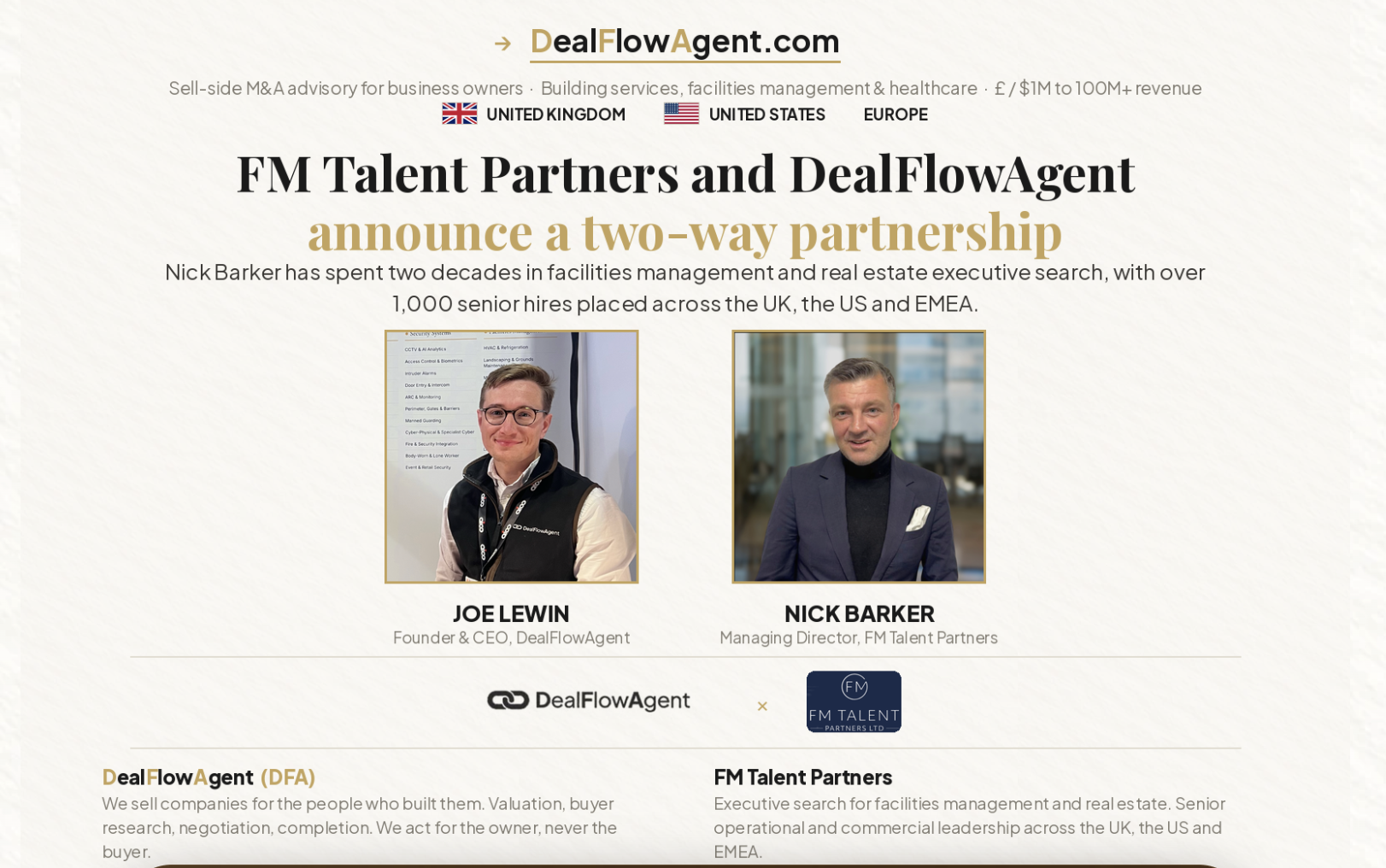
Nick leads FM Talent Partners, the facilities management and real estate leadership search firm, and is a leading specialist in building services and FM management talent. He partners with DealFlowAgent on two-way referrals: helping business owners and acquirers fill the key roles that decide whether a business is sellable, and introducing owners who are thinking about their next chapter to a team that knows their industry and their market. Key-person dependency is one of the two most common reasons a sale collapses, and Nick fixes it at source.
Nick leads FM Talent Partners, the facilities management and real estate leadership search firm, and is a leading specialist in building services and FM management talent. He partners with DealFlowAgent on two-way referrals: helping business owners and acquirers fill the key roles that decide whether a business is sellable, and introducing owners who are thinking about their next chapter to a team that knows their industry and their market. Key-person dependency is one of the two most common reasons a sale collapses, and Nick fixes it at source.

James Duboullay
Senior M&A Advisor
- •25+ years across investment banking, M&A and fundraising
- •Sector focus: essential services and software
- •Long-standing relationships with private equity buyers and growth funds
- •Personally advising DealFlowAgent founders for the past four years
- •25+ years across investment banking, M&A and fundraising
- •Sector focus: essential services and software
- •Long-standing relationships with private equity buyers and growth funds
- •Personally advising DealFlowAgent founders for the past four years

Emerson Patton
Sector Specialist: Building Services & Facilities Management
- •20+ years advising owners in building services, fire safety, HVAC, plumbing, and construction
- •Guided 200+ companies through growth, profit improvement, and exit planning
- •Builds equity value and operational structure long before a sale
- •Partners with DFA to prepare owners for exit while the advisory team runs the sale
- •20+ years advising owners in building services, fire safety, HVAC, plumbing, and construction
- •Guided 200+ companies through growth, profit improvement, and exit planning
- •Builds equity value and operational structure long before a sale
- •Partners with DFA to prepare owners for exit while the advisory team runs the sale

Kaya Kesici
M&A Advisor, Fire Safety, Security & Compliance
- •17 completed M&A transactions over the past six years across UK SME fire safety, security and compliance-led services
- •Sell-side and buy-side experience, buyer research, acquirer mapping, outreach and live process coordination
- •Information request lists, databook prep, IC-style summaries and EV-to-equity bridge work
- •Direct sector exposure across fire protection, security systems, CCTV, access control and intruder alarms
- •17 completed M&A transactions over the past six years across UK SME fire safety, security and compliance-led services
- •Sell-side and buy-side experience, buyer research, acquirer mapping, outreach and live process coordination
- •Information request lists, databook prep, IC-style summaries and EV-to-equity bridge work
- •Direct sector exposure across fire protection, security systems, CCTV, access control and intruder alarms
Previously

Ranger Fire & Security · Complete Building Services · Compliance Group

- •22 completed M&A transactions
- •Direct relationships with hundreds of strategic and financial acquirers
- •Previously built a mobility and field services business to 30 staff and 6 UK warehouses, then sold via competitive process with an EY M&A partner
- •Raised £2m in funding; placed 3rd of 1,900 at OnStage (the "Y Combinator of Europe")
- •Full-stack developer of advanced agent systems and second-brain tooling for the M&A process
- •22 completed M&A transactions
- •Direct relationships with hundreds of strategic and financial acquirers
- •Previously built a mobility and field services business to 30 staff and 6 UK warehouses, then sold via competitive process with an EY M&A partner
- •Raised £2m in funding; placed 3rd of 1,900 at OnStage (the "Y Combinator of Europe")
- •Full-stack developer of advanced agent systems and second-brain tooling for the M&A process
Sector Expert
Industry-Specific Advisor
For every engagement we add a sector specialist from your industry to the core team: a 15–25 year operator or advisor with direct relationships in your niche. Recruited per deal so you get the right fit, not a generalist.
For every engagement we add a sector specialist from your industry to the core team: a 15–25 year operator or advisor with direct relationships in your niche. Recruited per deal so you get the right fit, not a generalist.
The bench is growing. Two senior M&A hires confirmed for late July 2026, selected from 200+ applicants out of Goldman Sachs, Deutsche Bank, EY, KPMG and leading boutique M&A firms. See open roles →
The AI layer behind every advisor
Two in-house AI systems work alongside the human bench. They are software, not people, built and supervised by the advisory team.

Sage
AI Deal Concierge
Available 24/7. Monitors every signal in your deal and keeps the advisory team one step ahead. Trained on thousands of M&A transactions.

Sterling
Buy-Side Deal Origination Agent
Engages 13,000+ acquirers to surface live mandates and intent, then feeds your advisors with warm, ranked buyer matches.
The Exit Readiness Scorecard
Score your business across the factors acquirers underwrite, including key-person dependency, contract quality, customer concentration and earnings quality. Complete it below, print it, or download the PDF and work through it with your leadership team.
Watch the intro from our founder, Joe
Two minutes on how DealFlowAgent runs a confidential, competitive sale process for owners of building services, facilities management and healthcare businesses.
Joe Lewin
Exited entrepreneur and M&A advisor who has guided 20+ business owners through successful exits. Joe built and sold his first company after scaling to 80,000+ users and raised over £2M in funding. He founded DealflowAgent to combine traditional M&A expertise with AI technology, creating aligned advisory solutions for SME business owners. Joe regularly speaks on exit planning and M&A trends, and has built a network of thousands of strategic acquirers across UK and US markets.
What is your business actually worth?
Sector by sector benchmarks built from real completed transactions, with the valuation bands acquirers underwrite against.
- Fire Safety Business Valuation & EBITDA MultiplesWhat fire alarm, extinguisher, sprinkler and passive fire protection businesses sell for, band by band.
- Security Systems Business Valuation & EBITDA MultiplesCCTV, access control, intruder alarms and monitoring: the multiples acquirers are paying in 2026.
- Compliance, Testing & Inspection Valuation GuideWhy recurring statutory inspection revenue attracts the highest multiples in building services.
- Electrical Contracting Valuation & EBITDA MultiplesNICEIC, EICR and EV infrastructure: how electrical contractors are valued and sold.
- HVAC, Refrigeration & Cooling Valuation GuideService contract density, engineer retention and the multiples HVAC consolidators pay.