Valuation Gaps and Key-Person Dependency: The Two Reasons Business Sales Collapse
Deals rarely fail for exotic reasons. They fail because of a valuation gap neither side will close, or a business that cannot run without the person trying to leave it. Here is how to fix both, plus why DealFlowAgent has partnered with FM Talent Partners.

Most owners preparing to sell spend their energy on the number. What is the business worth, what multiple should it command, what did the company down the road get. That work matters. It is also only half the problem.
Deals that fail rarely fail for exotic reasons. They fail for one of two, and usually for both at once. The first is a valuation gap that neither side will close. The second is a business that cannot run without the person trying to leave it.
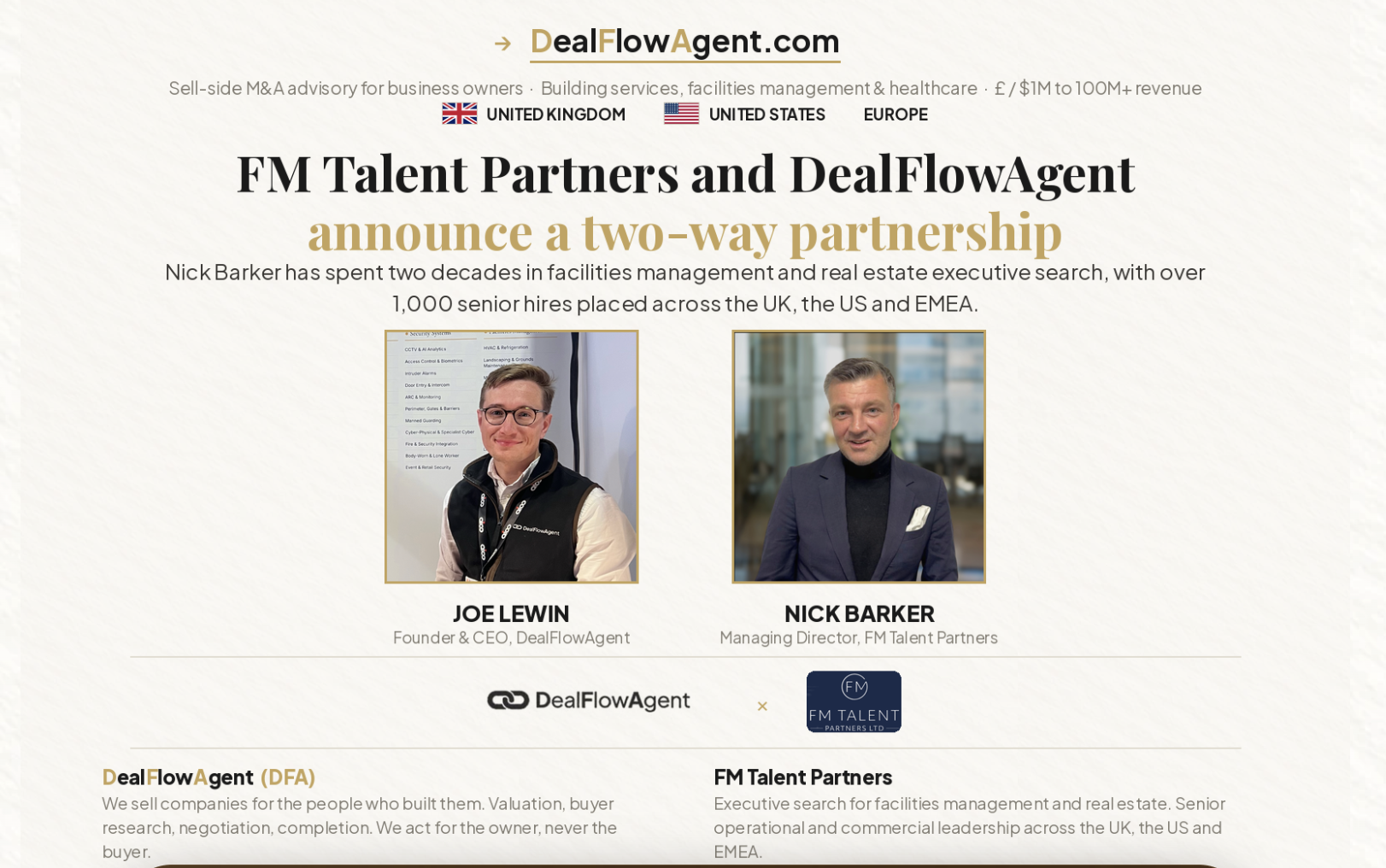
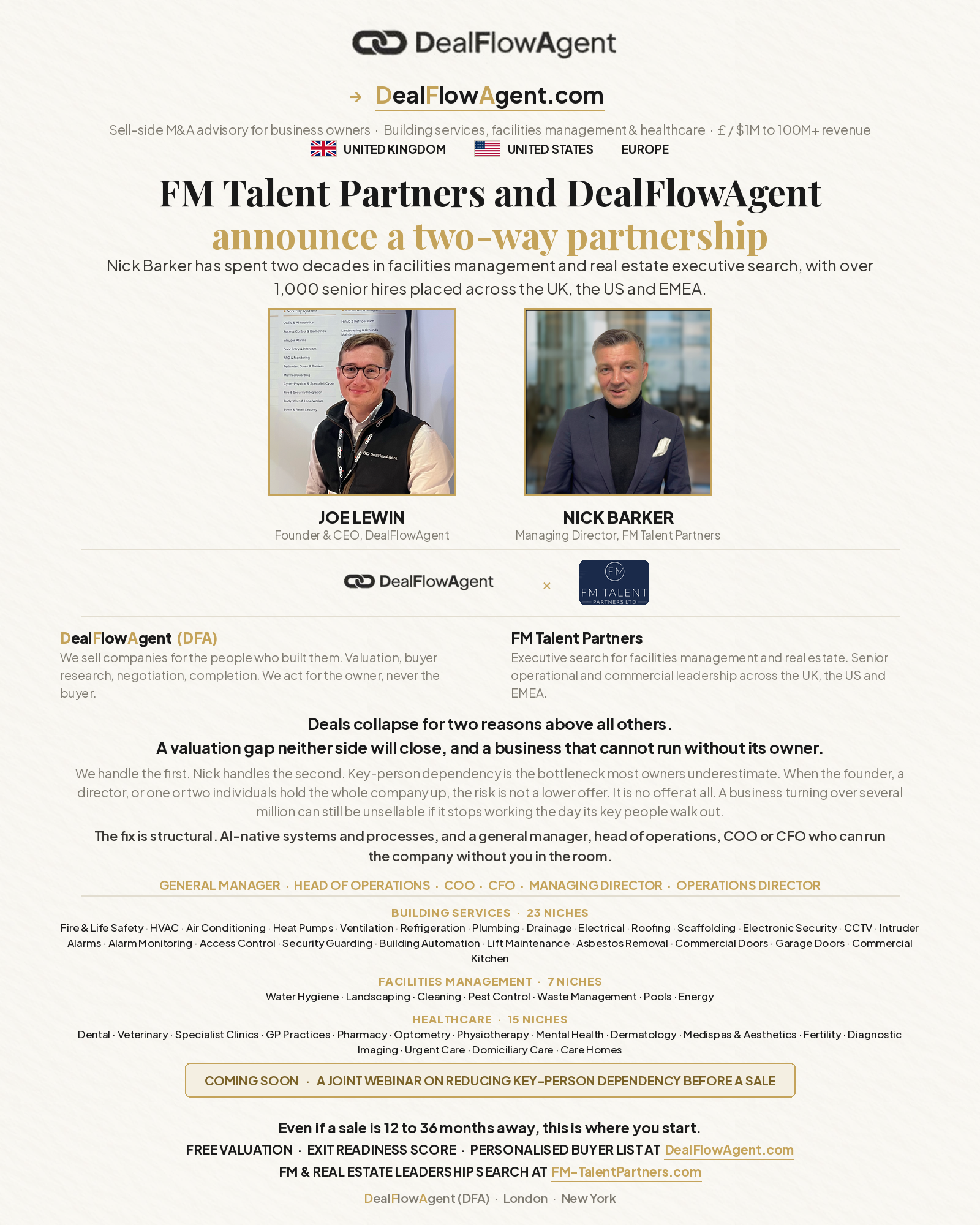
We can fix the first. Fixing the second needs a specialist, which is why DealFlowAgent, founded by Joe Lewin, has entered a two-way partnership with FM Talent Partners, the facilities management and real estate leadership search firm led by Nick Barker.
The valuation gap
A valuation gap is what happens when an owner's number and a buyer's number are built from different evidence.
The owner's number is usually built from a memory. A competitor sold for eight times EBITDA in 2022. A broker sent an unsolicited letter quoting a range. A trade body dinner produced a figure that stuck. None of those are the same as what an acquirer will actually pay for this business, in this niche, in this quarter, with these accounts.
The buyer's number is built from what they can defend to an investment committee: normalised earnings, contract quality, customer concentration, and the cost of replacing what walks out the door on completion.
The gap between those two numbers is where deals die. Not loudly, and rarely in a single conversation. The process simply slows, the buyer's questions get sharper, and eight months later everyone is tired and nobody has signed anything.
Closing that gap is evidence work, and it can be done well before a sale. What buyers in your niche actually paid. What your adjusted EBITDA survives after a quality-of-earnings review. Which specific changes move your multiple rather than just your revenue. An owner who has done that work arrives at the table with a number a buyer recognises, and the negotiation becomes about terms rather than about reality.
Our sector valuation guides exist for exactly this reason. They set out the ranges buyers are underwriting today in fire safety, HVAC, electrical contracting, security systems and compliance, testing and inspection, with the evidence behind them. If you want the number for your own business rather than the range for your sector, the free valuation takes a few minutes.
Key-person dependency, the problem most owners underestimate
The second reason is harder to see from the inside, because it does not feel like a problem. It feels like being good at your job.
Key-person dependency is what a buyer calls it when the business only works because specific people are in it. Usually that is the founder. Sometimes it is a long-serving operations director who holds every client relationship in their head, or one or two engineers who are the only people who can price a job properly.
Here is the part owners consistently get wrong. They assume this risk costs them a lower offer. It often costs them the offer entirely.
A business turning over several million pounds can be genuinely unsellable if it stops working the day its key people walk out. The buyer is not purchasing revenue. They are purchasing a system that produces revenue. If the system is a person, and that person is leaving as part of the transaction, there is nothing to buy.
This is also why key-person dependency shows up so late. It is invisible in the accounts. It surfaces in diligence, at the point where a buyer starts asking who prices the work, who holds the top ten client relationships, what happens to the contract renewal cycle if you are not there, and how long the handover would realistically take. By then the owner is emotionally committed, professional fees are already spent, and the answer is disappointing.
What it actually looks like
In building services, facilities management and healthcare businesses, dependency tends to cluster in the same five places.
| Where it sits | What the buyer asks in diligence | What it costs you |
|---|---|---|
| Pricing and estimating | Who quotes the work, and what is the margin logic | Deferred consideration, or a broken process |
| Client relationships | Why do the top ten accounts renew | A lower multiple and a longer earn-out |
| Technical authority | Who holds the accreditations and sign-off | The buyer walks if the licence is personal |
| Commercial decisions | What moves without the founder in the room | A longer, tighter retention package |
| Institutional memory | Where is any of this written down | Slower integration, discounted offer |
None of these stop a profitable business from operating. All of them stop it from transferring.
The pattern is sharpest where the trade rests on a named individual's accreditation or competence. A fire risk assessment practice, a water hygiene business operating under the HSE Legionella regime, or a testing, inspection and certification company can all be excellent businesses and still be untransferable if the competence sits with the owner rather than with the company.
The fix is structural, not motivational
Owners often respond to this by trying to work less, or by delegating harder. That is not the fix, because it treats a structural problem as a discipline problem.
The two things that genuinely reduce dependency are systems and a hire.
Systems means the operating knowledge coming out of people's heads and into something the business owns. Documented pricing logic. A CRM that holds the relationship history rather than a phone. Standard operating procedures for the work that generates the margin. AI-native systems and processes now do a meaningful share of this, because the capture and retrieval problem that made documentation so painful is largely solved. What used to take a year of someone's evenings can now be built in weeks. We covered that shift in AI and automation for service businesses.
The hire means bringing in the person who runs the company when the owner does not. Depending on the size and shape of the business, that is a general manager, a head of operations, a chief operating officer, or a chief financial officer. It is the single most valuable appointment most owner-led businesses make in the three years before a sale, and it is also the one most owners defer, because it is expensive, because it feels like an admission, and because finding the right person is genuinely difficult.
That last point is the reason for this partnership.
Score your own business before you decide anything
Before you decide whether the issue is price or dependency, score it. The scorecard below is the same instrument we use with owners across building services and facilities management, covering earnings quality, contract cover, customer concentration, technical authority and the handover risk a buyer will price. Complete it on screen, print it, or download the PDF and work through it with your leadership team.
The Exit Readiness Scorecard
Score your business across the factors acquirers underwrite, including key-person dependency, contract quality, customer concentration and earnings quality. Complete it below, print it, or download the PDF and work through it with your leadership team.
If you would rather see the underlying framework first, the exit readiness page sets out how each factor is weighted, and exit planning covers the sequencing, including the tax position and Business Asset Disposal Relief.
Why we partnered with FM Talent Partners

Nick Barker has spent two decades in facilities management and real estate executive search, with over 1,000 senior hires placed across the UK, the United States and EMEA. He is Managing Director of FM Talent Partners, which places mid to senior leadership across sales, operations, and director through to board level, with specialist depth in the data centre sector.
His network is the operators. Ours is the acquirers. That is the whole logic of the arrangement.
When an owner comes to us three years out from a sale and the diagnosis is dependency rather than price, the honest answer has always been that they need a specific hire and we cannot make it for them. Now we can point them at someone who does exactly that, in exactly their sector.
It runs the other way too. Every completed sale is a leadership event. Founders exit, integration creates new roles, and acquirers need operational leadership they did not have the day before completion. Those are Nick's mandates, and they sit alongside the acquirer relationships we run through our buy-side network.
We are also running a joint webinar on reducing key-person dependency before a sale. Details will follow on both firms' pages, and on our media hub.
What this means if you are thinking about selling
You do not need to be ready to sell to act on any of this. In fact the opposite is true, because the changes that move a valuation take twelve to thirty-six months to show up in the numbers a buyer will underwrite.
| Time to exit | What to fix | What a buyer sees |
|---|---|---|
| 36 months out | Make the senior hire, document the pricing logic | A management team with a track record |
| 24 months out | Convert reactive work to contracted, recurring revenue | Visible, defensible earnings |
| 12 months out | Clean the accounts, reduce concentration, formalise contracts | A quality-of-earnings review that holds |
| 6 months out | Assemble diligence, brief the market, run a competitive process | Several buyers, not one |
If a sale is somewhere on your horizon, the two questions worth answering now are what your business is actually worth on today's evidence, and what would happen to it if you stopped turning up. The first we can answer for you at no cost. The second usually answers itself the moment you ask it honestly.
You can see how that plays out in practice in our case studies, and in our approach to running a competitive process rather than a single negotiation.
Frequently asked questions
What is key-person dependency in an M&A context? Key-person dependency is the risk that a business cannot operate normally if one or more specific individuals leave. In owner-led businesses this is usually the founder. Buyers treat it as a transfer risk rather than a performance risk, which is why it can prevent a sale outright rather than simply reducing the price.
Does key-person dependency reduce the valuation or stop the sale? Both are possible, and the second is more common than owners expect. A buyer who cannot see how the business runs without its owner may reduce the offer, structure a larger portion as deferred consideration tied to the owner staying, or decline to proceed at all.
How long does it take to reduce key-person dependency before a sale? Typically twelve to thirty-six months. A senior operational hire needs time to be recruited, to take over relationships and decisions, and then to build a track record a buyer can verify in diligence. A hire made three months before a process starts does not solve the problem, because there is no evidence the handover worked.
Which hire reduces dependency most? It depends on where the dependency sits. If the owner is the commercial and operational centre of the business, a general manager or chief operating officer is usually the answer. If the dependency is financial control and reporting quality, a chief financial officer or finance director tends to matter more, and it also improves the quality of the numbers a buyer receives.
What is a valuation gap? A valuation gap is the difference between the price an owner expects and the price a buyer will defend internally. It is usually caused by the owner's number being based on anecdote or on headline revenue, and the buyer's number being based on normalised earnings, contract quality and transfer risk.
How do I know whether my problem is price or dependency? Score the business first. The exit readiness scorecard above separates the two: earnings quality and contract cover drive the multiple, while technical authority, pricing knowledge and relationship ownership drive transferability. Most owners find that one column is materially weaker than the other.
Start here
Even if a sale is twelve to thirty-six months away, this is where you start.
- A free valuation, benchmarked against comparable UK and US transactions in your niche
- An exit readiness score across the factors buyers actually underwrite
- A personalised buyer list of the acquirers most likely to want your business
For leadership search across facilities management and real estate, speak to FM Talent Partners. For anything on the sale side, book a confidential call.
Sources and further reading
- Business Asset Disposal Relief, GOV.UK, on the tax treatment of a qualifying business disposal
- Companies House, for the filed accounts a buyer reads before they speak to you
- Legionnaires' disease and water hygiene duties, Health and Safety Executive, on where competence obligations sit
- Institute of Workplace and Facilities Management, on professional standards in UK facilities management
- International Facility Management Association, for the equivalent standards in the United States
- British Private Equity and Venture Capital Association, on private equity and buy-and-build activity in the UK
- Exit Planning Institute, on owner readiness and the transferability of value
DealFlowAgent is a specialist sell-side M&A advisory for owner-led businesses in building services, facilities management and healthcare, with offices in London and New York. About us.
Experienced Dealmakers Lead Your Exit
A senior M&A bench, plus a sector specialist recruited for your industry on every deal.

Head of M&A
Recently joined, name announcing soon
Recently joined from one of the largest M&A advisory firms in the UK. As an ex-Director, our new Head of M&A was selected from over 220 applicants to lead the advisory bench across Building Services, Facilities Management, and Healthcare.
Recently joined from one of the largest M&A advisory firms in the UK. As an ex-Director, our new Head of M&A was selected from over 220 applicants to lead the advisory bench across Building Services, Facilities Management, and Healthcare.

Martin is one of the most well-connected figures in UK fire, security, building services and FM. He is Chairman of both the Fire Industry Association and the British Security Industry Association, the only person in the UK to hold both roles simultaneously. Martin spent over a decade in senior leadership at Mitie, latterly as Industry Liaison Director for its fire and security division, helping scale the business past £500m in revenue and playing a role in the £366m acquisition of Marlowe plc, which created one of the UK's largest compliance, fire and security services groups. He joined DealFlowAgent because owners in these sectors deserve a genuine sector-specialist advisor across valuation, business optimisation and buyer access. In recognition of his industry roles, he acts in a personal, non-partisan capacity.
Martin is one of the most well-connected figures in UK fire, security, building services and FM. He is Chairman of both the Fire Industry Association and the British Security Industry Association, the only person in the UK to hold both roles simultaneously. Martin spent over a decade in senior leadership at Mitie, latterly as Industry Liaison Director for its fire and security division, helping scale the business past £500m in revenue and playing a role in the £366m acquisition of Marlowe plc, which created one of the UK's largest compliance, fire and security services groups. He joined DealFlowAgent because owners in these sectors deserve a genuine sector-specialist advisor across valuation, business optimisation and buyer access. In recognition of his industry roles, he acts in a personal, non-partisan capacity.

James Duboullay
Senior M&A Advisor
- •25+ years across investment banking, M&A and fundraising
- •Sector focus: essential services and software
- •Long-standing relationships with private equity buyers and growth funds
- •Personally advising DealFlowAgent founders for the past four years
- •25+ years across investment banking, M&A and fundraising
- •Sector focus: essential services and software
- •Long-standing relationships with private equity buyers and growth funds
- •Personally advising DealFlowAgent founders for the past four years

Emerson Patton
Sector Specialist: Building Services & Facilities Management
- •20+ years advising owners in building services, fire safety, HVAC, plumbing, and construction
- •Guided 200+ companies through growth, profit improvement, and exit planning
- •Builds equity value and operational structure long before a sale
- •Partners with DFA to prepare owners for exit while the advisory team runs the sale
- •20+ years advising owners in building services, fire safety, HVAC, plumbing, and construction
- •Guided 200+ companies through growth, profit improvement, and exit planning
- •Builds equity value and operational structure long before a sale
- •Partners with DFA to prepare owners for exit while the advisory team runs the sale

Kaya Kesici
M&A Advisor, Fire Safety, Security & Compliance
- •17 completed M&A transactions over the past six years across UK SME fire safety, security and compliance-led services
- •Sell-side and buy-side experience, buyer research, acquirer mapping, outreach and live process coordination
- •Information request lists, databook prep, IC-style summaries and EV-to-equity bridge work
- •Direct sector exposure across fire protection, security systems, CCTV, access control and intruder alarms
- •17 completed M&A transactions over the past six years across UK SME fire safety, security and compliance-led services
- •Sell-side and buy-side experience, buyer research, acquirer mapping, outreach and live process coordination
- •Information request lists, databook prep, IC-style summaries and EV-to-equity bridge work
- •Direct sector exposure across fire protection, security systems, CCTV, access control and intruder alarms
Previously


Ranger Fire & Security · Complete Building Services · Compliance Group

- •22 completed M&A transactions
- •Direct relationships with hundreds of strategic and financial acquirers
- •Previously built a mobility and field services business to 30 staff and 6 UK warehouses, then sold via competitive process with an EY M&A partner
- •Raised £2m in funding; placed 3rd of 1,900 at OnStage (the "Y Combinator of Europe")
- •Full-stack developer of advanced agent systems and second-brain tooling for the M&A process
- •22 completed M&A transactions
- •Direct relationships with hundreds of strategic and financial acquirers
- •Previously built a mobility and field services business to 30 staff and 6 UK warehouses, then sold via competitive process with an EY M&A partner
- •Raised £2m in funding; placed 3rd of 1,900 at OnStage (the "Y Combinator of Europe")
- •Full-stack developer of advanced agent systems and second-brain tooling for the M&A process
Sector Expert
Industry-Specific Advisor
For every engagement we add a sector specialist from your industry to the core team: a 15–25 year operator or advisor with direct relationships in your niche. Recruited per deal so you get the right fit, not a generalist.
For every engagement we add a sector specialist from your industry to the core team: a 15–25 year operator or advisor with direct relationships in your niche. Recruited per deal so you get the right fit, not a generalist.
The bench is growing. Two senior M&A hires confirmed for late July 2026, selected from 200+ applicants out of Goldman Sachs, Deutsche Bank, EY, KPMG and leading boutique M&A firms. See open roles →
The AI layer behind every advisor
Two in-house AI systems work alongside the human bench. They are software, not people, built and supervised by the advisory team.

Sage
AI Deal Concierge
Available 24/7. Monitors every signal in your deal and keeps the advisory team one step ahead. Trained on thousands of M&A transactions.

Sterling
Buy-Side Deal Origination Agent
Engages 13,000+ acquirers to surface live mandates and intent, then feeds your advisors with warm, ranked buyer matches.
Watch the intro from our founder, Joe
Two minutes on how DealFlowAgent runs a confidential, competitive sale process for owners of building services, facilities management and healthcare businesses.
Joe Lewin
Exited entrepreneur and M&A advisor who has guided 20+ business owners through successful exits. Joe built and sold his first company after scaling to 80,000+ users and raised over £2M in funding. He founded DealflowAgent to combine traditional M&A expertise with AI technology, creating aligned advisory solutions for SME business owners. Joe regularly speaks on exit planning and M&A trends, and has built a network of thousands of strategic acquirers across UK and US markets.