
Sell Your Security Business: 2026 Guide
A practical guide for UK and US security business owners on valuations, buyers, and how to run a successful sale process in 2026.

DealFlowAgent is a leading specialist in niche building services, with dedicated M&A advisory and brokerage coverage for electronic security businesses across the UK and US. We help owners secure multiple acquisition offers at higher valuations.
Sell your security systems businessWhat is your business worth today?
Enter your website and our M&A team will prepare a written valuation and exit optimisation report. No cost, no credit card, no obligation.
Strictly confidential
Strictly confidential. Your personalized report is prepared by our internal team alone — the founder, head of M&A and associates. It is never shown to buyers or anyone outside the deal team without your permission.
Already know your number?
Meta title: Sell Your Security Business: 2026 Guide SEO description: How to sell a security business in the UK or US in 2026 - EBITDA multiples, key buyers, sale process, and expert M&A advice for owners. Excerpt: A practical guide for UK and US security business owners on valuations, buyers, and how to run a successful sale process in 2026. Slug: sell-security-business-uk-us-guide-2026
Security businesses are among the most actively acquired companies in the lower-middle market right now. Whether you run an alarm monitoring operation, an integrated electronic security firm, or a manned guarding business, acquirers - from large strategics to PE-backed roll-ups - are competing to buy quality security companies across the UK and the US. If you have been thinking about an exit, 2026 is shaping up to be one of the most favourable seller's markets in recent memory.
At DealFlow Agent, we advise business owners across the built-environment and security sector on how to position their companies for sale and run competitive processes. Security sits alongside fire safety as one of the most sought-after niches by acquirers globally, and the data bears that out.
This guide covers everything a security business owner needs to know: current valuations, who is buying, how to prepare, and the key differences between selling in the UK versus the US.
Why Now Is the Right Time to Sell Your Security Business
The numbers tell a compelling story. According to Capstone Partners' Security M&A Update, security sector M&A surged 24.1% year-on-year in 2025, reaching 242 completed transactions. That level of deal volume reflects structural demand, not a short-term cycle.
Several forces are driving this:
Private equity is deploying capital aggressively. PE add-on transactions accounted for 45.9% of all security deals in 2025 - up 14.4% year-on-year. PE platform formations jumped 33.3% to 20 new platforms. Roll-up vehicles are actively seeking quality bolt-on acquisitions to build scale ahead of their own exits.
Data centre construction is creating unprecedented demand. The explosion in AI infrastructure and hyperscale data centres across the UK, Ireland, and the US is driving fire and life safety M&A at pace. The Fire and Life Safety segment alone jumped 66.7% year-on-year to 125 transactions in 2025. Security and fire systems are mandated in every new facility.
School safety spending is a new tailwind. In the US, Warburg Pincus acquired Raptor Technologies from Thoma Bravo for $1.8 billion in November 2025, making a significant statement about the value placed on school safety platforms. Flock Safety reached a $7.5 billion post-money valuation with backing from Andreessen Horowitz, Axon, and Y Combinator. This institutional capital is filtering down into smaller acquisitions.
Strategic buyers are expanding their footprints. Allied Universal acquired Mulligan Security in August 2025. Menzies Aviation acquired G2 Secure Staff, lifting revenues by 20% to $3.1 billion. The uniformed guard segment saw a 150% year-on-year jump in deal volume - albeit from a smaller base of 9 transactions.
For UK sellers, the economic context adds further urgency. Interest rates have moderated from their 2023 peaks, debt financing is more accessible again, and acquirers who paused between 2022 and 2024 are actively re-entering the market with dry powder to deploy.
EBITDA Multiples: What Is a Security Business Worth?
Valuation depends heavily on the type of security business, its revenue quality, and the size of the transaction. Smaller, owner-managed businesses trade at lower multiples than PE-backed platforms. Recurring revenue - measured as Monthly Recurring Revenue (MRR) or Annual Recurring Revenue (ARR) - is the single most important value driver in this sector.
The table below reflects current market conditions based on publicly available transaction data and industry benchmarks from Peak Business Valuation and Capstone Partners.
| Business Type | UK Multiple Range | US Multiple Range |
|---|---|---|
| Alarm monitoring (small, owner-managed) | 3x - 5x EBITDA | 3x - 5x EBITDA |
| Electronic security (integrated systems) | 6x - 10x EBITDA | 6x - 10x EBITDA |
| PE-backed platforms (scale, high RMR) | 10x - 15x+ EBITDA | 11.8x EBITDA (5-year average) |
A few important qualifications on these ranges:
Recurring revenue commands a premium. Businesses with a high proportion of contracted monitoring or maintenance revenue - where clients pay monthly regardless of call-outs - attract materially higher multiples than project-led businesses. For smaller alarm companies where recurring revenue is the dominant model, SDE multiples of 5x to 6x are achievable even at the owner-managed level, according to Peak Business Valuation's analysis of security alarm company valuations.
Size matters. A business generating GBP 500,000 EBITDA and a business generating GBP 5 million EBITDA will not trade at the same multiple, even if their revenue quality is identical. Larger businesses attract more competitive buyer interest and typically command a 1x to 3x premium over smaller equivalents.
Strategic fit can stretch multiples beyond the ranges above. If your business fills a specific geographic gap for a roll-up platform, or brings a capability they lack - such as a particular technology integration or a government contract base - buyers will pay above-market prices to secure it.
Understanding Your Buyer: Who Acquires Security Businesses?
Security sector acquirers fall into three broad categories, each with different motivations and pricing behaviour.
Strategic Buyers
The large strategics are household names in the sector. In the UK, the dominant players by turnover include Mitie (GBP 1.179 billion turnover in 2025), Allied Universal/G4S (GBP 710 million), OCS Group (GBP 395 million), Securitas Security Services (GBP 345 million), and Bidvest Noonan (GBP 302 million). These businesses acquire to add revenue, gain geographic coverage, or absorb client relationships.
In the US, ADT remains the largest residential security operator with $359 million in monthly recurring revenue. Securitas Technology generates $100 million MRR. Everon (the rebranded ADT Commercial business, based in Irving, Texas) has $38.7 million MRR and has been active in the mid-market.
Strategic buyers typically pay fair market multiples but move more slowly through due diligence and can impose longer completion timelines. They also tend to integrate businesses fully into their platforms, which can affect staff retention arrangements.
Private Equity Roll-Up Platforms
This is where the most competitive bidding happens for quality security businesses in the GBP 1 million to GBP 30 million revenue range.
Pye-Barker Fire and Safety, backed by Gemspring Capital, completed 57 acquisitions in 2025 alone. With 9,000 employees operating across 47 US states and $26.6 million in monthly recurring revenue, Pye-Barker is the most acquisitive operator in the combined fire and security sector globally. Their model is to acquire strong regional businesses, retain the local management team, and layer in shared back-office functions.
The PE roll-up model works because it compresses valuation arbitrage: they buy individual businesses at 6x to 8x EBITDA, aggregate them into a platform, and sell the consolidated group at 12x to 15x EBITDA - generating significant returns for fund investors. As a seller, this means PE-backed buyers are genuinely motivated and often faster to transact than strategics.
You can read more about how our buy-side advisory practice works with PE platforms actively seeking acquisitions in the security sector.
Smaller Trade Buyers
Regional security companies looking to expand geographically or add capabilities (such as CCTV monitoring or access control integration) are active acquirers at smaller deal sizes. These buyers typically self-fund or use bank debt, which constrains their pricing but makes for simpler completion mechanics. They often suit sellers who want a clean exit with minimal transition obligations.
According to Capstone Partners' Security M&A Update, private strategic M&A - a category that includes both large strategics and smaller trade buyers - rose 36.1% year-on-year in 2025, accounting for 34.3% of total deal volume.
Preparing Your Security Business for Sale
Preparation is where most deals are won or lost. A business that arrives at the market in poor condition will either receive low offers or fail to complete. Here is what acquirers scrutinise in security sector transactions.
Maximise Recurring Monthly Revenue
RMR (or MRR) is the primary value driver in security M&A. Before going to market, audit your contract base and ensure:
- All monitoring and maintenance agreements are signed, current, and not month-to-month where possible
- Contracts have appropriate notice periods (12 months is ideal)
- You can evidence renewal rates (aim for 90%+ annual retention)
- Revenue is split clearly between recurring (monitoring, maintenance) and non-recurring (installations, project work)
Buyers will model your recurring revenue separately and apply a higher multiple to that stream.
Hold the Right Certifications
In the UK, certification from the National Security Inspectorate (NSI) or SSAIB is effectively a commercial prerequisite for serious buyers. NSI Gold certification in particular signals quality management and compliance standards that reduce buyer risk. SIA licensing must be current for all relevant staff - each licence costs GBP 204 and is valid for three years. Buyers will check every licence during due diligence.
In the US, licensing requirements vary by state. Florida's Chapter 493 (administered by the FDACS) is one of the more prescriptive regimes. If your business operates across multiple states, ensure licensing is current in every jurisdiction - a missed renewal can become a material issue in due diligence.
Reduce Owner Dependency
The single biggest discount buyers apply to security businesses is for owner dependency. If your clients only deal with you, if you are the signatory on key contracts, or if your staff would leave without your presence, buyers will price that risk into their offer - or walk away.
The fix requires planning 12 to 24 months before going to market. Promote a senior manager to handle client relationships. Have your operations manager run the business for at least one quarter without you in the building. Document every process so that the business functions on systems, not on your personal knowledge.
Document SOPs and Technology Integration
Buyers want to see that your business is operationally robust. Standard Operating Procedures (SOPs) for installation, monitoring response, maintenance schedules, and customer onboarding should be written and followed. If your business uses a central station management platform, a field service management tool, or an integrated CRM, demonstrate that these are embedded and used consistently.
Technology integration is increasingly important as acquirers look to consolidate data across multiple acquisitions. Businesses that can export clean data from modern software platforms are easier to integrate and command better terms.
Present Clean Financials
Three years of management accounts, ideally with a Quality of Earnings (QoE) analysis prepared by an independent accountant, is the standard expectation in any transaction over GBP 2 million. Buyers will restate your EBITDA to remove one-off costs, owner benefits, and non-recurring items. Do this work yourself before going to market - it puts you in control of the narrative.
The Sale Process: Step by Step
A well-run security business sale typically takes six to nine months from mandate to completion.
1. Preparation (months 1-2): Appoint an M&A adviser, prepare an Information Memorandum (IM), build a financial model, and agree on your target buyer list.
2. Confidential marketing (months 2-3): The IM is shared under NDA with a curated list of strategic and financial buyers. Your identity remains confidential until buyers sign the NDA and receive the IM.
3. Indicative offers (month 3): Buyers submit non-binding indicative offers. Your adviser presents these alongside qualitative factors - buyer credibility, likely integration approach, treatment of staff.
4. Management presentations (months 3-4): You meet the shortlisted buyers (typically three to five) and present your business in detail. This is your opportunity to assess cultural fit and the seriousness of each buyer.
5. Final offers and Letter of Intent (month 4-5): Buyers submit binding or semi-binding offers. You select a preferred buyer and sign a Letter of Intent (LOI) or Heads of Terms, which sets the price, structure, and key conditions.
6. Due diligence (months 5-7): The buyer's legal and financial advisers conduct detailed diligence on your financials, contracts, certifications, employment records, and IT systems. Prepare a data room early.
7. Legal completion (months 7-9): Sale and Purchase Agreement (SPA) is negotiated and signed. Funds transfer. You are free to exit or stay on for an agreed transition period.
UK vs US Considerations
Selling a security business in the UK and selling one in the US share broad similarities - both markets are active, both are dominated by PE roll-ups, and both value recurring revenue above everything else. But there are material differences that owners need to understand.
Regulatory Environment
UK sellers must ensure SIA licensing, NSI or SSAIB certification, and GDPR compliance for any CCTV operations are all in order before marketing begins. The Building Safety Act 2022 has added compliance layers for businesses operating in higher-risk buildings. Buyers will conduct detailed regulatory due diligence and any gaps will either reduce price or create escrow holdbacks.
US sellers face a more fragmented regulatory environment. Licensing is state-by-state, and a business operating across multiple states needs to maintain compliance in each jurisdiction independently. NFPA codes govern fire and life safety systems. These requirements are well understood by US buyers, but international sellers entering the US market should take specialist legal advice.
Tax Treatment
For UK sellers, Business Asset Disposal Relief (BADR) remains the most important tax planning tool. BADR reduces Capital Gains Tax to 10% on qualifying business disposals up to a lifetime limit - though the April 2026 changes to BADR have tightened the rules. You should read our detailed guide on BADR tax changes in April 2026 to understand how these affect security business exits.
For US sellers, federal long-term capital gains tax applies at 20% for higher earners, plus the 3.8% Net Investment Income Tax and any applicable state taxes. Deal structure - asset sale versus share sale - has significant tax implications in both jurisdictions and should be modelled with your tax adviser before accepting any offer.
Cross-Border Buyers
A growing number of US-based PE platforms are actively looking at UK security acquisitions as a route to international expansion. Pye-Barker, for example, already operates at scale and has the infrastructure to absorb UK bolt-ons. For UK sellers, this creates an additional buyer pool and can drive competitive tension in a sale process.
Similarly, some UK-based businesses are acquiring US operations or being acquired by US buyers as part of a transatlantic strategy. If your business has any US revenue or US client relationships, highlight this prominently - it will attract attention from acquirers on both sides of the Atlantic.
If you are considering a business sale in a related sector, our guide on pest control business valuations in the UK in 2026 illustrates how similar recurring-revenue service businesses are being valued and sold.
Frequently Asked Questions
1. What is my security business worth in 2026?
It depends on your business type, size, and revenue quality. Small alarm monitoring businesses with predominantly recurring revenue typically trade at 3x to 5x EBITDA. Integrated electronic security businesses trade at 6x to 10x EBITDA. PE-backed platforms at scale trade at 10x to 15x+. The five-year average EV/EBITDA for security sector transactions in the US is 11.8x, according to Capstone Partners.
2. How long does it take to sell a security business?
A well-run process typically takes six to nine months from appointing an adviser to legal completion. Businesses that are well-prepared with clean financials and organised contracts at the upper end of that range; poorly prepared businesses can take 12 months or more - and sometimes fail to complete at all.
3. Do I need NSI Gold certification to sell?
You do not legally need it, but in practice, most serious acquirers - particularly PE-backed roll-ups and large strategics - expect NSI Gold or SSAIB certification as a baseline. Without it, your buyer pool narrows significantly and buyers will apply a risk discount to their offer. If you do not hold the certification, begin the process at least 18 months before going to market.
4. Will the buyer keep my staff?
Most acquirers in the security sector are buying operational businesses and have strong incentives to retain existing staff - particularly engineers, monitoring centre operators, and supervisors. PE-backed roll-ups in particular tend to retain local management teams as part of their operating model. Staff terms should be a specific negotiating point in your Heads of Terms.
5. What is recurring monthly revenue (RMR) and why does it matter?
RMR is the contracted revenue your business receives each month from monitoring, maintenance, and service agreements - revenue that arrives without you having to sell anything new. It is the most important metric in security business valuations because it demonstrates predictable cash flow. Buyers apply higher multiples to RMR than to project-based revenue, so maximising your RMR before going to market directly increases your sale price.
6. Can I sell part of my business and retain an equity stake?
Yes. PE-backed acquirers in particular often offer sellers the option to roll a proportion of their equity into the new structure - typically 20% to 40%. This allows you to take significant cash at completion while retaining upside from the platform's future growth. For sellers who are younger or want continued involvement, this can be an attractive structure.
7. What is the difference between a share sale and an asset sale?
In a share sale, the buyer acquires your company including all its liabilities, contracts, and history. In an asset sale, the buyer cherry-picks specific assets (contracts, equipment, goodwill) and leaves liabilities behind. Sellers generally prefer share sales for tax efficiency. Buyers often prefer asset sales to limit liability exposure. Negotiating the sale structure is a key part of the transaction process.
8. How do I find buyers for my security business without word getting out?
A professionally run sale process uses a controlled, confidential approach. Buyers are approached under a blind teaser that describes your business without identifying it. NDAs are signed before any details are disclosed. Your identity is revealed only to buyers who have signed the NDA and are progressing to the Information Memorandum stage. Properly managed, this process keeps the market from finding out you are selling until you are ready to announce completion.
9. What tax relief is available on the sale proceeds in the UK?
Business Asset Disposal Relief (BADR) is the primary relief, reducing the CGT rate to 10% on qualifying business disposals up to a lifetime limit. The April 2026 changes have adjusted the BADR rules for businesses in building services and related sectors - see our BADR guide for the current position. Entrepreneurs' Relief was the predecessor to BADR and the same basic structure applies, though the lifetime limits and qualifying conditions have changed.
10. Is now a good time to sell, or should I wait?
Timing a sale to market peaks is difficult. What is clear is that the current conditions - 242 transactions completed in 2025, PE platforms with significant dry powder, data centre and school safety spending driving demand - represent a seller-friendly environment that may not persist indefinitely. Interest rates, economic conditions, and PE fund cycles all influence deal activity. Sellers who are prepared and come to market in 2026 are well positioned to achieve strong valuations.
Get a Confidential Valuation for Your Security Business
If you own a security business and are considering your options - whether a full exit, a partial sale, or simply understanding what your business is worth - DealFlow Agent can help. We work with business owners across the UK and internationally, providing confidential, conflict-free M&A advisory for companies valued between GBP 1 million and GBP 30 million.
Security is one of the most active sectors in the lower-middle market today, and the right process - run by advisers who understand the sector and the buyer community - can make a material difference to your outcome.
Contact us today for a confidential conversation about your business and what it might achieve in the current market.
Sources: Capstone Partners Security M&A Update 2026 | Pye-Barker Fire and Safety - 57 Acquisitions in 2025 | Security Industry Authority | National Security Inspectorate | Peak Business Valuation - Security Alarm Valuation Multiples
Related reading
- Security systems valuation guide: EBITDA multiples
- Electronic security M&A
- Alarm monitoring M&A
- Testing, inspection and certification hub
- All sector valuation guides
- Exit planning guide for owners
- Free valuation estimate
- See who is buying: free buyer list
- Book a confidential call
Sources
Experienced Dealmakers Lead Your Exit
A senior M&A bench, plus a sector specialist recruited for your industry on every deal.

Head of M&A
Joining 22 August 2026, name announcing soon
Joining full-time on 22 August 2026 from the largest M&A advisory firm in the UK, owned by K3 Capital. As an ex-Director he managed teams of M&A advisors, analysts and associates, working daily with business owners, buyers and stakeholders on live acquisition deals. Selected from 260 applicants alongside colleagues from investment banking backgrounds, he brings that experience and network to lead the advisory bench across Building Services, Facilities Management, and Healthcare.
Joining full-time on 22 August 2026 from the largest M&A advisory firm in the UK, owned by K3 Capital. As an ex-Director he managed teams of M&A advisors, analysts and associates, working daily with business owners, buyers and stakeholders on live acquisition deals. Selected from 260 applicants alongside colleagues from investment banking backgrounds, he brings that experience and network to lead the advisory bench across Building Services, Facilities Management, and Healthcare.

Martin is one of the most well-connected figures in UK fire, security, building services and FM. He is Chairman of both the Fire Industry Association and the British Security Industry Association, the only person in the UK to hold both roles simultaneously. Martin spent over a decade in senior leadership at Mitie, latterly as Industry Liaison Director for its fire and security division, helping scale the business past £500m in revenue and playing a role in the £366m acquisition of Marlowe plc, which created one of the UK's largest compliance, fire and security services groups. He joined DealFlowAgent because owners in these sectors deserve a genuine sector-specialist advisor across valuation, business optimisation and buyer access. In recognition of his industry roles, he acts in a personal, non-partisan capacity.
Martin is one of the most well-connected figures in UK fire, security, building services and FM. He is Chairman of both the Fire Industry Association and the British Security Industry Association, the only person in the UK to hold both roles simultaneously. Martin spent over a decade in senior leadership at Mitie, latterly as Industry Liaison Director for its fire and security division, helping scale the business past £500m in revenue and playing a role in the £366m acquisition of Marlowe plc, which created one of the UK's largest compliance, fire and security services groups. He joined DealFlowAgent because owners in these sectors deserve a genuine sector-specialist advisor across valuation, business optimisation and buyer access. In recognition of his industry roles, he acts in a personal, non-partisan capacity.

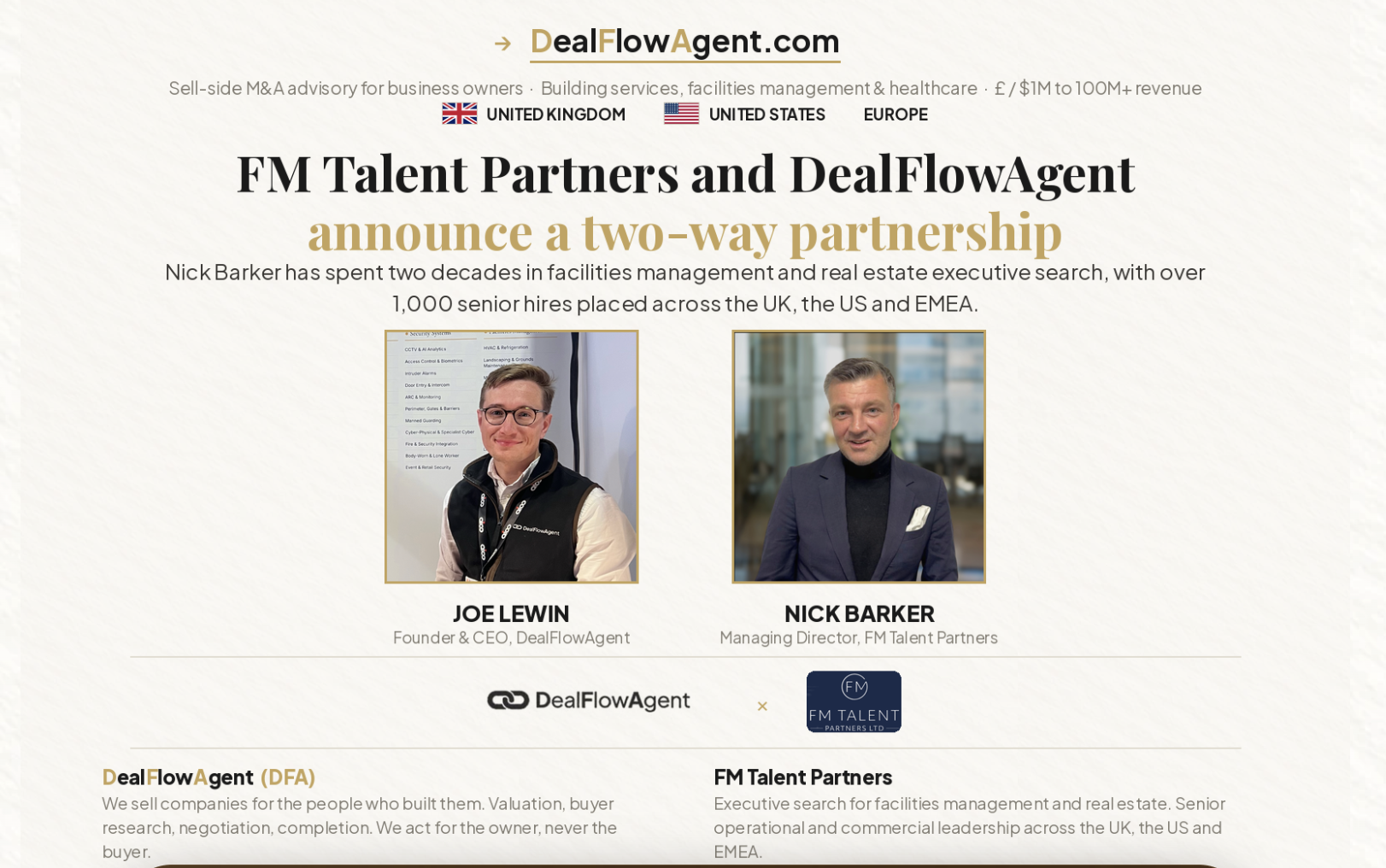
Nick leads FM Talent Partners, the facilities management and real estate leadership search firm, and is a leading specialist in building services and FM management talent. He partners with DealFlowAgent on two-way referrals: helping business owners and acquirers fill the key roles that decide whether a business is sellable, and introducing owners who are thinking about their next chapter to a team that knows their industry and their market. Key-person dependency is one of the two most common reasons a sale collapses, and Nick fixes it at source.
Nick leads FM Talent Partners, the facilities management and real estate leadership search firm, and is a leading specialist in building services and FM management talent. He partners with DealFlowAgent on two-way referrals: helping business owners and acquirers fill the key roles that decide whether a business is sellable, and introducing owners who are thinking about their next chapter to a team that knows their industry and their market. Key-person dependency is one of the two most common reasons a sale collapses, and Nick fixes it at source.

James Duboullay
Senior M&A Advisor
- •25+ years across investment banking, M&A and fundraising
- •Sector focus: essential services and software
- •Long-standing relationships with private equity buyers and growth funds
- •Personally advising DealFlowAgent founders for the past four years
- •25+ years across investment banking, M&A and fundraising
- •Sector focus: essential services and software
- •Long-standing relationships with private equity buyers and growth funds
- •Personally advising DealFlowAgent founders for the past four years

Emerson Patton
Sector Specialist: Building Services & Facilities Management
- •20+ years advising owners in building services, fire safety, HVAC, plumbing, and construction
- •Guided 200+ companies through growth, profit improvement, and exit planning
- •Builds equity value and operational structure long before a sale
- •Partners with DFA to prepare owners for exit while the advisory team runs the sale
- •20+ years advising owners in building services, fire safety, HVAC, plumbing, and construction
- •Guided 200+ companies through growth, profit improvement, and exit planning
- •Builds equity value and operational structure long before a sale
- •Partners with DFA to prepare owners for exit while the advisory team runs the sale

Kaya Kesici
M&A Advisor, Fire Safety, Security & Compliance
- •17 completed M&A transactions over the past six years across UK SME fire safety, security and compliance-led services
- •Sell-side and buy-side experience, buyer research, acquirer mapping, outreach and live process coordination
- •Information request lists, databook prep, IC-style summaries and EV-to-equity bridge work
- •Direct sector exposure across fire protection, security systems, CCTV, access control and intruder alarms
- •17 completed M&A transactions over the past six years across UK SME fire safety, security and compliance-led services
- •Sell-side and buy-side experience, buyer research, acquirer mapping, outreach and live process coordination
- •Information request lists, databook prep, IC-style summaries and EV-to-equity bridge work
- •Direct sector exposure across fire protection, security systems, CCTV, access control and intruder alarms
Previously

Ranger Fire & Security · Complete Building Services · Compliance Group

- •22 completed M&A transactions
- •Direct relationships with hundreds of strategic and financial acquirers
- •Previously built a mobility and field services business to 30 staff and 6 UK warehouses, then sold via competitive process with an EY M&A partner
- •Raised £2m in funding; placed 3rd of 1,900 at OnStage (the "Y Combinator of Europe")
- •Full-stack developer of advanced agent systems and second-brain tooling for the M&A process
- •22 completed M&A transactions
- •Direct relationships with hundreds of strategic and financial acquirers
- •Previously built a mobility and field services business to 30 staff and 6 UK warehouses, then sold via competitive process with an EY M&A partner
- •Raised £2m in funding; placed 3rd of 1,900 at OnStage (the "Y Combinator of Europe")
- •Full-stack developer of advanced agent systems and second-brain tooling for the M&A process
Sector Expert
Industry-Specific Advisor
For every engagement we add a sector specialist from your industry to the core team: a 15–25 year operator or advisor with direct relationships in your niche. Recruited per deal so you get the right fit, not a generalist.
For every engagement we add a sector specialist from your industry to the core team: a 15–25 year operator or advisor with direct relationships in your niche. Recruited per deal so you get the right fit, not a generalist.
The bench is growing. Two senior M&A hires confirmed for late July 2026, selected from 200+ applicants out of Goldman Sachs, Deutsche Bank, EY, KPMG and leading boutique M&A firms. See open roles →
The AI layer behind every advisor
Two in-house AI systems work alongside the human bench. They are software, not people, built and supervised by the advisory team.

Sage
AI Deal Concierge
Available 24/7. Monitors every signal in your deal and keeps the advisory team one step ahead. Trained on thousands of M&A transactions.

Sterling
Buy-Side Deal Origination Agent
Engages 13,000+ acquirers to surface live mandates and intent, then feeds your advisors with warm, ranked buyer matches.
The Exit Readiness Scorecard
Score your business across the factors acquirers underwrite, including key-person dependency, contract quality, customer concentration and earnings quality. Complete it below, print it, or download the PDF and work through it with your leadership team.
Watch the intro from our founder, Joe
Two minutes on how DealFlowAgent runs a confidential, competitive sale process for owners of building services, facilities management and healthcare businesses.
Security Systems M&A Specialists
Thinking of selling your security systems business?
DealFlowAgent is a leading specialist in niche building services, with dedicated M&A advisory and brokerage coverage for electronic security businesses across the UK and US. Our trusted advisors leverage industry knowledge, buyer relationships and proprietary technology to help business owners secure multiple acquisition offers at higher valuations.
Joe Lewin
Exited entrepreneur and M&A advisor who has guided 20+ business owners through successful exits. Joe built and sold his first company after scaling to 80,000+ users and raised over £2M in funding. He founded DealflowAgent to combine traditional M&A expertise with AI technology, creating aligned advisory solutions for SME business owners. Joe regularly speaks on exit planning and M&A trends, and has built a network of thousands of strategic acquirers across UK and US markets.
What is your business actually worth?
Sector by sector benchmarks built from real completed transactions, with the valuation bands acquirers underwrite against.
- Security Systems Business Valuation & EBITDA MultiplesCCTV, access control, intruder alarms and monitoring: the multiples acquirers are paying in 2026.
- Fire Safety Business Valuation & EBITDA MultiplesWhat fire alarm, extinguisher, sprinkler and passive fire protection businesses sell for, band by band.
- Compliance, Testing & Inspection Valuation GuideWhy recurring statutory inspection revenue attracts the highest multiples in building services.
- Electrical Contracting Valuation & EBITDA MultiplesNICEIC, EICR and EV infrastructure: how electrical contractors are valued and sold.
- HVAC, Refrigeration & Cooling Valuation GuideService contract density, engineer retention and the multiples HVAC consolidators pay.