Your Business Valuation Is Wrong. Here Is Why.
Most online valuation tools were built for startups raising capital. If you are a profitable business considering a sale, the number they give you is based on a completely different transaction.

What is your business worth today?
Enter your website and our M&A team will prepare a written valuation and exit optimisation report. No cost, no credit card, no obligation.
Strictly confidential
Strictly confidential. Your personalized report is prepared by our internal team alone — the founder, head of M&A and associates. It is never shown to buyers or anyone outside the deal team without your permission.
Already know your number?
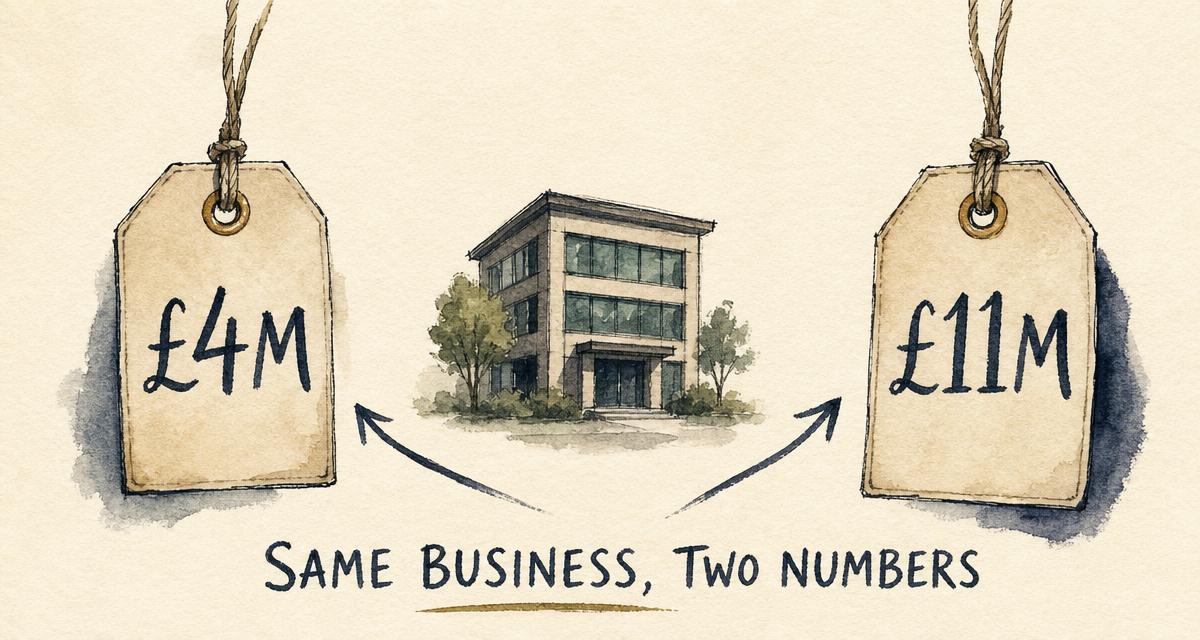
Most online valuation tools were built for startups raising capital. If you are a profitable business owner considering a sale, the number they give you is not just inaccurate. It is based on a completely different transaction.
There is a quiet epidemic among business owners considering an exit. They Google "business valuation," use one of the free tools that appear on the first page, receive a number, and then carry that number into every conversation they have about selling their business for the next two to five years.
The problem is that the number is almost always wrong. Not because the calculator made a mathematical error, but because it answered the wrong question entirely. For a full comparison of the tools available and what each one gets wrong, see our valuation calculator comparison.
Two Transactions That Look the Same But Are Not
When a startup raises a Series A round at a "£10 million valuation," what has actually happened is that an investor has paid, say, £2 million for a 20 per cent stake in the company. The founder still owns 80 per cent. The company still has the same revenue, the same team, and the same customers it had yesterday. Nobody has "bought" the business. An investor has bought a minority stake in its future potential.
When a building services company sells for "£10 million," what has happened is that a buyer has paid £10 million (in some combination of cash, deferred consideration, and earn-out) to acquire 100 per cent of the business, its contracts, its employees, its assets, its liabilities, and its future cash flows. The owner walks away. The buyer takes over.
These are fundamentally different transactions. The methodologies for pricing them are different. The multiples are different. The risk profiles are different. And yet the internet treats them as interchangeable. The British Private Equity & Venture Capital Association (BVCA) publishes separate guidance for each transaction type precisely because they require different analytical frameworks.
How Funding-Round Methodology Distorts Acquisition Values
Equidam, one of the most sophisticated free valuation tools available, uses five methods: the Scorecard Method, the Checklist Method, two variants of Discounted Cash Flow, and the Venture Capital Method. It has valued 160,000 companies and helped startups raise over $5 billion in funding.
The Venture Capital Method works backwards from an expected exit. It asks: "If this company exits in five years at a certain multiple of revenue, and the investor needs a 10x return on their money, what should the pre-money valuation be today?" This is a perfectly valid methodology for a venture capitalist deciding whether to invest. It is completely irrelevant for a business owner trying to understand what a trade buyer would pay for their company next year.
The Scorecard and Checklist methods were developed by angel investor networks (notably Bill Payne's Scorecard Method and the Berkus Method) to compare early-stage startups against each other. They assess factors like "strength of the management team" and "size of the opportunity" relative to a benchmark average. Again, valid for angel investing. Irrelevant for pricing a mature, profitable business with ten years of trading history.
The result is that a profitable £3 million revenue company entering its details into a funding-round calculator will often receive a valuation that is 30 to 100 per cent higher than what any buyer would actually pay in an acquisition. The calculator is not wrong. It is answering a different question: "What could you raise capital at?" rather than "What would someone pay to own this business outright?"
The Tiered Reality of Acquisition Multiples
In the real world of acquisitions, multiples are not a single number. They exist on a spectrum, and where your business sits on that spectrum depends on dozens of factors that no simple calculator can assess.
Consider EBITDA multiples for UK fire safety companies in 2026. A business with project-based revenue, high owner dependency, no accreditations beyond basic competence, and a single geographic market might trade at 3 to 4 times adjusted EBITDA. The same business with 80 per cent recurring revenue from maintenance contracts, BAFE SP203 certification, a management team that operates independently, and coverage across three regions might trade at 6 to 8 times.
The difference between 3.5x and 7x on £500,000 of adjusted EBITDA is the difference between £1.75 million and £3.5 million. That is not a rounding error. That is a life-changing amount of money. And the factors that determine where on the spectrum your business sits are precisely the factors that no sixty-second calculator can assess: contract quality, customer concentration, key-person risk, operational systems, accreditation depth, and competitive position.
The BDO Private Company Price Index tracks these multiples quarterly for UK mid-market transactions, and the Plimsoll Analysis provides sector-specific benchmarking for hundreds of UK industries.
Quality of Earnings: What Buyers Actually Pay For
The most sophisticated buyers in the lower mid-market do not pay a multiple of your reported profit. They pay a multiple of what they call "maintainable earnings" or "quality-adjusted EBITDA." This is your profit after a forensic examination of what is real, what is one-off, what is discretionary, and what would change under new ownership. The ICAEW's guidance on quality of earnings provides the professional framework for this analysis.
A financial due diligence team will:
Strip out the owner's above-market salary and replace it with the cost of a hired managing director. If you pay yourself £180,000 but the role would cost £95,000 to fill, that £85,000 difference is an add-back that increases your adjusted EBITDA.
Remove one-off costs that will not recur: the legal fees from a dispute that settled, the recruitment costs from a restructure that is now complete, the write-off of a bad debt from a customer who has since been replaced.
Remove related-party transactions: the rent you pay to your own property company above market rate, the consultancy fees to your spouse's company, the personal vehicle costs running through the business.
But they will also remove things that flatter your numbers: the revenue from a contract that is not renewing, the margin from a project that was mispriced and will not be repeated, the cost savings from a vacancy you have not yet filled.
The result is a number that is often different from your reported profit by 20 to 40 per cent in either direction. And it is this adjusted number that the multiple is applied to. A calculator that takes your reported profit and multiplies it by a generic industry average is ignoring the most important step in the entire valuation process.
The Cost of Two Chartered Accountants
Here is the uncomfortable truth that the free calculator market does not want you to think about. A proper valuation, the kind that would survive scrutiny from a buyer's due diligence team, traditionally requires:
A chartered accountant to prepare the adjusted EBITDA bridge, verify the add-backs, and produce a financial summary that a buyer can rely on. Cost: £5,000 to £15,000 depending on complexity. The ICAEW and ICAS both publish guidance on what a formal valuation engagement should include.
A corporate finance advisor to assess the qualitative factors (market position, customer quality, team depth, growth trajectory), identify the right buyer universe, and determine an appropriate multiple range. Cost: typically included in a success fee of 2 to 5 per cent of transaction value, but the upfront advisory work alone would cost £3,000 to £10,000 if billed hourly.
For a business worth £2 million to £5 million, spending £10,000 to £20,000 on professional valuation advice before you even decide whether to sell is a significant barrier. Many owners never do it. They rely on the free calculator, the unsolicited approach from a buyer, or the opinion of their regular accountant (who may have no M&A experience whatsoever).
This is the gap we built our valuation calculator to fill. Not to replace professional advice, but to give every business owner access to the same analytical framework that a corporate finance team would use, at no cost, in 15 minutes, with a report they can take to their accountant and say: "Is this right?" For a detailed side-by-side comparison of what our free report delivers versus a formal opinion, see our article on the 15-minute valuation vs the £15,000 valuation.
What an Acquisition-Focused Valuation Actually Looks Like
A valuation designed for a trade sale or private equity acquisition starts from a completely different set of assumptions than a funding-round valuation:
The buyer is paying for cash flows, not potential. A venture capitalist pays for what the business might become. An acquirer pays for what it demonstrably is, with a modest premium for near-term growth that can be evidenced.
The multiple reflects risk, not ambition. A higher multiple does not mean the business is "better." It means the buyer perceives lower risk in the future cash flows. Contracted revenue is lower risk than project revenue. A diversified customer base is lower risk than concentration. A management team is lower risk than owner dependency.
Deal structure matters as much as headline price. A £4 million valuation with £3 million in cash at completion and £1 million deferred over two years is a very different proposition from a £5 million valuation with £2 million in cash, £1.5 million in earn-out tied to revenue targets, and £1.5 million in equity roll-over. The second headline is higher, but the certain cash is lower. The Law Society's practice note on business acquisitions provides useful context on how deal structures work in England and Wales.
The valuation is not the price. The valuation is the starting point for a negotiation. The final price depends on competitive tension (how many buyers are at the table), the strategic value to the specific buyer (synergies, geographic expansion, capability acquisition), and the quality of the process (how well the business is presented, how efficiently diligence is managed, and how skilfully the negotiation is conducted).
A Better Way to Think About Your Number
If you are a business owner with £1 million to £30 million of revenue, operating in an essential services sector, and you are considering a sale in the next one to five years, here is what you actually need:
You need to know your adjusted EBITDA, not your reported profit. You need to understand which add-backs a buyer would accept and which they would reject. You need to know where your business sits on the multiple spectrum for your specific sub-niche, and what is pushing it up or pulling it down. You need to see three scenarios: what it is worth today, what it would be worth in twelve months with no changes, and what it could be worth in twelve months with targeted preparation.
And you need all of this presented in a format that a chartered accountant could scrutinise, that a buyer's due diligence team would recognise, and that you could use to make a genuinely informed decision.
That is what our valuation calculator produces. It takes 15 minutes. It is free. It is confidential. And it is designed exclusively for acquisitions, not funding rounds. You can also score your exit readiness across the twelve factors acquirers underwrite, or explore our sector-specific guides for HVAC, electrical contracting, security systems, and compliance testing.
DealFlowAgent is a specialist M&A advisory firm for owner-led businesses in building services, facilities management, healthcare, and professional services. We have completed 22 acquisitions and assessed hundreds more. Our valuation calculator is built on the same analytical framework our advisory team uses on live mandates. Book a confidential call or start your valuation now.
Experienced Dealmakers Lead Your Exit
A senior M&A bench, plus a sector specialist recruited for your industry on every deal.

Head of M&A
Joining 22 August 2026, name announcing soon
Joining full-time on 22 August 2026 from the largest M&A advisory firm in the UK, owned by K3 Capital. As an ex-Director he managed teams of M&A advisors, analysts and associates, working daily with business owners, buyers and stakeholders on live acquisition deals. Selected from 260 applicants alongside colleagues from investment banking backgrounds, he brings that experience and network to lead the advisory bench across Building Services, Facilities Management, and Healthcare.
Joining full-time on 22 August 2026 from the largest M&A advisory firm in the UK, owned by K3 Capital. As an ex-Director he managed teams of M&A advisors, analysts and associates, working daily with business owners, buyers and stakeholders on live acquisition deals. Selected from 260 applicants alongside colleagues from investment banking backgrounds, he brings that experience and network to lead the advisory bench across Building Services, Facilities Management, and Healthcare.

Martin is one of the most well-connected figures in UK fire, security, building services and FM. He is Chairman of both the Fire Industry Association and the British Security Industry Association, the only person in the UK to hold both roles simultaneously. Martin spent over a decade in senior leadership at Mitie, latterly as Industry Liaison Director for its fire and security division, helping scale the business past £500m in revenue and playing a role in the £366m acquisition of Marlowe plc, which created one of the UK's largest compliance, fire and security services groups. He joined DealFlowAgent because owners in these sectors deserve a genuine sector-specialist advisor across valuation, business optimisation and buyer access. In recognition of his industry roles, he acts in a personal, non-partisan capacity.
Martin is one of the most well-connected figures in UK fire, security, building services and FM. He is Chairman of both the Fire Industry Association and the British Security Industry Association, the only person in the UK to hold both roles simultaneously. Martin spent over a decade in senior leadership at Mitie, latterly as Industry Liaison Director for its fire and security division, helping scale the business past £500m in revenue and playing a role in the £366m acquisition of Marlowe plc, which created one of the UK's largest compliance, fire and security services groups. He joined DealFlowAgent because owners in these sectors deserve a genuine sector-specialist advisor across valuation, business optimisation and buyer access. In recognition of his industry roles, he acts in a personal, non-partisan capacity.

Nick leads FM Talent Partners, the facilities management and real estate leadership search firm, and is a leading specialist in building services and FM management talent. He partners with DealFlowAgent on two-way referrals: helping business owners and acquirers fill the key roles that decide whether a business is sellable, and introducing owners who are thinking about their next chapter to a team that knows their industry and their market. Key-person dependency is one of the two most common reasons a sale collapses, and Nick fixes it at source.
Nick leads FM Talent Partners, the facilities management and real estate leadership search firm, and is a leading specialist in building services and FM management talent. He partners with DealFlowAgent on two-way referrals: helping business owners and acquirers fill the key roles that decide whether a business is sellable, and introducing owners who are thinking about their next chapter to a team that knows their industry and their market. Key-person dependency is one of the two most common reasons a sale collapses, and Nick fixes it at source.

James Duboullay
Senior M&A Advisor
- •25+ years across investment banking, M&A and fundraising
- •Sector focus: essential services and software
- •Long-standing relationships with private equity buyers and growth funds
- •Personally advising DealFlowAgent founders for the past four years
- •25+ years across investment banking, M&A and fundraising
- •Sector focus: essential services and software
- •Long-standing relationships with private equity buyers and growth funds
- •Personally advising DealFlowAgent founders for the past four years

Emerson Patton
Sector Specialist: Building Services & Facilities Management
- •20+ years advising owners in building services, fire safety, HVAC, plumbing, and construction
- •Guided 200+ companies through growth, profit improvement, and exit planning
- •Builds equity value and operational structure long before a sale
- •Partners with DFA to prepare owners for exit while the advisory team runs the sale
- •20+ years advising owners in building services, fire safety, HVAC, plumbing, and construction
- •Guided 200+ companies through growth, profit improvement, and exit planning
- •Builds equity value and operational structure long before a sale
- •Partners with DFA to prepare owners for exit while the advisory team runs the sale

Kaya Kesici
M&A Advisor, Fire Safety, Security & Compliance
- •17 completed M&A transactions over the past six years across UK SME fire safety, security and compliance-led services
- •Sell-side and buy-side experience, buyer research, acquirer mapping, outreach and live process coordination
- •Information request lists, databook prep, IC-style summaries and EV-to-equity bridge work
- •Direct sector exposure across fire protection, security systems, CCTV, access control and intruder alarms
- •17 completed M&A transactions over the past six years across UK SME fire safety, security and compliance-led services
- •Sell-side and buy-side experience, buyer research, acquirer mapping, outreach and live process coordination
- •Information request lists, databook prep, IC-style summaries and EV-to-equity bridge work
- •Direct sector exposure across fire protection, security systems, CCTV, access control and intruder alarms
Previously


Ranger Fire & Security · Complete Building Services · Compliance Group

- •22 completed M&A transactions
- •Direct relationships with hundreds of strategic and financial acquirers
- •Previously built a mobility and field services business to 30 staff and 6 UK warehouses, then sold via competitive process with an EY M&A partner
- •Raised £2m in funding; placed 3rd of 1,900 at OnStage (the "Y Combinator of Europe")
- •Full-stack developer of advanced agent systems and second-brain tooling for the M&A process
- •22 completed M&A transactions
- •Direct relationships with hundreds of strategic and financial acquirers
- •Previously built a mobility and field services business to 30 staff and 6 UK warehouses, then sold via competitive process with an EY M&A partner
- •Raised £2m in funding; placed 3rd of 1,900 at OnStage (the "Y Combinator of Europe")
- •Full-stack developer of advanced agent systems and second-brain tooling for the M&A process
Sector Expert
Industry-Specific Advisor
For every engagement we add a sector specialist from your industry to the core team: a 15–25 year operator or advisor with direct relationships in your niche. Recruited per deal so you get the right fit, not a generalist.
For every engagement we add a sector specialist from your industry to the core team: a 15–25 year operator or advisor with direct relationships in your niche. Recruited per deal so you get the right fit, not a generalist.
The bench is growing. Two senior M&A hires confirmed for late July 2026, selected from 200+ applicants out of Goldman Sachs, Deutsche Bank, EY, KPMG and leading boutique M&A firms. See open roles →
The AI layer behind every advisor
Two in-house AI systems work alongside the human bench. They are software, not people, built and supervised by the advisory team.

Sage
AI Deal Concierge
Available 24/7. Monitors every signal in your deal and keeps the advisory team one step ahead. Trained on thousands of M&A transactions.

Sterling
Buy-Side Deal Origination Agent
Engages 13,000+ acquirers to surface live mandates and intent, then feeds your advisors with warm, ranked buyer matches.
The Exit Readiness Scorecard
Score your business across the factors acquirers underwrite, including key-person dependency, contract quality, customer concentration and earnings quality. Complete it below, print it, or download the PDF and work through it with your leadership team.
Watch the intro from our founder, Joe
Two minutes on how DealFlowAgent runs a confidential, competitive sale process for owners of building services, facilities management and healthcare businesses.
Joe Lewin
Exited entrepreneur and M&A advisor who has guided 20+ business owners through successful exits. Joe built and sold his first company after scaling to 80,000+ users and raised over £2M in funding. He founded DealflowAgent to combine traditional M&A expertise with AI technology, creating aligned advisory solutions for SME business owners. Joe regularly speaks on exit planning and M&A trends, and has built a network of thousands of strategic acquirers across UK and US markets.
What is your business actually worth?
Sector by sector benchmarks built from real completed transactions, with the valuation bands acquirers underwrite against.
- Fire Safety Business Valuation & EBITDA MultiplesWhat fire alarm, extinguisher, sprinkler and passive fire protection businesses sell for, band by band.
- Security Systems Business Valuation & EBITDA MultiplesCCTV, access control, intruder alarms and monitoring: the multiples acquirers are paying in 2026.
- Compliance, Testing & Inspection Valuation GuideWhy recurring statutory inspection revenue attracts the highest multiples in building services.
- Electrical Contracting Valuation & EBITDA MultiplesNICEIC, EICR and EV infrastructure: how electrical contractors are valued and sold.
- HVAC, Refrigeration & Cooling Valuation GuideService contract density, engineer retention and the multiples HVAC consolidators pay.