Complii's lift acquisitions: Ansor's compliance strategy
Four regional lift and escalator specialists joined Complii in 2026. We examine the acquisition strategy, management continuity and implications for independent owners.
London, UK. Analysis as at 31 October 2026. Between May and September 2026, Complii bought four independent lift and escalator businesses and turned them into a national division. The deals show how a private equity-backed compliance group values a statutory maintenance book, and what that means for independent lift owners watching from the outside.
The short answer
Complii, a UK building safety and compliance group backed by Ansor, acquired Classic Lifts (Scotland), The Escalator Company, White Lift Services and The General Lift Company between May and September 2026. Together they give its new Lifts and Escalators division coverage across Scotland, Yorkshire and the North of England, and London and the South East. Complii's stated aim is to offer national clients one compliance partner across water, air, fire, electrical, and lifts and escalators. No terms were disclosed on any of the four deals, and the announcements emphasised management continuity, with role changes at Classic Lifts and transition support from White Lift's founders. For owners, the signal is that contracted lift maintenance is now being bought as a strategic service line by multi-service compliance groups, as well as by specialist lift consolidators such as LDC-backed Pace Group.
Recent transactions
Announced in the 45 days to 31 October 2026.
| Target company |
Acquirer |
Primary investor |
Country |
Announced |
What was disclosed |
| GMS Services Limited |
Complii |
Ansor |
UK |
28 September 2026 |
Wigan-headquartered water hygiene, Legionella and mechanical services provider with a Midlands base. Joins Complii's Water division. Gemma Ollerton is Managing Director. Terms not disclosed. |
Complii's lifts division: the four deals
The table uses publication dates on Complii's own announcement pages, not completion dates. Earlier trade reports and the supplied timeline artwork show different dates for some deals. The reliable transaction sequence is May to September; the artwork's day-level labels should not be read as verified completion dates.
| Target company |
Base |
Founded |
Company announcement published |
Leadership after the deal |
| Classic Lifts (Scotland) |
Glasgow |
1998 |
22 May 2026 |
Former owner Dave McColl stays as Executive Director and supports the division's acquisition strategy. William Coleman becomes Managing Director. |
| The Escalator Company |
Rochester, Kent |
2002 |
15 May 2026 |
Kelly Barber continues as Managing Director. |
| White Lift Services |
Leeds |
1991 |
19 August 2026 |
Chris Gadsby leads day-to-day operations. Founders Phil and Carole White support the transition ahead of planned retirement. |
| The General Lift Company |
Swanley, Kent |
1986 |
13 September 2026 |
Managing Director Derek Powis remains actively involved, with operational and technical leadership unchanged. |
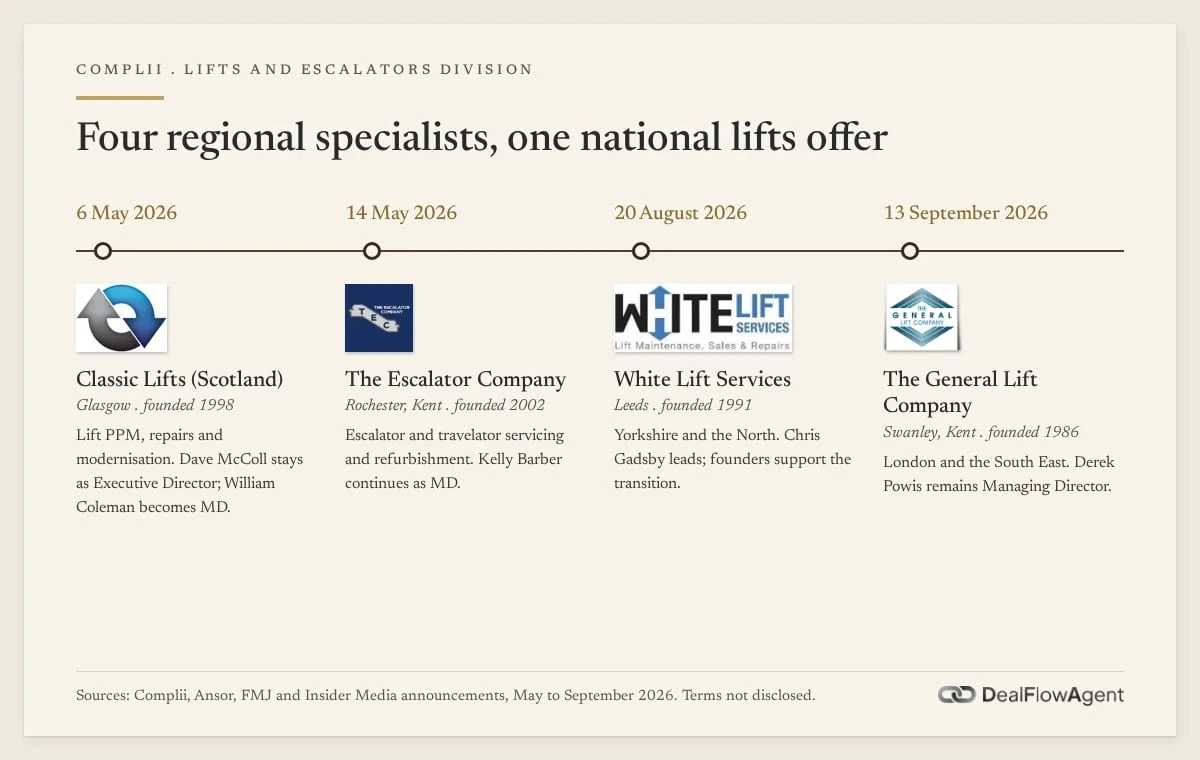
Strategic rationale: why Complii is consolidating lifts and escalators
Complii is a building safety and compliance group backed by Ansor. Its acquisitions combine specialist operators across complementary compliance services. The lift deals extend that model into maintenance, repairs, escalators and modernisation.
The commercial logic is cross-selling to large estates. Before May 2026, Complii covered water, air, fire and electrical compliance. Lifts are the fifth service a housing association, NHS trust, retailer or managed estate must keep compliant, and one that often sits with a separate specialist. Sarah Dixon described the ambition as "a comprehensive UK platform across all five of our divisions".
The clearest statement of the thesis came with a hire. On 24 September 2026, Complii appointed Dan Learmouth as Head of Sales for Lifts and Escalators, covering national and key accounts. The announcement describes national organisations seeking to streamline supply chains and consolidate compliance partners. The acquisitions build the coverage. The sales layer sells it as one contract.
Geography explains the targets: Scotland from Classic Lifts, Yorkshire and the North from White Lift, and London, Kent and the South East from General Lift and The Escalator Company. The Escalator Company also adds escalator and travelator expertise across all major manufacturers' equipment, which most lift independents lack.
Comparing buyer strategies
A lift specialist can assess overlap with its engineer routes and maintained units. A multi-service compliance group can also assess whether lift customers need complementary water, fire and electrical services. Those are different strategic questions, not disclosed pricing formulas. Owners should compare each buyer's actual integration plan and funding position rather than assuming all consolidators value the same asset identically.
Inside the acquired companies: legacy, operations and management continuity
Classic Lifts (Scotland), Glasgow. Operating since 1998, Classic Lifts provides planned preventative maintenance, reactive repairs, emergency call-outs, modernisation and installation. It launched Complii's lifts division. Former owner Dave McColl became Executive Director with a remit to support further lift acquisitions, and former Operations Director William Coleman became Managing Director.
The Escalator Company, Rochester. Founded in 2002 as a Barber family business, it services, maintains, refurbishes and installs escalators and travelators, with a stated preference for refurbishment over replacement. The acquisition announcement describes the benefit of greater resources and reach, while Kelly Barber continues as Managing Director.
White Lift Services, Leeds. Founded in 1991 by Phil and Carole White, it covers Yorkshire and the North with 24-hour support for passenger lifts, goods lifts, food hoists and stair lifts, and holds LEIA membership and SafeContractor accreditation. Managing Director Chris Gadsby said customers keep "the same team and the same care". The announcement says the founders will return to support the transition ahead of retirement.
The General Lift Company, Swanley. Established in 1986, it serves commercial and public sector clients across London and the South East. Derek Powis framed the deal as access to "greater scale, resources and support".
The announcements stress continuity for customers and staff, while describing changes to leadership roles and transition arrangements. In a trade short of qualified lift engineers, the team is a large part of what is being bought.
Joe Lewin covered Complii's lift deals on LinkedIn.
View the original post on LinkedIn
What consolidators are pricing in lift maintenance books
The regulation that makes the revenue recurring
Under regulation 9 of the Lifting Operations and Lifting Equipment Regulations 1998 (LOLER), lifting equipment for lifting people must be thoroughly examined at least every six months, or in line with a written examination scheme. The examination is carried out by a competent person, frequently an engineering inspector working for the building owner's insurer, and the defects it records have to be put right. The Provision and Use of Work Equipment Regulations 1998 (PUWER) add a duty to keep work equipment maintained in an efficient state and in good repair.
The maintenance contractor sits between those two duties. It delivers the planned visits that keep the lift safe and the remedial work that each examination report generates. That is why buyers treat a contracted lift portfolio as close to an annuity. A building owner cannot stop maintaining a passenger lift without taking it out of service.
How buyers weigh each revenue stream
In order of preference: contracted maintenance (multi-year agreements, ideally comprehensive, with price review), billable repairs generated by the portfolio, modernisation (where the incumbent maintainer is best placed), and new installation, valued mainly for converting into maintenance contracts.
What earns a premium and what costs you at due diligence
| Earns a premium |
Costs you at due diligence |
| Written contracts with clear terms, renewal dates and price review clauses |
Rolling or verbal arrangements nobody can evidence |
| A high share of revenue from contracted maintenance |
Revenue dominated by one-off installation projects |
| A spread of clients, without material dependence on one customer |
One housing provider or framework carrying the business |
| Engineers who can work across manufacturers' controllers |
Heavy reliance on one or two senior engineers |
| A manager who runs the business day to day |
An owner who prices every job and holds every client relationship |
| Dense routes, a clear unit register and complete examination records |
Scattered units and gaps in records |
Where valuations sit
None of Complii's four deals disclosed a price. There is therefore no verified transaction multiple to attribute to them. Our lift and elevator valuation guide explains the assessment framework, but indicative guide ranges are not evidence of the prices paid in these acquisitions.
Two businesses with the same profit can attract different offers because of contract renewal, route density, customer concentration and management dependence. Enterprise value must also be distinguished from equity proceeds, which depend on cash, debt, working capital and the offer structure.
Common deal structures and management continuity
None of the four announcements disclosed how consideration was paid. Offers in this sector typically combine cash at completion with deferred payments, an earn-out or reinvestment into the buyer's group. That balance decides much of an owner's real outcome, and it improves with competition between buyers.
The announcements do show how buyers handle people. Founders who wanted to step back, such as the Whites, supported a transition. A founder who wanted to stay, such as Dave McColl, took a group role. For owners who weigh legacy and team welfare alongside price, these are questions to put to every buyer.
What competing lift owners should do now
1. Build a contract register you could hand to a buyer. List every maintained unit with its site, contract type, term, renewal date, notice period and price review clause, and put rolling or verbal arrangements into writing. It is a core document for lift acquisition due diligence.
2. Normalise your EBITDA before a buyer does it for you. Separate genuine one-off costs, owner salary adjustments and personal expenses from trading profit, with evidence for each. Our note on recurring revenue and normalised EBITDA explains why an unproven add-back costs several times its value.
3. Benchmark against what consolidators are asking for. Compare your unit density, contracted share, client concentration and management depth against current acquirer requirements for lift and elevator service businesses. Then get an objective view of where you sit today with a free business valuation report. If you are two or three years from stepping back, our guide to exit planning sets out what to work on first.
The practical outcome for an owner
The useful outcome is not a higher headline multiple in isolation. It is a clearer choice of buyer, a documented transition plan for the team and a defensible view of cash proceeds. A lift specialist may offer route overlap and technical depth; a multi-service compliance group may offer wider customer access. Neither model guarantees a better outcome. Ask how each would retain managers, maintain service standards and fund modernisation after completion.
Our integrated M&A deal team connects advisory, legal and tax considerations. The business exit planning process sets out how readiness work can be sequenced before a formal sale.
Related recent acquisitions in lifts and adjacent compliance sectors
- Complii in water hygiene: GMS Services in Wigan (September 2026). See our water hygiene and Legionella page.
- PTSG in fire doors and water treatment: IDSL Group in August and Neptune Compliance, Tamworth, on 1 October 2026. Read our PTSG analysis.
- Independent lift owners: see the wider acquisition and preparation context on our lift maintenance page.
Frequently asked questions
Who owns Complii?
Complii is backed by Ansor. Sarah Dixon is identified as chief executive in the acquisition announcements reviewed.
How many acquisitions has Complii made?
This article reviews four named lift and escalator businesses added between May and September 2026. It is not an exhaustive count of all Complii acquisitions.
What do lift maintenance businesses sell for in 2026?
The prices of the four Complii acquisitions were not disclosed. A defensible valuation needs normalised earnings, contract evidence, route density and management depth. Our lift and elevator valuation guide explains these drivers; it should not be read as a disclosure of Complii's deal prices.
What happens to my staff if I sell to a consolidator?
In a share sale, employees stay employed by the same company, so their contracts continue unchanged. In an asset sale, the Transfer of Undertakings (Protection of Employment) Regulations 2006 (TUPE) usually transfer staff to the buyer on their existing terms. In all four Complii lift deals, existing leadership stayed in place. Qualified lift engineers are scarce, so most buyers treat retaining the team as a priority.
Should I wait for a consolidator to approach me?
An approach shows one buyer is interested. It does not show what others would pay. Lift specialists and multi-service groups value the same business differently, so comparing several buyers in a controlled process usually improves price, structure and fit.
How can I assess my lift business valuation confidentially?
Start with a free business valuation report. Signing up never broadcasts a business. The report is free, confidential and reviewed by a Partner before delivery, with no obligation to appoint us. Requesting it does not start buyer outreach. Acquirer introductions require a mandate and the owner's approval.
Sources
- Complii, Classic Lifts (Scotland) acquisition announcement, published 22 May 2026
- Complii, The Escalator Company acquisition announcement, published 15 May 2026
- Complii, White Lift Services announcement, published 19 August 2026
- Complii, General Lift Company announcement, published 13 September 2026
- Complii, Dan Learmouth appointment, 24 September 2026
- Complii, GMS Services acquisition, 28 September 2026
- LOLER 1998, regulation 9
- HSE, LOLER guidance
- PUWER 1998, regulation 5
Analysis compiled from public announcements and regulatory guidance checked on 31 October 2026. These are third-party transactions, not deals advised by DealFlowAgent. No transaction price or EBITDA multiple is inferred.
Get Your Free Valuation Report · More insights