
Lower Middle Market M&A: Why £5M-£50M Businesses Are Commanding Record Valuations
Lower middle market businesses (£5M-£50M) command record valuations and unprecedented buyer interest in 2025. Perfect exit timing.

Serving business owners across the United Kingdom and United States

Lower Middle Market M&A: Why £5M-£50M Businesses Are Commanding Record Valuations
The lower middle market (LMM) has emerged as the most dynamic segment of the M&A landscape in 2025, with businesses valued between £5M and £50M enterprise value commanding record valuations and unprecedented buyer interest. This market segment offers unique advantages that are driving exceptional outcomes for well-positioned sellers.
The Lower Middle Market Advantage
Lower middle market businesses occupy a strategic sweet spot in the M&A ecosystem, offering growth potential and operational improvement opportunities with significantly less competition than large-cap transactions. Connection Capital's detailed analysis demonstrates that companies owned by specialist mid-market funds exhibit significantly higher EBITDA compound annual growth rates.
This performance advantage stems from the ability to implement operational improvements, pursue strategic acquisitions, and optimize capital structures in businesses that are large enough to support professional management but small enough to achieve meaningful impact from strategic initiatives.
DealFlowAgent's comprehensive platform specializes in the lower middle market, providing business owners with access to the most active and sophisticated buyers in this dynamic segment.
Valuation Multiples and Market Dynamics
Current lower middle market valuations reflect the intense competition among buyers and favorable market conditions. Windsor Drake's comprehensive sector analysis shows median EBITDA multiples holding at 6.2x, with technology companies achieving 7.8x and healthcare businesses reaching 6.5x multiples.
These multiples represent significant premiums compared to historical averages, driven by private equity deployment pressure, strategic buyer activity, and favorable financing conditions. Recurring revenue models command additional premiums of 1.5-2.0x due to predictability and customer retention characteristics.
DealFlowAgent's valuation technology provides real-time market analysis and comparable transaction data to help business owners understand their potential valuations in the current market environment.
Private Equity's Lower Middle Market Focus
Private equity firms have intensified their focus on the lower middle market for several strategic reasons. The segment offers better growth prospects, operational improvement opportunities, and less competition compared to large-cap deals. Baird's comprehensive market analysis shows that LMM businesses are attracting premium valuations due to less debt reliance and stronger fundamentals.
The lower middle market enables private equity firms to implement their operational expertise more effectively, pursue strategic add-on acquisitions, and achieve meaningful impact on business performance. This dynamic creates exceptional opportunities for business owners who position their companies correctly for private equity acquisition.
DealFlowAgent's buyer-matching technology connects business owners with the most relevant and aggressive private equity buyers in the lower middle market segment.
Strategic Buyer Interest and Consolidation Trends
Strategic buyers are increasingly active in the lower middle market, pursuing consolidation strategies and geographic expansion opportunities. Boxwood Partners' market insights highlight that quality LMM businesses are commanding strong valuations, with key drivers including supply chain resilience, consistent profitability, and diversified customer bases.
Strategic acquisitions in the lower middle market often involve industry consolidation, where larger companies acquire smaller competitors to achieve market share, operational synergies, and geographic expansion. These transactions frequently command premium valuations due to synergistic benefits.
Understanding strategic buyer motivations and positioning businesses to maximize synergistic value is crucial for optimal exit outcomes. DealFlowAgent's market intelligence provides detailed analysis of strategic buyer activity and acquisition criteria.
Financing Dynamics and Deal Structure
Lower middle market transactions benefit from diverse financing options and favorable lending conditions. Viking Mergers' 2025 outlook identifies declining interest rates as making financing more affordable, while private equity firms maintain over £500 billion in global dry powder.
The financing landscape for LMM transactions includes traditional bank debt, mezzanine financing, seller financing, and equity contributions. This diversity enables creative deal structures that optimize outcomes for both buyers and sellers.
DealFlowAgent's exit planning services help business owners understand financing dynamics and structure transactions optimally to maximize total consideration and minimize risk.
The Silver Tsunami Impact
The demographic shift of baby boomer business owners reaching retirement age is creating unprecedented opportunities in the lower middle market. This "silver tsunami" is driving increased deal flow and competitive dynamics that benefit sellers.
Independent Investment Bankers Corp.'s analysis shows a wave of family and founder-owned businesses coming to market in 2025-2026, creating both opportunities and challenges for buyers and sellers.
The key for business owners is timing their exits strategically to capitalize on favorable market conditions while avoiding potential market saturation from increased supply.
Operational Excellence and Value Creation
Lower middle market buyers focus intensely on operational excellence and value creation opportunities. Businesses with documented processes, strong management teams, and scalable operations command premium valuations and attract more sophisticated buyers.
Development Corporate's due diligence analysis emphasizes that financial record analysis is crucial for assessing business health and risks, while legal and regulatory compliance review identifies potential liabilities.
Preparing businesses for sophisticated due diligence and positioning operational strengths effectively is crucial for successful lower middle market transactions. Professional guidance ensures optimal preparation and presentation.
Technology Integration and Digital Transformation
Technology integration and digital transformation increasingly influence lower middle market valuations. Buyers value businesses with modern technology infrastructure, data analytics capabilities, and digital customer engagement platforms.
DealFlowAgent's intelligence-led platform represents the future of M&A advisory in the lower middle market, combining artificial intelligence with human expertise to optimize transaction outcomes and deliver superior results.
The integration of technology in business operations, customer management, and financial reporting significantly enhances buyer appeal and valuation multiples in the current market environment.
Geographic and Industry Considerations
Lower middle market dynamics vary significantly across geographic regions and industry sectors. Understanding local market conditions, buyer preferences, and regulatory environments is crucial for optimal positioning and execution.
Certain industries within the lower middle market are experiencing exceptional buyer interest and valuation premiums. Healthcare services, technology businesses, and industrial companies with recurring revenue models are particularly attractive to buyers.
DealFlowAgent's comprehensive market coverage provides access to buyers across all geographic regions and industry sectors, ensuring optimal market coverage and competitive dynamics.
Risk Factors and Mitigation Strategies
Lower middle market transactions involve specific risk factors that require careful consideration and mitigation strategies. Common risks include customer concentration, key person dependency, and market volatility.
Effective risk mitigation involves diversification strategies, succession planning, and operational documentation. Professional guidance ensures comprehensive risk assessment and mitigation strategies that enhance buyer confidence and valuation outcomes.
Market Timing and Strategic Considerations
Current market conditions create exceptional opportunities for lower middle market exits, but timing remains crucial. The convergence of private equity deployment pressure, strategic buyer activity, and favorable financing conditions creates a window that may not persist indefinitely.
Understanding market cycles, buyer behavior, and optimal timing for market engagement is crucial for maximizing exit outcomes. Professional analysis and strategic guidance ensure optimal timing and positioning.
Future Outlook and Strategic Implications
The lower middle market outlook remains positive through 2025 and into 2026, supported by continued buyer interest, favorable financing conditions, and demographic trends. However, increased deal flow from the silver tsunami may create more competitive dynamics for sellers.
The key is positioning businesses strategically to stand out in an increasingly competitive market while capitalizing on current favorable conditions. DealFlowAgent's comprehensive platform provides the strategic guidance and execution capabilities necessary for success.
Conclusion: Capitalizing on Lower Middle Market Opportunities
The lower middle market represents exceptional opportunities for business owners who understand current dynamics and position their companies strategically. Record valuations, intense buyer competition, and favorable financing conditions create optimal exit environments.
Success requires sophisticated market analysis, strategic positioning, and optimal execution. DealFlowAgent's specialized focus on the lower middle market provides the expertise, technology, and market access necessary to achieve optimal outcomes in this dynamic segment.
Frequently Asked Questions
Q1: What defines the lower middle market in M&A?
Answer: The lower middle market typically includes businesses with £5M to £50M enterprise value or £1M to £10M EBITDA. These businesses are large enough for institutional buyers but small enough for meaningful operational improvements and growth strategies.
Q2: Why are LMM businesses commanding record valuations in 2025?
Answer: Record valuations result from intense buyer competition, private equity deployment pressure, favorable financing conditions, and the strategic advantages of LMM businesses including growth potential and operational improvement opportunities.
Q3: What EBITDA multiples are typical for LMM transactions?
Answer: Median EBITDA multiples are holding at 6.2x, with technology companies achieving 7.8x and healthcare businesses reaching 6.5x. Recurring revenue models command additional premiums of 1.5-2.0x.
Q4: How does the "silver tsunami" affect LMM M&A?
Answer: The retirement of baby boomer business owners is creating increased deal flow and competitive dynamics. While this benefits current sellers through buyer competition, it may create market saturation in future years.
Q5: What makes a business attractive to LMM buyers?
Answer: Key attractors include recurring revenue, operational scalability, strong management teams, documented processes, diversified customer bases, and growth potential. Technology integration and digital capabilities are increasingly important.
References
- Connection Capital - Why is the mid-market attractive to private equity?
- Windsor Drake - Lower Middle Market Valuation Multiples 2025
- Baird - M&A Market Update: Strategic Insights from H1 2025
- Boxwood Partners - What Lower Middle Market Owners Need to Know
- Viking Mergers - 2025 M&A Outlook for the Lower Middle Market
Related reading
- All sector valuation guides: EBITDA multiples by niche
- Fire safety valuation guide
- HVAC valuation guide
- Maintenance contracts valuation guide
- Building services M&A
- Facilities management M&A
- Healthcare M&A
- Exit planning guide for owners
- Free valuation estimate
- See who is buying: free buyer list
- Book a confidential call
Sources
- Business Asset Disposal Relief, GOV.UK
- Capital Gains Tax, GOV.UK
- Bank of England Bank Rate
- ONS Business Demography, UK
Experienced Dealmakers Lead Your Exit
A senior M&A bench, plus a sector specialist recruited for your industry on every deal.

Head of M&A
Joining 22 August 2026, name announcing soon
Joining full-time on 22 August 2026 from the largest M&A advisory firm in the UK, owned by K3 Capital. As an ex-Director he managed teams of M&A advisors, analysts and associates, working daily with business owners, buyers and stakeholders on live acquisition deals. Selected from 260 applicants alongside colleagues from investment banking backgrounds, he brings that experience and network to lead the advisory bench across Building Services, Facilities Management, and Healthcare.
Joining full-time on 22 August 2026 from the largest M&A advisory firm in the UK, owned by K3 Capital. As an ex-Director he managed teams of M&A advisors, analysts and associates, working daily with business owners, buyers and stakeholders on live acquisition deals. Selected from 260 applicants alongside colleagues from investment banking backgrounds, he brings that experience and network to lead the advisory bench across Building Services, Facilities Management, and Healthcare.

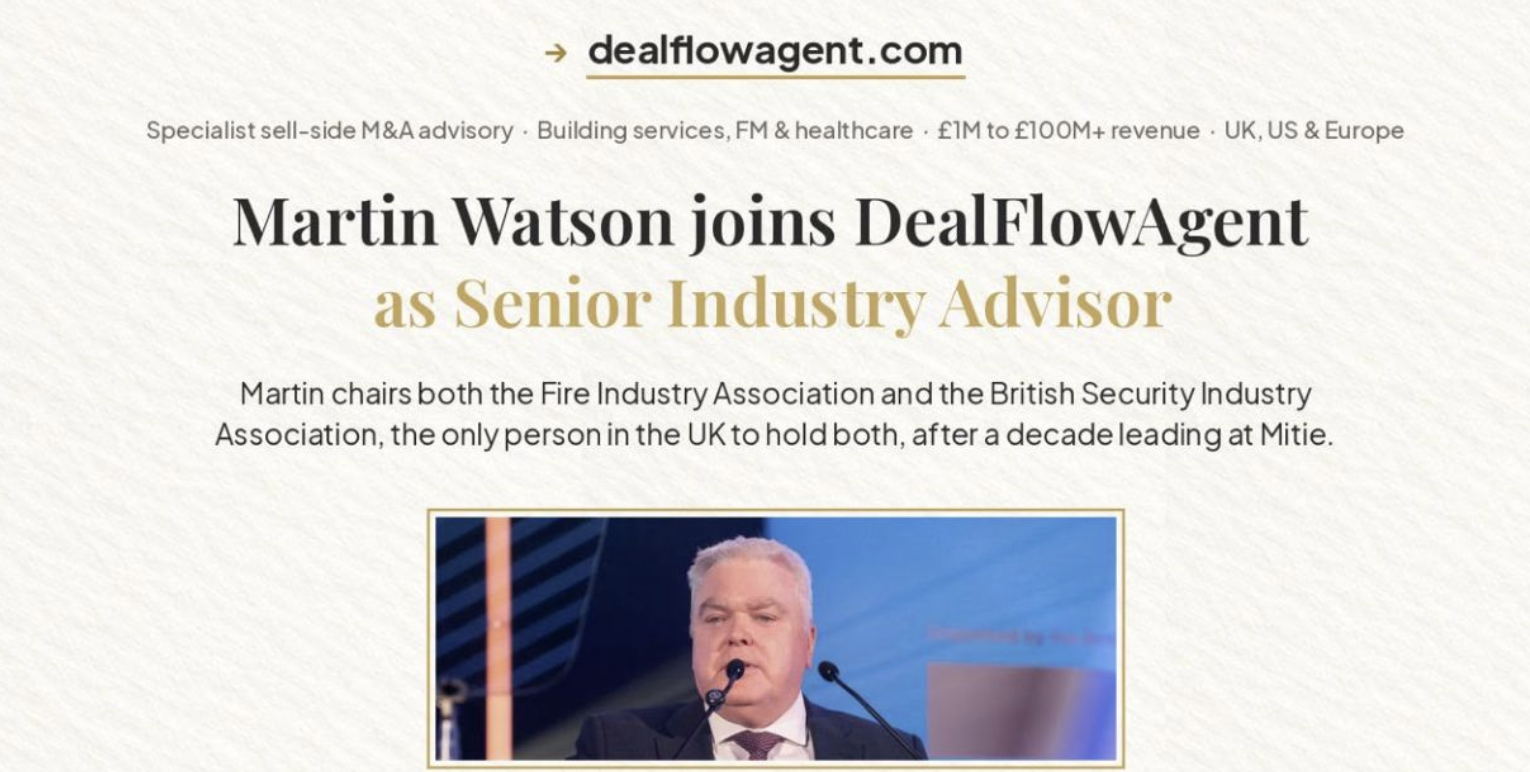
Martin is one of the most well-connected figures in UK fire, security, building services and FM. He is Chairman of both the Fire Industry Association and the British Security Industry Association, the only person in the UK to hold both roles simultaneously. Martin spent over a decade in senior leadership at Mitie, latterly as Industry Liaison Director for its fire and security division, helping scale the business past £500m in revenue and playing a role in the £366m acquisition of Marlowe plc, which created one of the UK's largest compliance, fire and security services groups. He joined DealFlowAgent because owners in these sectors deserve a genuine sector-specialist advisor across valuation, business optimisation and buyer access. In recognition of his industry roles, he acts in a personal, non-partisan capacity.
Martin is one of the most well-connected figures in UK fire, security, building services and FM. He is Chairman of both the Fire Industry Association and the British Security Industry Association, the only person in the UK to hold both roles simultaneously. Martin spent over a decade in senior leadership at Mitie, latterly as Industry Liaison Director for its fire and security division, helping scale the business past £500m in revenue and playing a role in the £366m acquisition of Marlowe plc, which created one of the UK's largest compliance, fire and security services groups. He joined DealFlowAgent because owners in these sectors deserve a genuine sector-specialist advisor across valuation, business optimisation and buyer access. In recognition of his industry roles, he acts in a personal, non-partisan capacity.

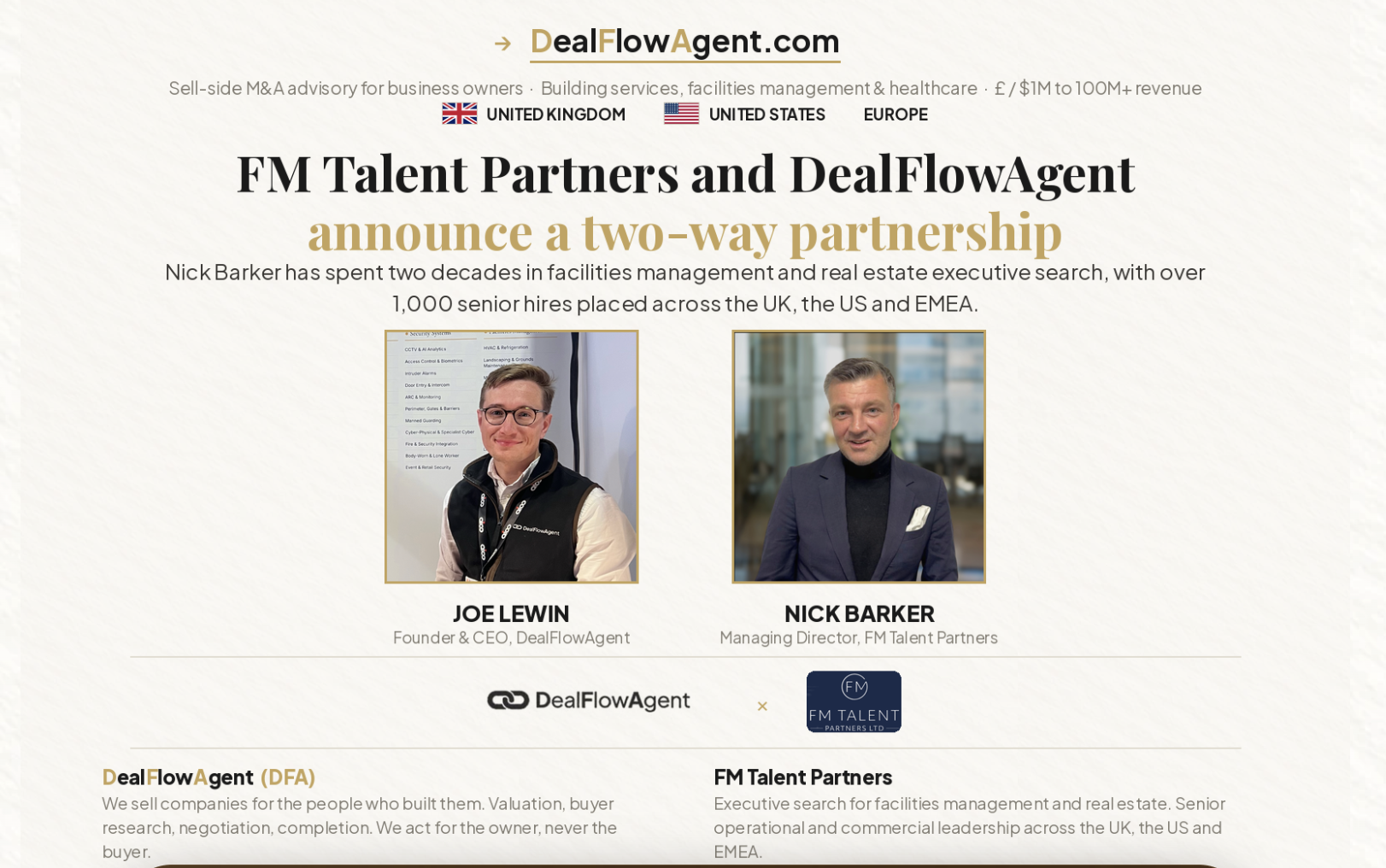
Nick leads FM Talent Partners, the facilities management and real estate leadership search firm, and is a leading specialist in building services and FM management talent. He partners with DealFlowAgent on two-way referrals: helping business owners and acquirers fill the key roles that decide whether a business is sellable, and introducing owners who are thinking about their next chapter to a team that knows their industry and their market. Key-person dependency is one of the two most common reasons a sale collapses, and Nick fixes it at source.
Nick leads FM Talent Partners, the facilities management and real estate leadership search firm, and is a leading specialist in building services and FM management talent. He partners with DealFlowAgent on two-way referrals: helping business owners and acquirers fill the key roles that decide whether a business is sellable, and introducing owners who are thinking about their next chapter to a team that knows their industry and their market. Key-person dependency is one of the two most common reasons a sale collapses, and Nick fixes it at source.

James Duboullay
Senior M&A Advisor
- •25+ years across investment banking, M&A and fundraising
- •Sector focus: essential services and software
- •Long-standing relationships with private equity buyers and growth funds
- •Personally advising DealFlowAgent founders for the past four years
- •25+ years across investment banking, M&A and fundraising
- •Sector focus: essential services and software
- •Long-standing relationships with private equity buyers and growth funds
- •Personally advising DealFlowAgent founders for the past four years

Emerson Patton
Sector Specialist: Building Services & Facilities Management
- •20+ years advising owners in building services, fire safety, HVAC, plumbing, and construction
- •Guided 200+ companies through growth, profit improvement, and exit planning
- •Builds equity value and operational structure long before a sale
- •Partners with DFA to prepare owners for exit while the advisory team runs the sale
- •20+ years advising owners in building services, fire safety, HVAC, plumbing, and construction
- •Guided 200+ companies through growth, profit improvement, and exit planning
- •Builds equity value and operational structure long before a sale
- •Partners with DFA to prepare owners for exit while the advisory team runs the sale

Kaya Kesici
M&A Advisor, Fire Safety, Security & Compliance
- •17 completed M&A transactions over the past six years across UK SME fire safety, security and compliance-led services
- •Sell-side and buy-side experience, buyer research, acquirer mapping, outreach and live process coordination
- •Information request lists, databook prep, IC-style summaries and EV-to-equity bridge work
- •Direct sector exposure across fire protection, security systems, CCTV, access control and intruder alarms
- •17 completed M&A transactions over the past six years across UK SME fire safety, security and compliance-led services
- •Sell-side and buy-side experience, buyer research, acquirer mapping, outreach and live process coordination
- •Information request lists, databook prep, IC-style summaries and EV-to-equity bridge work
- •Direct sector exposure across fire protection, security systems, CCTV, access control and intruder alarms
Previously


Ranger Fire & Security · Complete Building Services · Compliance Group

- •22 completed M&A transactions
- •Direct relationships with hundreds of strategic and financial acquirers
- •Previously built a mobility and field services business to 30 staff and 6 UK warehouses, then sold via competitive process with an EY M&A partner
- •Raised £2m in funding; placed 3rd of 1,900 at OnStage (the "Y Combinator of Europe")
- •Full-stack developer of advanced agent systems and second-brain tooling for the M&A process
- •22 completed M&A transactions
- •Direct relationships with hundreds of strategic and financial acquirers
- •Previously built a mobility and field services business to 30 staff and 6 UK warehouses, then sold via competitive process with an EY M&A partner
- •Raised £2m in funding; placed 3rd of 1,900 at OnStage (the "Y Combinator of Europe")
- •Full-stack developer of advanced agent systems and second-brain tooling for the M&A process
Sector Expert
Industry-Specific Advisor
For every engagement we add a sector specialist from your industry to the core team: a 15–25 year operator or advisor with direct relationships in your niche. Recruited per deal so you get the right fit, not a generalist.
For every engagement we add a sector specialist from your industry to the core team: a 15–25 year operator or advisor with direct relationships in your niche. Recruited per deal so you get the right fit, not a generalist.
The bench is growing. Two senior M&A hires confirmed for late July 2026, selected from 200+ applicants out of Goldman Sachs, Deutsche Bank, EY, KPMG and leading boutique M&A firms. See open roles →
The AI layer behind every advisor
Two in-house AI systems work alongside the human bench. They are software, not people, built and supervised by the advisory team.

Sage
AI Deal Concierge
Available 24/7. Monitors every signal in your deal and keeps the advisory team one step ahead. Trained on thousands of M&A transactions.

Sterling
Buy-Side Deal Origination Agent
Engages 13,000+ acquirers to surface live mandates and intent, then feeds your advisors with warm, ranked buyer matches.
The Exit Readiness Scorecard
Score your business across the factors acquirers underwrite, including key-person dependency, contract quality, customer concentration and earnings quality. Complete it below, print it, or download the PDF and work through it with your leadership team.
Watch the intro from our founder, Joe
Two minutes on how DealFlowAgent runs a confidential, competitive sale process for owners of building services, facilities management and healthcare businesses.
Joe Lewin
Exited entrepreneur and M&A advisor who has guided 20+ business owners through successful exits. Joe built and sold his first company after scaling to 80,000+ users and raised over £2M in funding. He founded DealflowAgent to combine traditional M&A expertise with AI technology, creating aligned advisory solutions for SME business owners. Joe regularly speaks on exit planning and M&A trends, and has built a network of thousands of strategic acquirers across UK and US markets.
What is your business actually worth?
Sector by sector benchmarks built from real completed transactions, with the valuation bands acquirers underwrite against.
- Fire Safety Business Valuation & EBITDA MultiplesWhat fire alarm, extinguisher, sprinkler and passive fire protection businesses sell for, band by band.
- Security Systems Business Valuation & EBITDA MultiplesCCTV, access control, intruder alarms and monitoring: the multiples acquirers are paying in 2026.
- Compliance, Testing & Inspection Valuation GuideWhy recurring statutory inspection revenue attracts the highest multiples in building services.
- Electrical Contracting Valuation & EBITDA MultiplesNICEIC, EICR and EV infrastructure: how electrical contractors are valued and sold.
- HVAC, Refrigeration & Cooling Valuation GuideService contract density, engineer retention and the multiples HVAC consolidators pay.