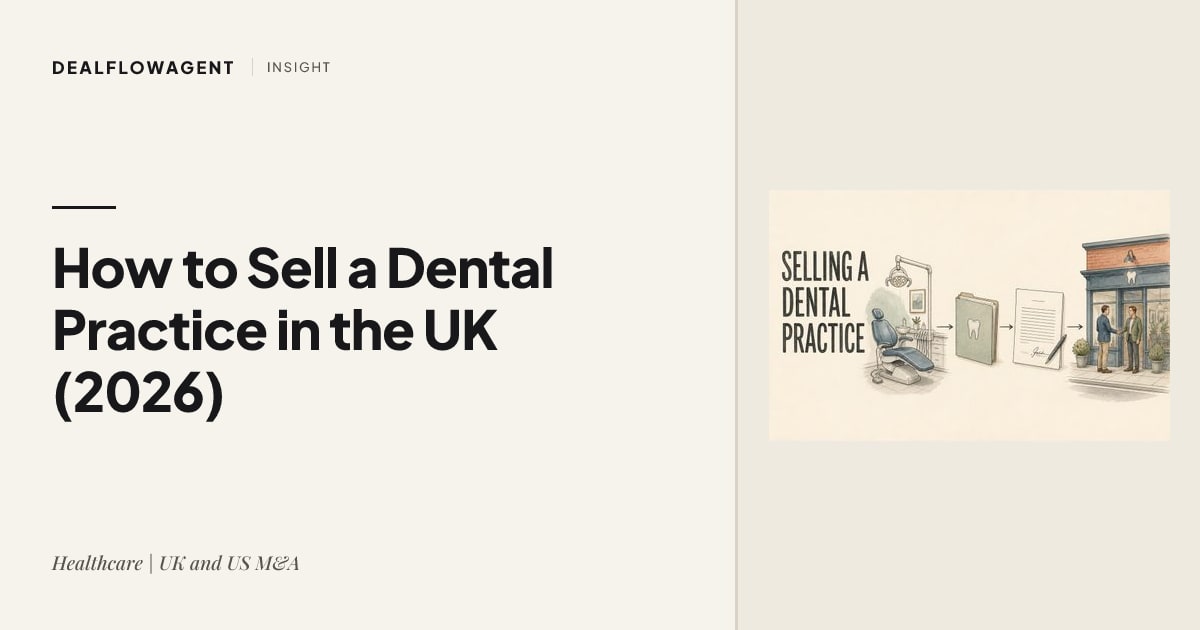
How to Sell a Dental Practice in the UK (2026)
The definitive 2025 guide for UK dentists on valuing and selling a practice. Learn about NHS vs private valuations and CQC compliance.

DealFlowAgent is a leading specialist in niche healthcare, with dedicated M&A advisory and brokerage coverage for dental practice businesses across the UK and US. We help owners secure multiple acquisition offers at higher valuations.
Sell your dental practices businessServing business owners across the United Kingdom and United States
The UK dental market is one of the most active and sophisticated M&A arenas in the healthcare sector. A combination of factors, including an aging population of dentists nearing retirement, the rise of corporate dental groups, and significant private equity investment, has created a robust seller’s market. For dental practice owners, this presents a prime opportunity to realize the value of their life's work.
However, selling a dental practice in 2026 is a complex undertaking. Buyers are more discerning than ever, and a successful, premium-value exit requires a deep understanding of valuation nuances, rigorous regulatory compliance, and a strategic approach to the market. This guide provides a definitive roadmap for UK dentists on how to value and sell their practice, navigate the critical role of the Care Quality Commission (CQC), and leverage technology to maximize their exit value.
Valuing a UK Dental Practice: NHS vs. Private
The valuation of a dental practice is not a one-size-fits-all calculation. The methodology and resulting multiples are heavily influenced by the practice’s revenue mix, specifically the split between NHS and private income. Buyers perceive the risks and opportunities associated with each stream differently.
| Practice Type | Key Valuation Driver | Typical EBITDA Multiple | Key Considerations |
|---|---|---|---|
| Mainly NHS | Value and stability of the GDS/PDS contract. | 5.0x - 8.0x | UDA rate, performer availability, local NHS demand, contract term. |
| Mixed Income | Balance of recurring NHS income and high-margin private treatments. | 6.0x - 9.0x | Percentage of private revenue, scope for private growth, patient demographics. |
| Fully Private | Brand reputation, fee structure, and profitability of specialist treatments. | 7.0x - 10.0x+ | Location, patient loyalty, associate stability, marketing effectiveness. |
While historically the stability of an NHS contract was seen as the gold standard, the market has evolved. Today, buyers often pay the highest multiples for well-run mixed and private practices that demonstrate significant potential for growth in high-margin cosmetic and specialist treatments [1].
The CQC: Your Most Important Due Diligence Hurdle
In the context of a dental practice sale, the Care Quality Commission (CQC) is arguably the most critical factor. A clean, well-documented CQC compliance record is essential for a smooth transaction. Any significant compliance failures discovered during due diligence can lead to a reduction in the offer price, delays, or even the collapse of the deal.
Buyers and their lenders will scrutinize your CQC reports and internal compliance documentation. They are looking for evidence of a well-led, safe, and effective practice. Before going to market, it is imperative to conduct a mock CQC inspection and address any potential shortcomings. This proactive approach demonstrates quality management and de-risks the transaction for the buyer.
A Step-by-Step Guide to Preparing Your Dental Practice for Sale
Strategic preparation is the key to unlocking the maximum value of your practice. The process should begin at least 12-24 months before your planned exit.
Step 1: Analyze and Optimize Your Profitability
Review your profit and loss statements line by line. Are your lab fees competitive? Are you maximizing your use of tax-efficient schemes? This is also the time to ensure your associate and hygienist agreements are structured correctly and that you are accurately tracking the profitability of different treatment types.
Step 2: Solidify Your Team and Operations
A practice that is dependent on the principal dentist is less valuable. Empower your practice manager and ensure your associate dentists are on secure, long-term contracts. Document all your clinical and administrative processes to demonstrate that the practice can operate efficiently without your daily involvement.
Step 3: Enhance Your Practice’s “Kerb Appeal”
First impressions matter. Invest in modernizing your practice, from the reception area to the clinical equipment. A well-presented, modern practice not only attracts more patients but also signals to buyers that the business has been well-maintained and requires minimal near-term capital expenditure.
Step 4: Obtain a Formal, Evidence-Based Valuation
Do not guess your practice’s value. Engage an M&A advisor who specializes in the dental sector. They will perform a detailed valuation based on your financial performance, revenue mix, CQC status, and current market comparables. This provides a credible, defensible basis for negotiations.
Leveraging AI to Achieve a Premium Exit
The traditional method of selling a dental practice often relies on a limited network of known buyers. This can leave significant money on the table. Modern, AI-driven platforms like DealFlowAgent are transforming this process.
Our technology analyzes a global database of thousands of potential acquirers, including corporate groups, private equity funds, and high-net-worth individuals. We use AI to match your practice with buyers whose strategic criteria it perfectly fits - buyers who will see the unique value in your location, patient demographics, or potential for specialist growth, and who are therefore willing to pay a premium price.
Meet the DealFlowAgent Team
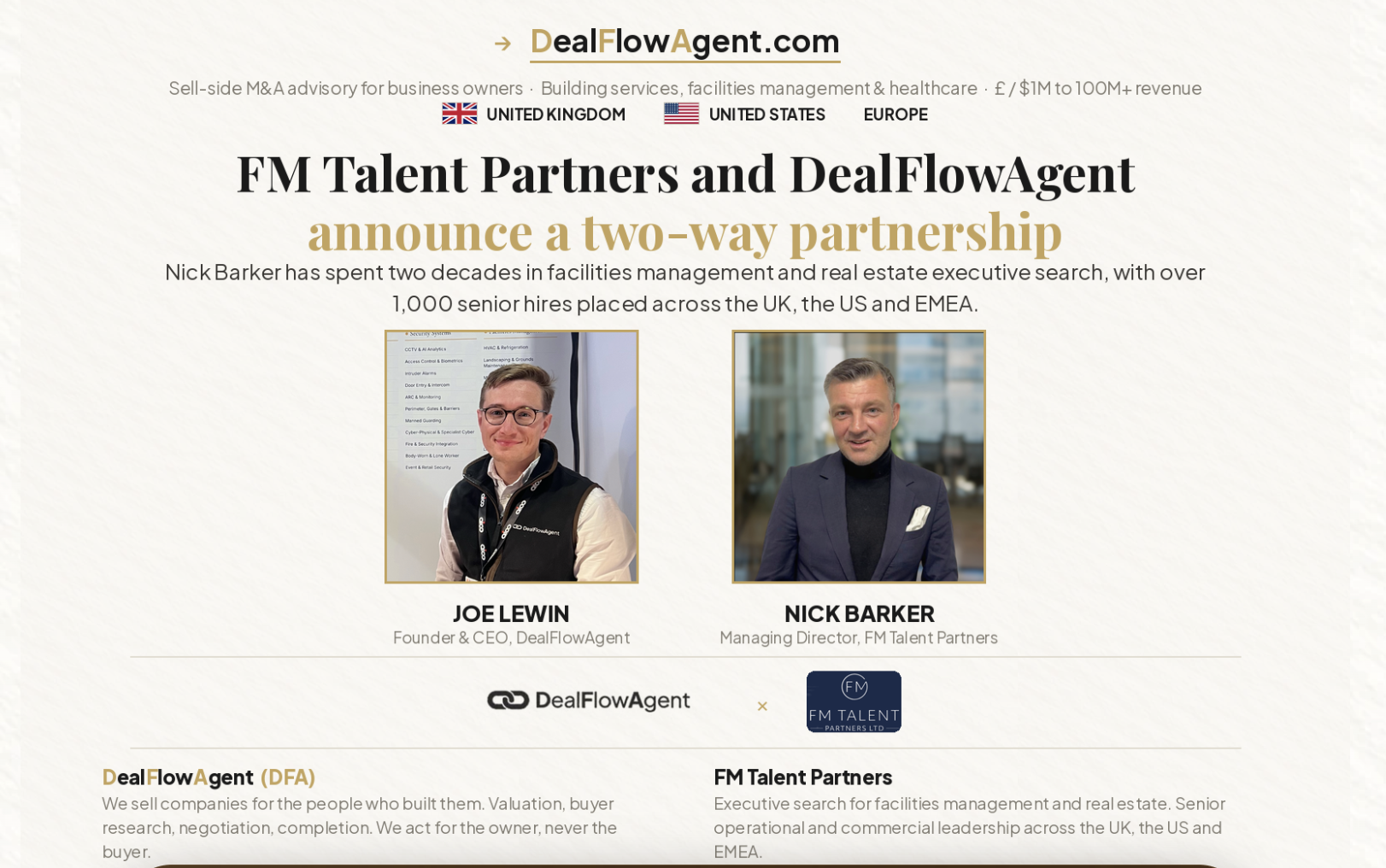
Joe Lewin, Founder & Lead Advisor Exited entrepreneur who has guided 20+ business owners through successful exits. Joe built and sold his first company after scaling to 80,000+ users and raised over £2M in funding. He founded DealFlowAgent to combine traditional M&A expertise with AI technology.
How We Work:
- Business Owners: Small success fee (lower than industry average). We only succeed when you do.
- M&A Advisors & Brokers: We partner with you - upload your sell-side mandates and we connect you to qualified buyers. We charge 20% of your success fee.
- Acquirers: Completely free. Register, speak to Sterling (our AI), and receive tailored deal flow.
Our Unique Advantage: Our proprietary conversational AI, Sterling, gathers intricate buyer insights through natural dialogue - exact search criteria, valuation preferences, deal structure requirements, green flags and red flags. This data enables precision matchmaking that traditional methods cannot achieve, helping business owners secure higher valuations with less stress.
Ready to Explore Your Exit Options?
If you're considering selling your business, DealFlowAgent can help you understand your options and connect with qualified buyers.
- Get a Free Buyer Match Report – See which buyers are actively looking for businesses like yours
- Book a Confidential Discovery Call – Speak with our M&A experts about your exit strategy
- Get your free valuation – Access our intelligence-led business valuation tools
Conclusion: A New Chapter for Your Practice
Selling your dental practice is a landmark event in your professional career. In a competitive 2026 market, achieving the best outcome requires more than just a history of profitability. It demands meticulous preparation, a deep understanding of value drivers, and a strategic approach to finding the right buyer. By focusing on compliance, optimizing your operations, and leveraging the power of technology, you can ensure your exit is both financially rewarding and a positive new chapter for the practice you have built.
Frequently Asked Questions
Q1: How is the value of my NHS contract calculated? The value is primarily based on the number of Units of Dental Activity (UDAs) and the value per UDA. However, buyers will also assess the risk of clawback and the ease of recruiting performers to service the contract.
Q2: What is the difference between goodwill and the asset value? Goodwill represents the intangible value of your practice, such as its brand, patient list, and reputation. The asset value relates to the tangible equipment, fixtures, and fittings. In most dental practice sales, goodwill is the largest component of the valuation.
Q3: Will I have to work in the practice after I sell it? Most buyers will require the principal to remain for a tie-in period of 1-3 years to ensure a smooth transition for patients and staff. The terms of this tie-in are a key point of negotiation.
Q4: How important is the location of my practice? Location is a major value driver, especially for private practices. Practices in affluent urban areas with good transport links and high footfall will typically command higher valuations.
Q5: What is an “associate-led” practice and why is it more valuable? An associate-led practice is one where the majority of the clinical work is performed by associate dentists rather than the principal. This is highly attractive to buyers as it demonstrates that the business is not dependent on the owner and is therefore more scalable.
Q6: Can I sell my practice if I have CQC compliance issues? It is very difficult. It is strongly recommended that you resolve any significant compliance issues before going to market. A poor CQC report is a major red flag for buyers.
Q7: What are corporate buyers looking for? Corporate buyers are looking for well-run, profitable practices with potential for growth. They are particularly interested in practices with multiple surgeries, a strong private revenue stream, and a stable team.
Q8: How does the sale of a limited company differ from a sole trader? The sale of a limited company is typically structured as a share sale, while a sole trader sells the assets and goodwill of the business. The tax implications are different for each, and you should seek specialist advice.
Q9: What information will I need for due diligence? You will need to provide comprehensive information on your financials (3 years), patient numbers, treatment mix, staff contracts, property lease, CQC reports, and all other operational and legal documentation.
Q10: Why should I use an M&A advisor instead of a traditional practice broker? A specialist M&A advisor provides a more strategic, data-driven service. They will conduct a deeper valuation, run a more competitive marketing process to a wider range of buyers, and have the expertise to negotiate the complex legal and financial aspects of the deal, ultimately achieving a higher value.
References
[1] “UK Dental M&A Report 2026.” Christie & Co. Accessed December 3, 2026.
Related reading
- Dental practice valuation guide: EBITDA multiples
- Dental practice M&A
- Healthcare M&A overview
- All sector valuation guides
- Exit planning guide for owners
- Free valuation estimate
- See who is buying: free buyer list
- Book a confidential call
Sources
The Exit Readiness Scorecard
Score your business across the factors acquirers underwrite, including key-person dependency, contract quality, customer concentration and earnings quality. Complete it below, print it, or download the PDF and work through it with your leadership team.
Watch the intro from our founder, Joe
Two minutes on how DealFlowAgent runs a confidential, competitive sale process for owners of building services, facilities management and healthcare businesses.
Dental Practices M&A Specialists
Thinking of selling your dental practices business?
DealFlowAgent is a leading specialist in niche healthcare, with dedicated M&A advisory and brokerage coverage for dental practice businesses across the UK and US. Our trusted advisors leverage industry knowledge, buyer relationships and proprietary technology to help business owners secure multiple acquisition offers at higher valuations.
Joe Lewin
Exited entrepreneur and M&A advisor who has guided 20+ business owners through successful exits. Joe built and sold his first company after scaling to 80,000+ users and raised over £2M in funding. He founded DealflowAgent to combine traditional M&A expertise with AI technology, creating aligned advisory solutions for SME business owners. Joe regularly speaks on exit planning and M&A trends, and has built a network of thousands of strategic acquirers across UK and US markets.
What is your business actually worth?
Sector by sector benchmarks built from real completed transactions, with the valuation bands acquirers underwrite against.
- Fire Safety Business Valuation & EBITDA MultiplesWhat fire alarm, extinguisher, sprinkler and passive fire protection businesses sell for, band by band.
- Security Systems Business Valuation & EBITDA MultiplesCCTV, access control, intruder alarms and monitoring: the multiples acquirers are paying in 2026.
- Compliance, Testing & Inspection Valuation GuideWhy recurring statutory inspection revenue attracts the highest multiples in building services.
- Electrical Contracting Valuation & EBITDA MultiplesNICEIC, EICR and EV infrastructure: how electrical contractors are valued and sold.
- HVAC, Refrigeration & Cooling Valuation GuideService contract density, engineer retention and the multiples HVAC consolidators pay.