
HVAC Recurring Revenue Valuation Guide UK 2026
How recurring revenue drives UK HVAC business valuations in 2026: EBITDA multiples by revenue type, the MSA premium, who is buying, and the levers owners can pull pre-sale to lift their multiple.

DealFlowAgent is a leading specialist in niche building services, with dedicated M&A advisory and brokerage coverage for HVAC businesses across the UK and US. We help owners secure multiple acquisition offers at higher valuations.
Sell your hvac businessWhat is your business worth today?
Enter your website and our M&A team will prepare a written valuation and exit optimisation report. No cost, no credit card, no obligation.
Strictly confidential
Strictly confidential. Your personalized report is prepared by our internal team alone, the founder, head of M&A and associates. It is never shown to buyers or anyone outside the deal team without your permission.
Already know your number?
Confidential, no cost
Considering selling your business?
Send a short message and we will come back to you within 24 hours.
Serving business owners across the United Kingdom and United States
If you own an HVAC business in the UK and have ever wondered why two companies of identical revenue can sell for radically different prices, the answer almost always comes back to one thing: the proportion of revenue that is genuinely recurring. In 2026, recurring revenue is no longer a "nice to have" - it is the single biggest lever a UK HVAC owner can pull to move their exit multiple from average to premium. If you are starting to think about an exit in the next 1 to 5 years, our HVAC M&A advisory page covers the structural drivers and how we approach valuation for installer-led, service-led, and hybrid HVAC businesses.
This guide breaks down exactly how UK HVAC valuations are being calculated in 2026, why service contracts and maintenance memberships command a meaningful multiple premium, and the specific steps owners can take in the 12 to 24 months before sale to engineer a higher recurring revenue mix and a stronger exit price.
Why Recurring Revenue Drives HVAC Valuations
A buyer purchasing an HVAC business is not just buying current profit. They are buying a forecast of future cash flow, and the discount they apply to that forecast is the inverse of how predictable it looks. Project-based installation revenue is inherently lumpy, weather-dependent, and economically sensitive. Maintenance contracts and service memberships are predictable, contractually committed, and renew at high rates. That is why every serious buyer in the UK HVAC market starts the conversation with a single question: what proportion of your revenue is contracted?
According to CT Acquisitions' analysis of recurring vs project revenue, the maintenance side of a typical residential HVAC business carves out at 5x to 7x EBITDA on a stand-alone basis, while the installation side trades at 3x to 4.5x. The blended multiple for a 30/70 maintenance/installation HVAC business sits at 4x to 5x. Shift that mix to 50/50, and the blended multiple moves materially higher. Shift it to 60/40 in favour of recurring, and you start attracting a different class of buyer entirely.
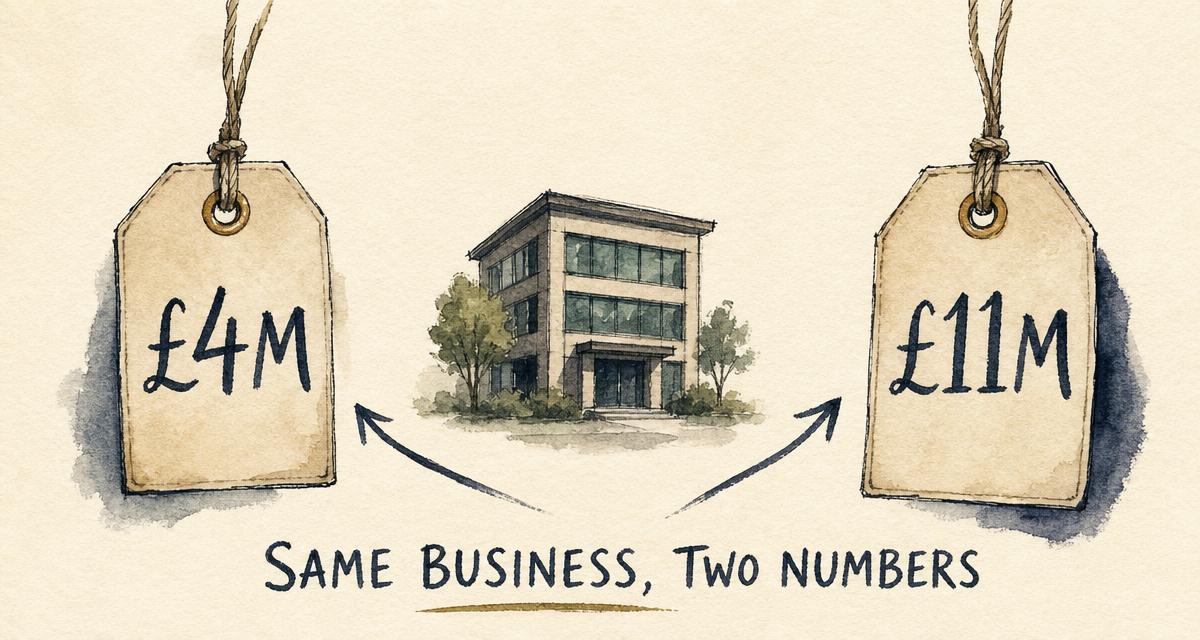
This is not a marginal effect. Exit Lab HVAC's 2026 valuation data puts the impact in concrete terms: HVAC businesses with 30% or more revenue from service agreements typically command 1x to 2x higher multiples than those relying primarily on project-based or new installation revenue. On a £1M EBITDA business, that is the difference between a £4M and a £6M exit. Same operational quality, same headline revenue, dramatically different result.
The 2026 UK HVAC Multiple Landscape
Before diving into how to engineer recurring revenue, it helps to understand the multiple range UK HVAC businesses are achieving in 2026 and where recurring revenue sits within that.
| Business Type | EBITDA Multiple Range | Key Driver |
|---|---|---|
| Installation-Heavy Residential | 3.5x - 5.5x | Volume, brand, lead generation |
| Service-Heavy Residential | 5.0x - 7.5x | Recurring revenue, MSAs, retention |
| Commercial HVAC (project-led) | 5.0x - 7.0x | Contract size, client tenure |
| Commercial HVAC (service-led) | 6.5x - 9.0x | Contracted maintenance backlog |
| Mixed Residential + Commercial | 6.0x - 8.5x | Diversification, reduced seasonality |
| Mechanical Contractor (full-service) | 6.5x - 9.0x | Multi-trade capability |
| PE Platform (£3M+ EBITDA) | 8.0x - 11.0x+ | Scale, governance, growth runway |
These figures align with Exit Lab HVAC's 2026 segmentation and First Page Sage's HVAC EBITDA & Valuation Multiples report, which puts the cross-sector average at 8x EBITDA for businesses above £1M and a 20% increase from pre-pandemic norms.
The pattern is clear. As you move from project-heavy to service-heavy, and from owner-operated to platform-grade, the multiple expands meaningfully. Recurring revenue is the fastest legitimate route between those points.
What Counts as "Recurring" - and What Does Not
This is where many HVAC owners get the valuation conversation wrong. Buyers and their accountants apply a strict definition of recurring revenue, and any revenue that does not meet the test gets re-classified as project revenue at the lower multiple.
True recurring revenue requires three characteristics:
- A signed agreement with defined renewal mechanics. A handshake annual service is not recurring revenue. A 12-month rolling contract with auto-renew terms is.
- Predictable cadence and pricing. The customer pays the same fee at the same frequency. Variable consumption-based billing falls outside the strict definition unless there is a contractual minimum.
- Documented retention metrics. Buyers will ask for cohort retention data covering at least 24 months. Logo retention, revenue retention, and net revenue retention all matter.
Where buyers see weak documentation, they apply discounts. We have seen owners present 40% recurring revenue figures during early conversations only to have buyers re-classify the number to 22% during due diligence because the contracts could not be produced or the renewal data did not hold up. That is a multiple compression of 1x to 2x EBITDA, easily worth six figures or more on a typical UK HVAC exit.
What Buyers Pay For Each Component
The 2026 UK HVAC business is rarely a pure-play service company or a pure-play installer. It is a mix. Sophisticated buyers value each component separately and weighted-average them. Here is how the typical components are valued in 2026:
| Revenue Component | Stand-alone Multiple | Notes |
|---|---|---|
| Annual Maintenance Plans (residential) | 5.0x - 7.0x | Auto-renew, direct debit preferred |
| Commercial MSAs (multi-year) | 6.0x - 8.0x | Three to five-year contracts command top end |
| Service Memberships (priority response) | 5.0x - 7.0x | Sticky if priced right and well-marketed |
| Refrigeration Service Contracts | 6.5x - 8.5x | Specialist labour, food/pharma contracts |
| Installation Revenue (one-off) | 3.0x - 4.5x | Treated as cyclical, low forward visibility |
| Repair Revenue (transactional) | 3.5x - 5.0x | Higher than install if customer is sticky |
| Heat Pump Installation (subsidised) | 3.5x - 5.5x | Boosted by BUS funding momentum |
CT Acquisitions' detailed analysis confirms the maintenance/installation split, while Marshall & Stevens' MSA valuation work underlines why multi-year managed service agreements at the commercial end command premium pricing in industrial valuation contexts.
The 2026 Buyer Landscape for UK HVAC
Understanding who is buying matters because different buyers care about recurring revenue in different ways. A founder selling to another founder is rarely paying for predictability. A PE platform almost always is. For owners thinking through who would actually acquire their business, our buy-side advisory team maintains a real-time view of active acquirers across UK building services, including HVAC.
Strategic Consolidators
Sureserve Group, backed by Cap10 Partners since taking the business private in 2023, has been particularly acquisitive across HVAC, heat networks, and energy services. The May 2025 acquisition of HI Group, a Nottinghamshire-based net zero specialist, illustrates their strategic appetite for businesses with strong technical capability and contracted public sector work.
Mitie Group, beyond its £350M Marlowe acquisition in 2025, continues to be the largest pure-play strategic acquirer of UK HVAC businesses with strong commercial MSA portfolios.
Private Equity Platforms
The platform-and-add-on playbook is alive and well in UK HVAC. Phoenix Equity Partners, Foresight Group, and LDC have all been active across the broader building services consolidation thesis, with HVAC platforms or add-on activity in the £3M to £30M EBITDA range over the last three years.
In the lower mid-market, Synova Capital, Rcapital, and Souter Investments have each been involved in HVAC-adjacent transactions where the underlying business carried strong recurring service revenue.
International Strategics
UK HVAC businesses with sufficient scale are increasingly on the radar of global majors. Daikin, Carrier, Trane Technologies, and Johnson Controls are all monitoring the UK service-led HVAC market, particularly where heat pump capability or commercial refrigeration depth is present. As Forbes Partners noted in their 2026 outlook, 2026 is shaping up as a broader recovery year for HVAC M&A activity supported by recent reporting from companies like Systemair, Latour, and Lindab.
For a wider view of how PE is approaching the building services consolidation thesis, our analysis of UK home services roll-ups covers the playbook in detail.
The Heat Pump Factor in 2026 Valuations
The structural shift towards heat pumps is now firmly visible in UK HVAC valuations. Heat pump installations reached a record 125,037 units in 2025, a 27% increase year on year, according to the Heat Pump Association. Government data confirms 2025 installation volumes were over four times higher than 2020, per BusinessGreen's coverage.
For HVAC business owners, this matters in three valuation-relevant ways:
- Heat pump installation creates a long-tail service annuity. A £12,000 heat pump install with a 10-year service agreement attached is worth meaningfully more in valuation terms than a £12,000 boiler swap with no follow-on service.
- MCS accreditation has become a moat. Buyers consistently pay a premium for accredited installer businesses with documented Boiler Upgrade Scheme (BUS) workflows. The accreditation is hard to replicate, and PE buyers know it.
- Refrigeration F-Gas qualified businesses are scarce. Specialist commercial refrigeration capability remains chronically under-supplied. Buyers will pay 1x to 2x EBITDA more for a service-led business with F-Gas certified technicians and food/pharma client contracts than for a generalist commercial HVAC equivalent.
Our plumber heat pump exit case study covers how a related plumbing business converted heat pump capability into an 11x EBITDA exit. The same structural levers apply to HVAC.
How To Engineer Higher Recurring Revenue Before Sale
Three to five years out from a planned exit, the most valuable strategic project an HVAC owner can run is a deliberate recurring revenue programme. The mathematics is simple: every percentage point of recurring revenue mix you can credibly add typically translates into 0.1x to 0.2x of multiple expansion at exit. On a £1M EBITDA business, moving from 25% recurring to 45% recurring can add £1.5M to £3M of headline value.
Here is what actually moves the needle.
Productise Your Maintenance Offer
Stop selling annual services as a discretionary add-on. Build a tiered membership programme - typically Bronze, Silver, Gold - with clear pricing, defined inclusions, and direct debit payment. Give your customers a reason to stay enrolled (priority response, no call-out fees, discounts on parts) and a structural barrier to leaving (pre-paid annual fees, multi-year discounts).
The growth in HVAC service memberships over the last decade has been over 400%, and the customers who enrol have meaningfully higher lifetime values, retention rates, and cross-sell rates than ad hoc service customers.
Move Customers to Direct Debit
Direct debit collection is a pricing signal as much as a payment mechanism. It tells buyers the customer relationship is institutionalised, the cash flow is predictable, and churn will be visible early. Practices with 70%+ of recurring revenue collected by direct debit consistently command a small multiple premium over equivalent businesses billing in arrears.
Capture Cohort Retention Data Properly
This is where most owners fall short during diligence. You need at least 24 months of cohort data showing how each annual customer cohort performs over time. What percentage renew at 12 months? At 24 months? What is the average annual revenue per retained customer? Without this data, buyers will assume the worst.
Implement a CAFM or service software platform that captures this data automatically. Joblogic, BigChange, simPRO, and ServiceTitan are all common UK choices. The system you choose matters less than the discipline of using it consistently.
Convert One-Off Customers Into Plan Customers
Every install or repair job is a recurring revenue opportunity. Build the plan offer into your invoicing process. Offer first-year membership at a meaningful discount when paid alongside an installation. Track conversion rates by technician and by job type. The businesses that exit at premium multiples typically achieve 25% to 40% plan conversion rates on new install jobs.
Sign Multi-Year Commercial MSAs
For commercial HVAC owners, the single biggest valuation lever is the conversion of annual rolling contracts to three or five-year MSAs with structured price escalators. A three-year contract with a 4% annual price escalator and a documented service level agreement is worth substantially more in due diligence than the same revenue billed annually with no commitment.
Diversify the Customer Base
Buyers cap multiples where customer concentration risk is high. If your top customer represents more than 15% of revenue, expect a haircut. If it is more than 25%, expect serious deal friction. Use the 12 to 24 months pre-sale to bring the concentration below 15% by signing new MSAs and growing existing mid-tier accounts.
For more detailed strategy on EBITDA optimisation pre-exit, our seven strategies guide covers the broader value engineering toolkit.
What Buyers Look at During Due Diligence
Once an offer is on the table, the recurring revenue claim gets stress-tested. Here is what serious buyers and their accountants will require evidence of.
| Diligence Item | What Buyers Want To See |
|---|---|
| Customer Contracts | Signed MSAs and membership agreements covering at least 80% of claimed recurring revenue |
| Direct Debit Mandates | Active mandate evidence for membership customers, ideally via Bacs reports |
| Cohort Retention | 24 to 36 months of customer cohort data showing logo and revenue retention |
| Renewal Metrics | Documented annual renewal rates, ideally 80%+ for memberships, 90%+ for commercial MSAs |
| Pricing History | Evidence of consistent price escalators, not erratic discounting |
| Service Software | Live access to CAFM/service software showing current contract base |
| Customer Concentration | No single customer above 15%, top 10 customers below 50% of revenue |
| Cancellation Rights | Buyer-friendly cancellation terms, ideally 30+ day notice |
| Margin per Contract | Plan-level profitability data, not just blended margin |
If any of these items are weak, expect either a multiple compression, a price reduction during the SPA negotiation, or an extended earn-out structure tied to retention metrics post-completion.
Frequently Asked Questions
What recurring revenue percentage do I need to attract premium buyers?
For premium PE-grade pricing, target 35% to 50% recurring revenue. Below 25%, expect installer-grade multiples (3x to 5x EBITDA). Between 25% and 35%, you start attracting more sophisticated buyers and the mid-range multiples (5x to 7x). Above 50%, you are competitive with platform-grade pricing and can credibly attract 8x to 10x.
How long does it take to materially shift my recurring revenue mix?
Realistically, 18 to 36 months from a standing start. Customer behavioural change takes time, and buyers test claims with 24 months of historical data. Owners who try to engineer a recurring revenue narrative in the six months before sale typically get found out during diligence and lose multiple expansion they thought they had earned.
Are heat pump service contracts more valuable than boiler service contracts?
Yes, modestly. Heat pump systems have longer service intervals, higher per-visit revenue, and a more institutional customer base (often supported by BUS grant claw-back conditions that effectively require ongoing service). The contracts also command a slight green premium with PE buyers running ESG mandates.
How do commercial MSAs differ from residential memberships in valuation terms?
Commercial MSAs typically command higher stand-alone multiples (6x to 8x) than residential memberships (5x to 7x) because contract sizes are larger, terms are longer, and customer creditworthiness is generally stronger. The trade-off is that commercial MSAs concentrate risk in fewer customers, so customer concentration becomes a more important diligence focus.
What is the impact of MCS accreditation on valuation?
MCS accreditation creates a credible barrier to entry and typically supports a 0.5x to 1x EBITDA premium on the recurring revenue base. The accreditation also enables BUS grant claims, which expand the addressable market and customer acquisition economics.
Can I claim the maintenance side of my business at a higher multiple if I sell the whole business?
In a single-buyer transaction, no - the buyer pays a blended multiple. However, sophisticated owners can run a structured carve-out process where the maintenance book is sold to one buyer at premium pricing and the installation business to another at the appropriate lower multiple. This adds complexity but can deliver 15% to 25% more total value when executed well.
How do buyers verify my retention claims?
They typically request 24 to 36 months of customer cohort data exported from your service software, supported by Bacs direct debit records and a sample of signed contracts. They will then back-test your claims by reconciling stated renewals to active customer lists at multiple points in time.
What is the difference between SDE and EBITDA for HVAC valuations?
SDE (Seller's Discretionary Earnings) adds back the owner's salary and benefits and is typically used for businesses below £500K of normalised earnings. EBITDA is used above that threshold. The same business may be quoted at 4x SDE or 6x EBITDA depending on the buyer's framework, but the underlying enterprise value should be similar.
How does the Building Safety Act affect HVAC valuations?
The Building Safety Act has tightened compliance requirements across HVAC, particularly on commercial work involving residential buildings. Businesses with strong compliance documentation, F-Gas certification, and a clean health and safety record consistently trade at higher multiples than equivalents with patchy records.
Should I sell now or wait until 2027 to capture more recurring revenue?
It depends on three things: your current recurring revenue mix, your trajectory, and the wider M&A cycle. If you can credibly add 10 percentage points of recurring mix in 18 months and 2027 looks like a strong M&A market, waiting often pays. If your mix is already strong and 2026 acquirer demand is high, accelerating may be the better call. The BADR tax change effective April 2026 has shifted the calculus for many owners - our BADR April 2026 analysis covers the tax timing implications in detail.
Take the Next Step
If you own a UK HVAC business and want to understand specifically how your recurring revenue mix translates into a 2026 exit valuation, the answer is not in a generic multiple table. It is in the line-by-line analysis of your contracts, cohort retention, customer concentration, and growth trajectory.
Speak to our HVAC M&A advisory team for a confidential preliminary valuation. We will walk through your revenue mix component by component, model the realistic 2026 multiple range, and identify the specific levers worth pulling in the 12 to 24 months before sale to maximise your exit multiple.
Related reading
- HVAC valuation guide: EBITDA multiples
- Heat pump and decarbonisation valuation guide
- Maintenance contracts valuation guide
- HVAC M&A
- Heat pump and renewables M&A
- Facilities management M&A
- Exit planning guide for owners
- Free valuation estimate
- See who is buying: free buyer list
- Book a confidential call
Sources
- MCS certification scheme
- Gas safety guidance, HSE
- Building regulations and approved documents, GOV.UK
Experienced Dealmakers Lead Your Exit
A senior M&A bench, plus a sector specialist recruited for your industry on every deal.

Duncan Moore
M&A Deal Lead
Joined full-time on 22 August 2026 from the largest M&A advisory firm in the UK, owned by K3 Capital. As an ex-Director he managed teams of M&A advisors, analysts and associates, working daily with business owners, buyers and stakeholders on live acquisition deals. Selected from 260 applicants alongside colleagues from investment banking backgrounds, he brings that experience and network to lead the advisory bench across Building Services, Facilities Management, and Healthcare.
Joined full-time on 22 August 2026 from the largest M&A advisory firm in the UK, owned by K3 Capital. As an ex-Director he managed teams of M&A advisors, analysts and associates, working daily with business owners, buyers and stakeholders on live acquisition deals. Selected from 260 applicants alongside colleagues from investment banking backgrounds, he brings that experience and network to lead the advisory bench across Building Services, Facilities Management, and Healthcare.

Martin is one of the most well-connected figures in UK fire, security, building services and FM. He is Chairman of both the Fire Industry Association and the British Security Industry Association, the only person in the UK to hold both roles simultaneously. Martin spent over a decade in senior leadership at Mitie, latterly as Industry Liaison Director for its fire and security division, helping scale the business past £500m in revenue and playing a role in the £366m acquisition of Marlowe plc, which created one of the UK's largest compliance, fire and security services groups. He joined DealFlowAgent because owners in these sectors deserve a genuine sector-specialist advisor across valuation, business optimisation and buyer access. In recognition of his industry roles, he acts in a personal, non-partisan capacity.
Martin is one of the most well-connected figures in UK fire, security, building services and FM. He is Chairman of both the Fire Industry Association and the British Security Industry Association, the only person in the UK to hold both roles simultaneously. Martin spent over a decade in senior leadership at Mitie, latterly as Industry Liaison Director for its fire and security division, helping scale the business past £500m in revenue and playing a role in the £366m acquisition of Marlowe plc, which created one of the UK's largest compliance, fire and security services groups. He joined DealFlowAgent because owners in these sectors deserve a genuine sector-specialist advisor across valuation, business optimisation and buyer access. In recognition of his industry roles, he acts in a personal, non-partisan capacity.

Nick leads FM Talent Partners, the facilities management and real estate leadership search firm, and is a leading specialist in building services and FM management talent. He partners with DealFlowAgent on two-way referrals: helping business owners and acquirers fill the key roles that decide whether a business is sellable, and introducing owners who are thinking about their next chapter to a team that knows their industry and their market. Key-person dependency is one of the two most common reasons a sale collapses, and Nick fixes it at source.
Nick leads FM Talent Partners, the facilities management and real estate leadership search firm, and is a leading specialist in building services and FM management talent. He partners with DealFlowAgent on two-way referrals: helping business owners and acquirers fill the key roles that decide whether a business is sellable, and introducing owners who are thinking about their next chapter to a team that knows their industry and their market. Key-person dependency is one of the two most common reasons a sale collapses, and Nick fixes it at source.

James Duboullay
Senior M&A Advisor
- •25+ years across investment banking, M&A and fundraising
- •Sector focus: essential services and software
- •Long-standing relationships with private equity buyers and growth funds
- •Personally advising DealFlowAgent founders for the past four years
- •25+ years across investment banking, M&A and fundraising
- •Sector focus: essential services and software
- •Long-standing relationships with private equity buyers and growth funds
- •Personally advising DealFlowAgent founders for the past four years

Emerson Patton
Sector Specialist: Building Services & Facilities Management
- •20+ years advising owners in building services, fire safety, HVAC, plumbing, and construction
- •Guided 200+ companies through growth, profit improvement, and exit planning
- •Builds equity value and operational structure long before a sale
- •Partners with DFA to prepare owners for exit while the advisory team runs the sale
- •20+ years advising owners in building services, fire safety, HVAC, plumbing, and construction
- •Guided 200+ companies through growth, profit improvement, and exit planning
- •Builds equity value and operational structure long before a sale
- •Partners with DFA to prepare owners for exit while the advisory team runs the sale

Kaya Kesici
M&A Advisor, Fire Safety, Security & Compliance
- •17 completed M&A transactions over the past six years across UK SME fire safety, security and compliance-led services
- •Sell-side and buy-side experience, buyer research, acquirer mapping, outreach and live process coordination
- •Information request lists, databook prep, IC-style summaries and EV-to-equity bridge work
- •Direct sector exposure across fire protection, security systems, CCTV, access control and intruder alarms
- •17 completed M&A transactions over the past six years across UK SME fire safety, security and compliance-led services
- •Sell-side and buy-side experience, buyer research, acquirer mapping, outreach and live process coordination
- •Information request lists, databook prep, IC-style summaries and EV-to-equity bridge work
- •Direct sector exposure across fire protection, security systems, CCTV, access control and intruder alarms
Previously


Ranger Fire & Security · Complete Building Services · Compliance Group

- •22 completed M&A transactions
- •Direct relationships with hundreds of strategic and financial acquirers
- •Previously built a mobility and field services business to 30 staff and 6 UK warehouses, then sold via competitive process with an EY M&A partner
- •Raised £2m in funding; placed 3rd of 1,900 at OnStage (the "Y Combinator of Europe")
- •Full-stack developer of advanced agent systems and second-brain tooling for the M&A process
- •22 completed M&A transactions
- •Direct relationships with hundreds of strategic and financial acquirers
- •Previously built a mobility and field services business to 30 staff and 6 UK warehouses, then sold via competitive process with an EY M&A partner
- •Raised £2m in funding; placed 3rd of 1,900 at OnStage (the "Y Combinator of Europe")
- •Full-stack developer of advanced agent systems and second-brain tooling for the M&A process
Sector Expert
Industry-Specific Advisor
For every engagement we add a sector specialist from your industry to the core team: a 15–25 year operator or advisor with direct relationships in your niche. Recruited per deal so you get the right fit, not a generalist.
For every engagement we add a sector specialist from your industry to the core team: a 15–25 year operator or advisor with direct relationships in your niche. Recruited per deal so you get the right fit, not a generalist.
The bench is growing. Two senior M&A hires confirmed for late July 2026, selected from 200+ applicants out of Goldman Sachs, Deutsche Bank, EY, KPMG and leading boutique M&A firms. See open roles →
The AI layer behind every advisor
Two in-house AI systems work alongside the human bench. They are software, not people, built and supervised by the advisory team.

Sage
AI Deal Concierge
Available 24/7. Monitors every signal in your deal and keeps the advisory team one step ahead. Trained on thousands of M&A transactions.

Sterling
Buy-Side Deal Origination Agent
Engages 13,000+ acquirers to surface live mandates and intent, then feeds your advisors with warm, ranked buyer matches.
The Exit Readiness Scorecard
Score your business across the factors acquirers underwrite, including key-person dependency, contract quality, customer concentration and earnings quality. Complete it below, print it, or download the PDF and work through it with your leadership team.
Watch the intro from our founder, Joe
Two minutes on how DealFlowAgent runs a confidential, competitive sale process for owners of building services, facilities management and healthcare businesses.
HVAC M&A Specialists
Thinking of selling your hvac business?
DealFlowAgent is a leading specialist in niche building services, with dedicated M&A advisory and brokerage coverage for HVAC businesses across the UK and US. Our trusted advisors leverage industry knowledge, buyer relationships and proprietary technology to help business owners secure multiple acquisition offers at higher valuations.
Joe Lewin
Exited entrepreneur and M&A advisor who has guided 20+ business owners through successful exits. Joe built and sold his first company after scaling to 80,000+ users and raised over £2M in funding. He founded DealflowAgent to combine traditional M&A expertise with AI technology, creating aligned advisory solutions for SME business owners. Joe regularly speaks on exit planning and M&A trends, and has built a network of thousands of strategic acquirers across UK and US markets.
What is your business actually worth?
Sector by sector benchmarks built from real completed transactions, with the valuation bands acquirers underwrite against.
- HVAC, Refrigeration & Cooling Valuation GuideService contract density, engineer retention and the multiples HVAC consolidators pay.
- Fire Safety Business Valuation & EBITDA MultiplesWhat fire alarm, extinguisher, sprinkler and passive fire protection businesses sell for, band by band.
- Security Systems Business Valuation & EBITDA MultiplesCCTV, access control, intruder alarms and monitoring: the multiples acquirers are paying in 2026.
- Compliance, Testing & Inspection Valuation GuideWhy recurring statutory inspection revenue attracts the highest multiples in building services.
- Electrical Contracting Valuation & EBITDA MultiplesNICEIC, EICR and EV infrastructure: how electrical contractors are valued and sold.