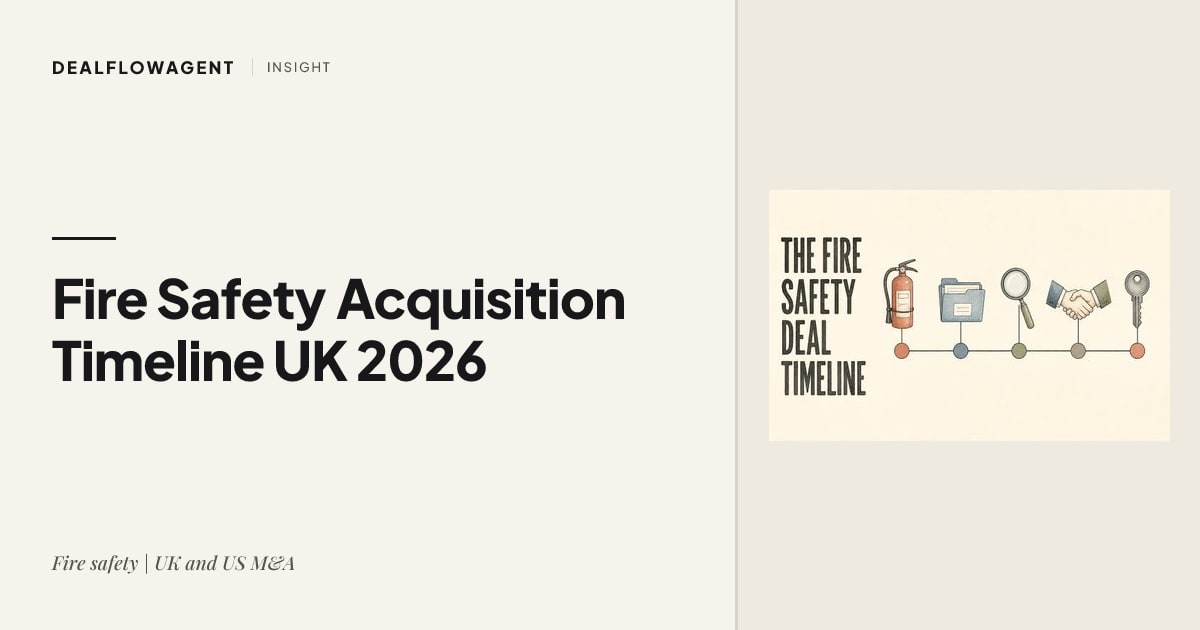
Fire Safety Acquisition Timeline UK 2026
Realistic month-by-month UK fire safety business acquisition timeline for 2026, from advisor engagement to completion, with the sector-specific variables that compress or stretch each phase.

DealFlowAgent is a leading specialist in niche building services, with dedicated M&A advisory and brokerage coverage for fire safety businesses across the UK and US. We help owners secure multiple acquisition offers at higher valuations.
Sell your fire safety businessWhat is your business worth today?
Enter your website and our M&A team will prepare a written valuation and exit optimisation report. No cost, no credit card, no obligation.
Strictly confidential
Strictly confidential. Your personalized report is prepared by our internal team alone, the founder, head of M&A and associates. It is never shown to buyers or anyone outside the deal team without your permission.
Already know your number?
Confidential, no cost
Considering selling your business?
Send a short message and we will come back to you within 24 hours.
Fire safety business owners considering an exit in 2026 are entering one of the most active M&A sub-sectors in the UK. Fire and security accounted for 23% of all UK facilities services deals in 2025, with private equity backed buyers driving 70% of those transactions, according to Grant Thornton's UK Fire and Security M&A Review 2025. The opportunity is real. The mistake most owners make is underestimating how long the process actually takes from first conversation to cleared funds.
This guide sets out a realistic month-by-month acquisition timeline for a UK fire safety company sale in 2026, the variables that compress or stretch each stage, and how to plan around the regulatory and integration realities specific to this sector. If you are starting to scope an exit, our fire safety M&A advisory page covers how we structure sale processes for owners of active fire, passive fire and integrated systems businesses.
The Headline Number: 9 to 14 Months
A well-prepared UK fire safety business with EBITDA between £500k and £5m should plan for a 9 to 14 month process from engaging an advisor to completion. Breakwater M&A puts the typical fire protection sale at 6 to 12 months, while Sampford Advisors and Wall Street Prep document sell-side auction processes that run 7 to 12 months in the lower mid-market once preparation is complete.
The variables that push a deal toward the longer end are well documented:
- Quality of financial records and whether a Quality of Earnings exercise is required
- Number of statutory and regulatory accreditations to verify (BAFE, FIA, NSI, SIA)
- Customer concentration and length of contracted recurring revenue
- Whether the buyer is a strategic, a PE platform, or a first-time financial sponsor
- Antitrust or regulatory clearance, rare at the lower mid-market but possible above £30m
- Vendor preparedness, which is the single largest swing factor
The next sections walk through each phase with realistic durations.
Phase 1: Pre-Market Preparation (Months 1 to 3)
Before any buyer is contacted, the business needs to be packaged. This phase routinely takes between 8 and 14 weeks for a fire safety company that has not previously been to market. Skipping or compressing it is the most common reason deals fall over later.
Month 1: Advisor Engagement and Diagnostic
The owner appoints a sell-side M&A advisor and a tax advisor. The advisor runs a commercial diagnostic that includes:
- Three years of normalised EBITDA build, including engineer utilisation, vehicle costs, and owner remuneration adjustments
- Customer cohort analysis to identify recurring revenue concentration
- Contract base review covering term length, price escalators, auto-renewal mechanics, and termination rights
- Accreditation register confirming BAFE, FIA, NSI, third party certification status and renewal dates
- Initial valuation range based on current market multiples for active fire, passive fire and integrated providers
This diagnostic typically takes 2 to 3 weeks of focused work. It is the foundation everything else is built on.
Month 2: Information Memorandum and Data Room
The advisor drafts the Information Memorandum (IM) and builds the virtual data room in parallel. For a fire safety business, the IM must articulate:
- Service mix split between active, passive, monitoring, design, and installation
- Geographic density and engineer base, including IR35 status of subcontractors
- Recurring revenue mix and Annual Recurring Revenue (ARR) growth
- Regulatory positioning post-Building Safety Act 2022 and the Fire Safety Act 2021
- Buy-and-build potential for PE-backed acquirers
Data room preparation for a fire safety business typically requires 250 to 450 indexed documents. This is more than a generalist FM business because of the regulatory, certification and engineer-level documentation buyers will request. Allow 3 to 4 weeks.
Month 3: Buyer List Development and Approach Strategy
The advisor finalises a long list of 60 to 120 qualified buyers and a short list of 20 to 40 to be approached in the first wave. For UK fire safety, the buyer universe includes:
- PE-backed consolidators such as New Path Fire (Duke Capital), ABCA Systems (Trimountain Partners), Marlowe Fire & Security (Inflexion legacy), Ipsum, Celnor, Phenna Group (Oakley), and Socotec
- Strategic trade buyers such as Johnson Controls, Honeywell, Bureau Veritas, BSI Group, and APi Group (which acquired Chubb Fire & Security from Carrier in a USD 3.1bn deal in 2021)
- Pure financial sponsors looking for a platform asset, typically targeting EBITDA above £3m
Outreach materials, NDAs and the teaser are finalised. By the end of month 3, the business is market-ready.
Phase 2: Marketing and Initial Bids (Months 4 to 5)
This is the auction round. Sampford Advisors and Wall Street Prep both quote 4 to 6 weeks for the first marketing round in lower mid-market processes.
Month 4: Teaser Distribution and NDAs
The advisor distributes a one-page anonymous teaser to the qualified buyer list. Interested parties sign an NDA, typically a UK-standard mutual NDA with a 24 month tail, and receive the IM. Expect 50% to 70% of teaser recipients to sign NDAs in an active sector like fire safety. The advisor manages question flow centrally.
Month 5: Indicative Offers (IOIs)
Buyers submit non-binding indications of interest, also called Indicative Offers. These contain:
- Headline enterprise value or EV range
- Proposed deal structure (cash, equity rollover, deferred consideration, earn-out)
- Proposed financing source and conditionality
- Required exclusivity period if selected
- Outline diligence requirements and timetable
A well-run process for a £1m to £5m EBITDA fire safety business should generate 5 to 12 IOIs. The advisor and seller select 3 to 6 buyers to invite to management presentations. The spread between highest and lowest IOI is typically 25% to 40%, which is why running a competitive process matters.
Phase 3: Management Meetings and Due Diligence (Months 6 to 8)
This phase combines the second auction round with the start of detailed diligence. Sampford documents 4 to 6 weeks for management presentations and LOI submissions, then 8 to 12 weeks for closing diligence and definitive agreements.
Month 6: Management Presentations and Site Visits
Each shortlisted buyer attends a half-day or full-day management presentation. For fire safety businesses, expect site visits to operational hubs and engineer briefings to be requested by serious buyers, particularly those evaluating self-delivery capability and engineer retention risk. The vendor management team should expect to commit 3 to 5 days per buyer in this period.
Month 7: Letters of Intent and Exclusivity
Following management meetings, buyers submit binding or near-binding Letters of Intent (LOIs). LOI structuring guidance from Joseph Brunelle recommends LOIs include:
- Defined purchase price and structure
- Equity injection and financing source
- Defined diligence timeline (typically 60 to 90 days for lower mid-market)
- Reps and warranties escrow requirement
- Working capital target and calculation method
- Post-completion seller involvement
The seller selects one buyer for exclusivity. Exclusivity periods of 60 to 90 days are standard. Going past 120 days without a clear path to signing erodes the seller's leverage substantially.
Month 8: Confirmatory Diligence
Confirmatory diligence in fire safety covers eight workstreams that run in parallel:
| Workstream | Typical duration | Lead party |
|---|---|---|
| Financial and tax (Quality of Earnings) | 4 to 6 weeks | Buyer's accountants |
| Legal (corporate, contracts, litigation) | 4 to 8 weeks | Buyer's solicitors |
| Commercial (customer references, market) | 3 to 5 weeks | Strategy consultant or in-house |
| Regulatory and accreditation (BAFE, FIA, NSI, SIA, TPC) | 2 to 4 weeks | Buyer's compliance team |
| Operational (engineer utilisation, fleet, systems) | 3 to 5 weeks | Buyer's operations team |
| Insurance and claims history (PL, EL, PI) | 2 to 3 weeks | Buyer's insurance advisor |
| Health, safety and environment | 2 to 4 weeks | EHS consultant |
| IT, cybersecurity and data protection | 2 to 4 weeks | Buyer's IT due diligence |
Most lower mid-market UK fire safety deals run diligence over 8 to 10 weeks once exclusivity starts. DataRooms.org confirms 30 to 90 days is typical depending on size, with mid-market transactions falling into the 45 to 60 day range.
For owners scoping how a buyer will assess their business, our buy-side advisory page outlines the diligence standards applied to acquisitive PE platforms in the building services sector.
Phase 4: Definitive Agreement and Signing (Months 9 to 11)
Diligence and legal documentation overlap. Drafting and negotiating the definitive Share Purchase Agreement (SPA) typically takes 6 to 10 weeks for a UK fire safety transaction with conventional structure.
Negotiation Hot Spots in Fire Safety SPAs
These are the recurring negotiation points specific to this sector:
- Reps and warranties on accreditations. Buyers will require reps that BAFE SP203, FIA Cat A and NSI Gold registrations are current, valid and not under review. A 24 to 36 month tail is standard.
- Specific indemnity for historic installation work. Active fire and passive fire installation work carries a long tail of potential liability under the Building Safety Act 2022, particularly for higher-risk buildings. Specific indemnity carve-outs for pre-completion work are common.
- Engineer retention and key person warranties. Buyers require warranties that named engineers and supervisors will remain for a defined period or trigger a price adjustment. Loss of accredited supervisors can void NSI certification.
- Customer contract change-of-control clauses. Around 30% to 40% of monitoring and maintenance contracts in this sector contain change-of-control termination rights. The advisor should map these in advance.
- Working capital normalisation. Fire safety businesses often carry significant accrued income on long maintenance cycles. Buyers will scrutinise the calculation methodology.
- Earn-out structuring. For deals above £5m EBITDA, expect 15% to 30% of consideration tied to a 2 to 3 year earn-out with EBITDA and recurring revenue retention triggers.
Month 11: Signing
By the end of month 11 in a clean process, the SPA is signed. In simpler structures, signing and completion happen on the same day (simultaneous signing and completion). In more complex deals, a gap exists for regulatory clearance, financing closure or carve-out preparation.
Phase 5: Completion and Post-Closing (Months 12 to 14)
Month 12: Completion Mechanics
Completion in a UK fire safety transaction includes:
- Funds flow through escrow agent or solicitors' client account
- Stock transfer forms and stamp duty submission to HMRC
- Updates to Companies House
- Notification to BAFE, FIA, NSI and SIA of change of control where required
- Customer and supplier notification under contractual obligations
- Engineer and PAYE transfer where TUPE applies in asset transactions
Months 13 and 14: Post-Completion Adjustments
Several items run after completion:
- Completion accounts. Working capital and net debt adjustments are typically agreed within 60 to 90 days post-completion. Disputes go to an expert determination.
- W&I insurance claims period. Most UK fire safety deals are now W&I insured. The claim notification period for general warranties is typically 24 months, with tax warranties at 7 years.
- Earn-out monitoring. Quarterly reporting and annual measurement against the earn-out targets begin immediately.
- Customer transition. Strategic buyers typically rebrand within 6 to 18 months. PE-backed buyers in buy-and-build mode often retain the brand for 24 to 36 months to preserve customer continuity.
What Compresses or Stretches the Timeline
Variables That Compress Timeline
- Audit-quality financial track record cuts diligence by 2 to 4 weeks
- Vendor-side QofE prepared in advance cuts buyer-side QofE timing in half
- Clean accreditation register with no pending reviews cuts compliance diligence by 1 to 2 weeks
- Bilateral negotiations skip the auction round (saves 4 to 6 weeks) but typically cost 10% to 20% on price
- Strategic buyer with sector knowledge moves faster than a first-time PE sponsor
Variables That Stretch Timeline
- Unrecorded liabilities or pending litigation surfacing in diligence (adds 4 to 12 weeks)
- Material variance between IM-stated EBITDA and QofE-derived EBITDA (often kills deals or adds 8+ weeks)
- Customer concentration above 30% triggering deeper reference work (adds 2 to 4 weeks)
- Engineer attrition during the process (can pause exclusivity)
- Accreditation issues, particularly BAFE SP203 or NSI Gold under review
- Complex structure including carve-outs, share-for-share rollovers, or multi-jurisdictional buyers
PKF Francis Clark found that almost a quarter of due diligence projects in 2025 uncovered issues large enough to delay or reduce deal terms. Pre-empting these is the single highest leverage activity an owner can do.
Realistic Timeline by Deal Size
Below is the realistic 2026 timeline range for UK fire safety transactions by deal size. These are based on Grant Thornton sector data, Wall Street Prep, Sampford Advisors and our own deal observations.
| EBITDA range | Typical timeline | Buyer profile most common |
|---|---|---|
| Under £500k | 8 to 12 months | Local trade or first-time PE search fund |
| £500k to £1.5m | 9 to 13 months | PE-backed regional consolidator |
| £1.5m to £5m | 10 to 14 months | PE-backed national platform or strategic |
| £5m to £15m | 11 to 16 months | Pure PE platform deal or international strategic |
| £15m+ | 12 to 18+ months | Large PE or international strategic, possible regulatory clearance |
Why 2026 Is a Strong Window
Lincoln International's Q4 2025 Fire and Life Safety Quarterly Review reported that M&A activity in the sector is poised to accelerate into 2026, with the pool of acquirers diversifying. Q4 2025 delivered a record 60 facilities services transactions according to Grant Thornton, supported by easing interest rates and renewed budget visibility.
The structural tailwinds remain in place:
- The UK fire and security market is highly fragmented with sub-£1m EBITDA owner-managed firms
- Regulatory tightening post-Grenfell creates non-discretionary spend
- Active fire systems generate recurring inspection and maintenance revenue
- A skills gap in qualified engineers protects margins for established providers
- Strong debt markets are funding PE buy-and-build at attractive terms (c EUR 40bn raised in European private credit in H1 2025, a threefold YoY increase)
- Acquisition appetite is broadening to international consolidators
For owners who began conversations in late 2025 or early 2026, completion windows in 2026 and 2027 align with strong buyer competition and accreted multiples for businesses with strong recurring revenue and clean accreditation records.
Tax Timing: BADR and the 2026 Rate Change
A timing factor specific to UK exits in 2026 is Business Asset Disposal Relief (BADR). The relief rate moved to 18% Capital Gains Tax from 6 April 2026, up from the prior 14% rate that applied between 6 April 2025 and 5 April 2026. There were further changes to Inheritance Tax Business Property Relief from April 2026. Our BADR April 2026 analysis covers the implications for building services owners in detail.
Net of the rate change, the timing decision remains primarily driven by business performance, market conditions and buyer competition. Owners should not accelerate or delay a sale solely on tax timing without a full advisor-led model of net proceeds across alternative completion months.
Common Owner Mistakes That Add 3 to 6 Months
The most common owner-driven causes of timeline slippage in fire safety transactions are:
- Approaching one buyer first without a competitive process. Removes leverage and often leads to re-running the process later.
- Reactive data room population during diligence. Documents pulled together in real time rather than indexed in advance.
- Engineer or supervisor departures during the process. Triggers buyer concerns about retention warranties.
- Late discovery of unrecorded liabilities. Old retentions, warranty claims, or PI matters surfacing in legal diligence.
- Inadequate customer contract review. Change-of-control clauses or termination rights discovered during diligence rather than before market.
- Misaligned advisor incentives. Generalist business brokers without sector experience often underprice the asset and struggle with regulatory diligence.
Each of these can add 4 to 12 weeks. Combined, they explain why some processes drag past 18 months.
Pre-Engagement Checklist for Fire Safety Owners
If you are 12 to 18 months from market, work through the following before engaging an advisor formally:
- Three years of management accounts reconciled to filed statutory accounts
- Engineer rota with qualifications, certifications and tenure
- Accreditation register with current certificates and renewal dates for BAFE, FIA, NSI Gold, SIA and TPC schemes
- Customer contract register with term length, escalator, change-of-control and termination clauses tagged
- Recurring revenue cohort analysis split between maintenance, monitoring and project work
- IR35 status review for all subcontracted engineers
- PI insurance claims register over the past six years
- Health and safety incident register with reportable RIDDOR items
- Top 10 customer concentration analysis with revenue trend
- IT and cybersecurity baseline review against ISO 27001 expectations
- Founder dependency assessment with documented succession plan
Most of these documents already exist within a well-run fire safety business. Pulling them together early is the highest leverage step an owner can take.
Frequently Asked Questions
Can a fire safety sale be completed in under 6 months?
Only in narrow circumstances. A bilateral approach from a well-known strategic buyer to a vendor with audit-quality records, no concentration issues and a clean accreditation register can complete in 4 to 6 months. The trade-off is typically 10% to 20% on price compared with a competitive process.
Does the timeline change for cross-border deals?
International strategic buyers add 4 to 8 weeks for legal complexity and additional diligence streams. Common cross-border buyers include APi Group (US), Johnson Controls (US), Bureau Veritas (France), Socotec (France), and BSI Group.
What happens if the buyer's financing falls through?
In well-structured LOIs, financing conditionality is defined and dated. If financing falls through during exclusivity, the advisor should re-engage the underbidder. Time lost is typically 4 to 8 weeks.
How does customer concentration affect the timeline?
Above 25% concentration from a single customer, expect 2 to 4 extra weeks of customer reference and contract diligence. Above 40%, expect a holdback in escrow and a structured earn-out tied to that customer's retention.
What is the timeline impact of W&I insurance?
W&I insurance adds 2 to 4 weeks to the legal phase as the insurer runs its own underwriting on the warranty schedule. The benefit is faster, cleaner negotiation on warranty caps, basket levels and tail. Most UK lower mid-market deals are now W&I insured.
Plan the Timeline Backwards
Most fire safety owners start thinking about a sale 6 to 9 months too late. Working the timeline backwards from a target completion window means starting advisor conversations 12 to 18 months ahead. Owners targeting completion in late 2026 or H1 2027 should be in active preparation now.
If you are scoping an exit and want a confidential view on realistic timing, valuation range, and the buyer landscape for your specific business, contact our team. We work exclusively with owners of UK building services and healthcare businesses across active fire, passive fire, integrated systems and adjacent sectors. We will give you a clear, evidence-based view on whether you are ready for market and what timeline a credible process should target.
Related reading
- Fire safety valuation guide: EBITDA multiples
- Fire sprinkler and suppression valuation guide
- Passive fire protection valuation guide
- Fire safety M&A
- Fire alarm and detection M&A
- Fire risk assessment M&A
- Testing, inspection and certification hub
- Exit planning guide for owners
- Free valuation estimate
- See who is buying: free buyer list
- Book a confidential call
Sources
- Fire Safety (England) Regulations 2022, legislation.gov.uk
- Fire Safety (England) Regulations 2022 guidance, GOV.UK
- BAFE, third party certification schemes
- Fire Industry Association
Experienced Dealmakers Lead Your Exit
A senior M&A bench, plus a sector specialist recruited for your industry on every deal.

Duncan Moore
M&A Deal Lead
Joined full-time on 22 August 2026 from the largest M&A advisory firm in the UK, owned by K3 Capital. As an ex-Director he managed teams of M&A advisors, analysts and associates, working daily with business owners, buyers and stakeholders on live acquisition deals. Selected from 260 applicants alongside colleagues from investment banking backgrounds, he brings that experience and network to lead the advisory bench across Building Services, Facilities Management, and Healthcare.
Joined full-time on 22 August 2026 from the largest M&A advisory firm in the UK, owned by K3 Capital. As an ex-Director he managed teams of M&A advisors, analysts and associates, working daily with business owners, buyers and stakeholders on live acquisition deals. Selected from 260 applicants alongside colleagues from investment banking backgrounds, he brings that experience and network to lead the advisory bench across Building Services, Facilities Management, and Healthcare.

Martin is one of the most well-connected figures in UK fire, security, building services and FM. He is Chairman of both the Fire Industry Association and the British Security Industry Association, the only person in the UK to hold both roles simultaneously. Martin spent over a decade in senior leadership at Mitie, latterly as Industry Liaison Director for its fire and security division, helping scale the business past £500m in revenue and playing a role in the £366m acquisition of Marlowe plc, which created one of the UK's largest compliance, fire and security services groups. He joined DealFlowAgent because owners in these sectors deserve a genuine sector-specialist advisor across valuation, business optimisation and buyer access. In recognition of his industry roles, he acts in a personal, non-partisan capacity.
Martin is one of the most well-connected figures in UK fire, security, building services and FM. He is Chairman of both the Fire Industry Association and the British Security Industry Association, the only person in the UK to hold both roles simultaneously. Martin spent over a decade in senior leadership at Mitie, latterly as Industry Liaison Director for its fire and security division, helping scale the business past £500m in revenue and playing a role in the £366m acquisition of Marlowe plc, which created one of the UK's largest compliance, fire and security services groups. He joined DealFlowAgent because owners in these sectors deserve a genuine sector-specialist advisor across valuation, business optimisation and buyer access. In recognition of his industry roles, he acts in a personal, non-partisan capacity.

Nick leads FM Talent Partners, the facilities management and real estate leadership search firm, and is a leading specialist in building services and FM management talent. He partners with DealFlowAgent on two-way referrals: helping business owners and acquirers fill the key roles that decide whether a business is sellable, and introducing owners who are thinking about their next chapter to a team that knows their industry and their market. Key-person dependency is one of the two most common reasons a sale collapses, and Nick fixes it at source.
Nick leads FM Talent Partners, the facilities management and real estate leadership search firm, and is a leading specialist in building services and FM management talent. He partners with DealFlowAgent on two-way referrals: helping business owners and acquirers fill the key roles that decide whether a business is sellable, and introducing owners who are thinking about their next chapter to a team that knows their industry and their market. Key-person dependency is one of the two most common reasons a sale collapses, and Nick fixes it at source.

James Duboullay
Senior M&A Advisor
- •25+ years across investment banking, M&A and fundraising
- •Sector focus: essential services and software
- •Long-standing relationships with private equity buyers and growth funds
- •Personally advising DealFlowAgent founders for the past four years
- •25+ years across investment banking, M&A and fundraising
- •Sector focus: essential services and software
- •Long-standing relationships with private equity buyers and growth funds
- •Personally advising DealFlowAgent founders for the past four years

Emerson Patton
Sector Specialist: Building Services & Facilities Management
- •20+ years advising owners in building services, fire safety, HVAC, plumbing, and construction
- •Guided 200+ companies through growth, profit improvement, and exit planning
- •Builds equity value and operational structure long before a sale
- •Partners with DFA to prepare owners for exit while the advisory team runs the sale
- •20+ years advising owners in building services, fire safety, HVAC, plumbing, and construction
- •Guided 200+ companies through growth, profit improvement, and exit planning
- •Builds equity value and operational structure long before a sale
- •Partners with DFA to prepare owners for exit while the advisory team runs the sale

Kaya Kesici
M&A Advisor, Fire Safety, Security & Compliance
- •17 completed M&A transactions over the past six years across UK SME fire safety, security and compliance-led services
- •Sell-side and buy-side experience, buyer research, acquirer mapping, outreach and live process coordination
- •Information request lists, databook prep, IC-style summaries and EV-to-equity bridge work
- •Direct sector exposure across fire protection, security systems, CCTV, access control and intruder alarms
- •17 completed M&A transactions over the past six years across UK SME fire safety, security and compliance-led services
- •Sell-side and buy-side experience, buyer research, acquirer mapping, outreach and live process coordination
- •Information request lists, databook prep, IC-style summaries and EV-to-equity bridge work
- •Direct sector exposure across fire protection, security systems, CCTV, access control and intruder alarms
Previously

Ranger Fire & Security · Complete Building Services · Compliance Group

- •22 completed M&A transactions
- •Direct relationships with hundreds of strategic and financial acquirers
- •Previously built a mobility and field services business to 30 staff and 6 UK warehouses, then sold via competitive process with an EY M&A partner
- •Raised £2m in funding; placed 3rd of 1,900 at OnStage (the "Y Combinator of Europe")
- •Full-stack developer of advanced agent systems and second-brain tooling for the M&A process
- •22 completed M&A transactions
- •Direct relationships with hundreds of strategic and financial acquirers
- •Previously built a mobility and field services business to 30 staff and 6 UK warehouses, then sold via competitive process with an EY M&A partner
- •Raised £2m in funding; placed 3rd of 1,900 at OnStage (the "Y Combinator of Europe")
- •Full-stack developer of advanced agent systems and second-brain tooling for the M&A process
Sector Expert
Industry-Specific Advisor
For every engagement we add a sector specialist from your industry to the core team: a 15–25 year operator or advisor with direct relationships in your niche. Recruited per deal so you get the right fit, not a generalist.
For every engagement we add a sector specialist from your industry to the core team: a 15–25 year operator or advisor with direct relationships in your niche. Recruited per deal so you get the right fit, not a generalist.
The bench is growing. Two senior M&A hires confirmed for late July 2026, selected from 200+ applicants out of Goldman Sachs, Deutsche Bank, EY, KPMG and leading boutique M&A firms. See open roles →
The AI layer behind every advisor
Two in-house AI systems work alongside the human bench. They are software, not people, built and supervised by the advisory team.

Sage
AI Deal Concierge
Available 24/7. Monitors every signal in your deal and keeps the advisory team one step ahead. Trained on thousands of M&A transactions.

Sterling
Buy-Side Deal Origination Agent
Engages 13,000+ acquirers to surface live mandates and intent, then feeds your advisors with warm, ranked buyer matches.
The Exit Readiness Scorecard
Score your business across the factors acquirers underwrite, including key-person dependency, contract quality, customer concentration and earnings quality. Complete it below, print it, or download the PDF and work through it with your leadership team.
Watch the intro from our founder, Joe
Two minutes on how DealFlowAgent runs a confidential, competitive sale process for owners of building services, facilities management and healthcare businesses.
Fire Safety M&A Specialists
Thinking of selling your fire safety business?
DealFlowAgent is a leading specialist in niche building services, with dedicated M&A advisory and brokerage coverage for fire safety businesses across the UK and US. Our trusted advisors leverage industry knowledge, buyer relationships and proprietary technology to help business owners secure multiple acquisition offers at higher valuations.
Joe Lewin
Exited entrepreneur and M&A advisor who has guided 20+ business owners through successful exits. Joe built and sold his first company after scaling to 80,000+ users and raised over £2M in funding. He founded DealflowAgent to combine traditional M&A expertise with AI technology, creating aligned advisory solutions for SME business owners. Joe regularly speaks on exit planning and M&A trends, and has built a network of thousands of strategic acquirers across UK and US markets.
What is your business actually worth?
Sector by sector benchmarks built from real completed transactions, with the valuation bands acquirers underwrite against.
- Fire Safety Business Valuation & EBITDA MultiplesWhat fire alarm, extinguisher, sprinkler and passive fire protection businesses sell for, band by band.
- Security Systems Business Valuation & EBITDA MultiplesCCTV, access control, intruder alarms and monitoring: the multiples acquirers are paying in 2026.
- Compliance, Testing & Inspection Valuation GuideWhy recurring statutory inspection revenue attracts the highest multiples in building services.
- Electrical Contracting Valuation & EBITDA MultiplesNICEIC, EICR and EV infrastructure: how electrical contractors are valued and sold.
- HVAC, Refrigeration & Cooling Valuation GuideService contract density, engineer retention and the multiples HVAC consolidators pay.